
United Kingdom Travel Guide Best Places to Visit & Things to Do in the United Kingdom
POPULAR TOURIST PLACES IN THE UK
- London
- Edinburgh
- Manchester
- Liverpool
- Bath
- Scottish Highlands
- The Cotswolds
- York
- Cardiff
- Belfast
WHY VISIT THE UNITED KINGDOM
The UK’s appeal comes from how much variety fits into a genuinely compact area. London alone could fill a trip — Buckingham Palace, the British Museum, and the Tower of London sit within a city where centuries of royal history share streets with some of the world’s most diverse neighborhoods, and the natural anchor of any London travel guide. A short train ride out, Bath offers Roman remains and Georgian architecture built from the same honey-colored stone that defines the Cotswolds’ postcard villages nearby — territory a good Cotswolds travel guide covers in full. North of the border, Edinburgh trades English royalty for Scottish history — its castle dominates the skyline from an extinct volcano, and the Royal Mile connects it to Holyroodhouse below, which is exactly what an Edinburgh travel guide is built to cover. Beyond the cities, the Scottish Highlands deliver landscape on a different scale entirely: Glencoe’s valleys, Loch Ness, and the Isle of Skye’s black mountains are as wild as anywhere in Europe, the focus of any dedicated Scottish Highlands travel guide. Manchester and Liverpool add industrial and musical heritage — Old Trafford, the Beatles’ Cavern Club — that rounds out a country where four distinct nations (England, Scotland, Wales, and Northern Ireland) each bring their own identity to a single, easy-to-navigate trip.

Six essential experiences
London's Royal Landmarks & Museums
Buckingham Palace, the Tower of London, and the British Museum anchor the capital — the essential answer to things to do in London. Many of London's greatest museums, including the British Museum and Tate Modern, are free to enter.
Edinburgh Castle & the Royal Mile
Scotland's most visited castle sits above the Royal Mile, which runs down to the Palace of Holyroodhouse — climb Arthur's Seat nearby for the city's best panoramic views, and the top result for things to do in Edinburgh. It's also consistently ranked among the best castles in the UK.
The Cotswolds' Honey-Stone Villages
Bibury, Bourton-on-the-Water, and Chipping Campden define quintessentially English countryside — best explored slowly, by car or bike, between villages.
Scottish Highlands
Glencoe, Loch Ness, and the Isle of Skye offer some of Europe's wildest scenery, tied together by the North Coast 500 driving route around Scotland's northern coast.
Bath's Roman Baths & Georgian Architecture
Nearly 2,000-year-old Roman remains sit alongside the Royal Crescent's Georgian townhouses — easily paired with a day trip to Stonehenge, and the essentials for things to do in Bath.
Liverpool's Beatles Heritage
Old Trafford and Manchester's football and industrial history cover things to do in Manchester, while the Beatles Story museum, the Cavern Club on Mathew Street, and the UNESCO-listed Albert Dock make up things to do in Liverpool — essential for music history alongside the city's own maritime heritage.
Practical details
Plan your visit
Best time to visit the United Kingdom
May to June brings mild weather, green countryside, and long daylight hours without peak summer crowds — a strong window for both cities and countryside. July and August are warmest but busiest and most expensive, especially during the Edinburgh Festival Fringe in August. September to October offers autumn foliage in the Cotswolds and Highlands with fewer crowds; November to February is cold and often grey, though Christmas markets add festive appeal to cities like Bath and Edinburgh.
Getting around
Trains connect London, Bath, Manchester, Liverpool, and Edinburgh efficiently, making a car unnecessary for a city-focused itinerary — though a car (or organized tour) helps for the Cotswolds and Scottish Highlands, where public transport is limited. Within London, the Underground (the Tube) is fastest; use an Oyster Card or contactless bank card for the cheapest fares.
Where to stay
London’s neighborhoods vary widely in price — staying slightly outside the center (Shoreditch, Notting Hill) often costs less while remaining well-connected by Tube. Edinburgh’s Old Town puts you within walking distance of the castle and Royal Mile. In the Cotswolds, smaller villages like Stow-on-the-Wold or Chipping Campden make a quieter, more affordable base than the busier tourist stops.
Continue exploring
From the journal
Latest United Kingdom guide
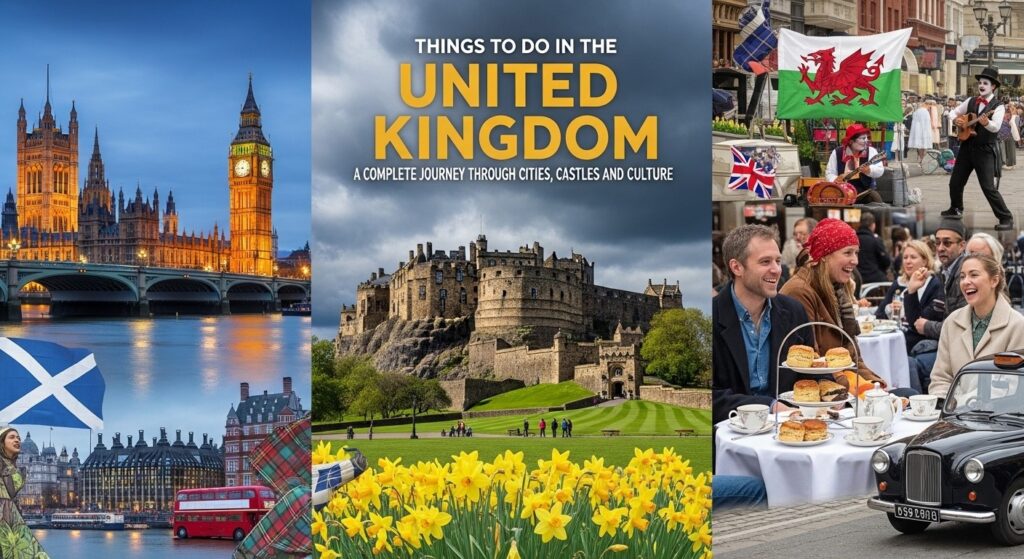
A deeper dive into planning your trip — cities, castles and countryside.
Frequently asked questions
The UK is best known for London’s royal landmarks and museums, Edinburgh Castle and the Scottish Highlands, historic castles across all four nations, and cultural exports from Shakespeare to the Beatles.
Most international visitors fly into London Heathrow or Gatwick, with Edinburgh and Manchester airports also serving direct international flights. Most visa-exempt visitors need an Electronic Travel Authorisation (ETA) before departure, so check current requirements based on nationality before booking.
Ten days covers London, Bath, the Cotswolds, and Edinburgh comfortably. A long weekend suits London alone; two weeks or more allows a deeper trip into the Scottish Highlands or Wales.
May to June or September to October, when the weather is at its mildest and most attractions are busy but not overwhelmed.
London, Edinburgh Castle, and the most popular Cotswolds villages draw heavy crowds, especially in summer. The Scottish Highlands beyond the main routes, and cities like York or Cardiff, stay considerably quieter.