
Canada Travel Guide Best Places to Visit & Things to Do in Canada
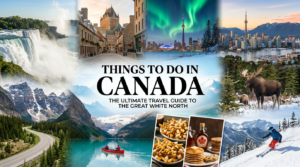
From Toronto’s skyline and Quebec City’s cobblestone streets to Banff’s turquoise lakes, Vancouver’s ocean-and-mountain backdrop, and Niagara Falls’ thundering power, this Canada travel guide covers the best places to visit in Canada and top Canada travel destinations for every kind of trip.
POPULAR TOURIST PLACES IN CANADA
- Toronto
- Vancouver
- Banff National Park
- Quebec City
- Montreal
- Ottawa
- Niagara Falls
- Calgary
- Victoria
- Halifax
WHY VISIT CANADA
Why visit Canada? Canada splits neatly into an eastern and western half, and most first-time trips build around one or the other — a good starting point for anyone still figuring out where to go in Canada. In the east, Toronto anchors a circuit that takes in Niagara Falls Canada, the nation’s capital Ottawa, and French Canada’s two great cities — Montreal’s bilingual creative energy and Quebec City’s UNESCO-listed Old Town, the only walled city in North America north of Mexico. In the west, a proper Vancouver travel guide covers a city that sits at the meeting point of ocean and mountains, a short Sea-to-Sky drive from Whistler, while Calgary serves as the gateway to Banff National Park travel and the wider Canadian Rockies travel route, where Lake Louise and Moraine Lake’s glacial turquoise water has become one of the most photographed sights in the country. Victoria, a short ferry from Vancouver, adds a quieter, garden-filled alternative, and further east, Halifax carries Atlantic Canada’s maritime history and lobster rolls. VIA Rail connects the eastern cities comfortably, while domestic flights bridge the vast distance between coasts — Canada is the world’s second-largest country by land area, which is why Canada tourism guide advice almost always recommends picking one region to explore properly rather than attempting the whole country at once, and it’s a strong contender among Canada travel experiences either way.

Six essential experiences
Lake Louise & Moraine Lake, Banff
Glacial turquoise lakes framed by the Canadian Rockies — Moraine Lake's view has appeared on the Canadian $20 bill and requires advance shuttle booking in peak season. A highlight among national parks in Canada.
CN Tower, Toronto
Canada's largest city's iconic tower offers a glass-floor observation deck and the EdgeWalk experience, with views stretching to Niagara Falls on a clear day — a core stop for any Toronto attractions list and things to do in Toronto.
Old Quebec City
The only walled city in North America north of Mexico, with the Château Frontenac and Dufferin Terrace anchoring a UNESCO World Heritage Old Town — the essentials for things to do in Quebec City.
Stanley Park & Granville Island, Vancouver
An 8.8-kilometer seawall through old-growth forest, paired with one of Canada's finest food markets on a former industrial island — the top answer to things to do in Vancouver.
Niagara Falls
The Canadian Horseshoe Falls, best experienced via the Journey Behind the Falls tunnels or a Hornblower cruise into the mist.
Icefields Parkway
Montreal, Calgary & Ottawa 232 kilometers of mountain highway between Banff and Jasper passing glaciers, waterfalls, and the Columbia Icefield — widely considered one of the most scenic drives in the world. Round out your trip with things to do in Montreal (Old Montreal, the food scene), things to do in Calgary (the Stampede, gateway to the Rockies), and things to do in Ottawa (Parliament Hill, the museums) for a fuller sense of what to do in Canada beyond the Rockies and coasts.
Practical details
Best time to visit Canada
Best time to visit Canada
June through September is Canada’s most popular window — warm weather across the country, ice-free lakes in Banff, and peak festival season in Toronto, Montreal, and Quebec City. Winter (December–March) brings ski season in the Rockies and Whistler plus Ottawa’s Winterlude and Quebec’s Winter Carnival; October delivers spectacular fall foliage nationwide. As for how many days in Canada is enough — a single region (east or west) works well in a week, while the full country deserves three to four.
Getting around & national parks
Domestic flights are essential for moving between eastern and western Canada given the country’s size. VIA Rail connects Toronto, Ottawa, Montreal, and Quebec City comfortably. A rental car is necessary for Banff, Niagara wine country, and other national parks in Canada; city transit is excellent in Toronto, Vancouver, Montreal, and Ottawa.
Where to stay
Toronto and Vancouver carry the highest accommodation costs; Montreal and Halifax offer noticeably better value — worth knowing if affordable travel in Canada is the priority. In Banff, book well ahead for peak summer season, when both the townsite and Lake Louise fill up. Comprehensive travel insurance with medical coverage is essential, as Canada’s healthcare system does not cover international visitors.
Continue exploring
From the journal
Latest Canada guide
A deeper dive into planning your trip — cities, the Rockies and national parks.
Frequently asked questions
Canada is best known for Niagara Falls, the Canadian Rockies and Banff National Park, its multicultural cities like Toronto and Vancouver, maple syrup, and French Canadian culture in Montreal and Quebec City.
Most international visitors fly into Toronto Pearson, Vancouver International, or Montreal-Trudeau airports. US citizens need no visa or eTA; most other visa-exempt nationalities need a quick online eTA before flying.
Seven days covers eastern or western Canada well on its own. Ten to fourteen days allows exploring one region thoroughly with a sample of another; three to four weeks suits a full cross-country trip.
June to August for cities and national parks, winter for skiing and ice festivals, and October for fall foliage — Canada rewards visits across every season depending on the activity.
Banff’s Lake Louise and Moraine Lake, Niagara Falls, and downtown Toronto draw heavy crowds in peak summer. Halifax, Victoria, and Canada’s more remote national parks like Gros Morne stay considerably quieter.