
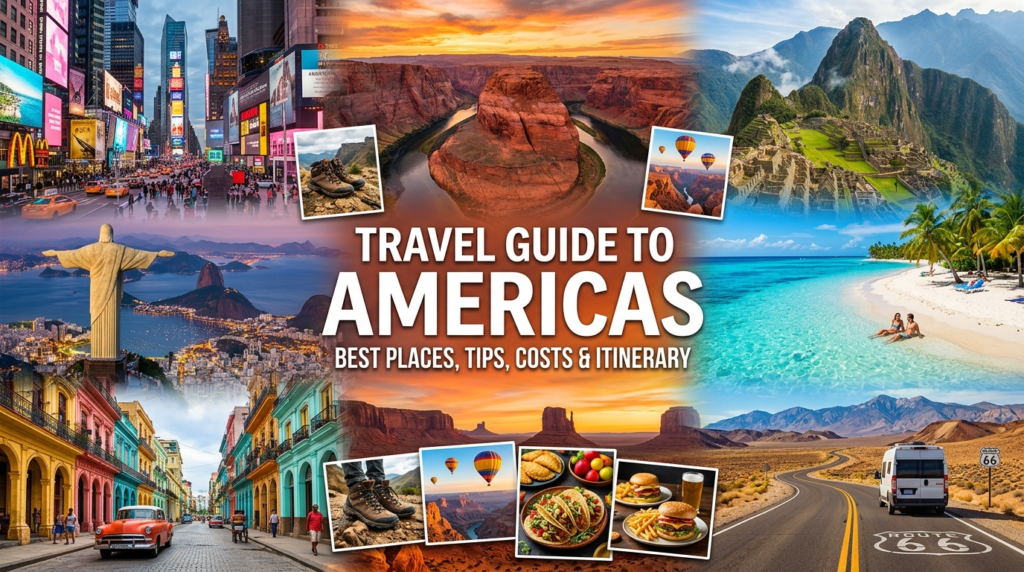
The Americas stretch from the Arctic tundra of northern Canada to the tip of Tierra del Fuego at the bottom of South America — a vast, breathtaking double continent that covers more than a quarter of the Earth’s land surface. Within this extraordinary expanse, you will find every type of landscape imaginable: the frozen peaks of Patagonia, the golden deserts of the Atacama, the dense emerald canopy of the Amazon rainforest, the turquoise waters of the Caribbean, the towering skyscrapers of New York City, and the ancient stone citadels of the Inca Empire. This travel guide to Americas is your complete companion to exploring one of the most diverse and rewarding travel regions on Earth.
Whether you are searching for things to do in the Americas for the first time or planning your return to go deeper, this guide covers the full range of experiences available across North America, Central America, South America, and the Caribbean — from iconic bucket-list landmarks to hidden cultural treasures that most visitors never discover.
Why Visit the Americas?
The Americas offer a scale and diversity of experience that no other region on the planet can match. In a single trip, you can stand in a glass-floored observation deck above the Manhattan skyline, hike through cloud forest to a lost Inca city, dance to samba in Rio de Janeiro, kayak beneath glaciers in Patagonia, and snorkel the world’s second-largest coral reef in Belize. There is no single “Americas experience” — every country, every region, and every city tells a completely different story.
American culture and traditions are equally varied. The Indigenous peoples of the Americas — from the Navajo of the American Southwest to the Quechua of the Andes to the Maya of Central America — have built civilizations that continue to shape art, food, architecture, and spiritual life across the continent. European colonial history, African heritage brought through the slave trade, waves of Asian immigration, and the dynamism of modern urban culture have all layered into the extraordinary cultural mosaic that the Americas present today.
The Americas are also home to some of the greatest natural wonders in the Americas — the Grand Canyon, Niagara Falls, Iguazu Falls, the Amazon River, the Galápagos Islands, Patagonia, the Atacama Desert, and the Caribbean’s coral reef ecosystems — each of them deserving a place on any serious traveler’s lifetime list.
Best Places to Visit in the Americas
The best places to visit in the Americas depend entirely on your travel style and interests. North America offers world-class cities, spectacular national parks, and some of the most iconic road trips on Earth. Central America is a compact wonderland of ancient ruins, rainforests, volcanoes, and pristine beaches. South America presents the full drama of the continent — from Andean civilizations to Amazon wilderness to Patagonian glaciers. The Caribbean delivers turquoise waters, tropical culture, and island life in its most relaxed and beautiful form.
For first-time visitors, the most popular entry points are New York, Miami, Cancun, or one of the major South American gateway cities like Lima, Bogotá, or Buenos Aires. Each offers an excellent base for radiating outward to discover more of the continent’s astonishing variety.
How to Plan a Trip to the Americas
Choose Your Destinations
Start by deciding which region of the Americas aligns with your interests. If iconic cities, national parks, and road trips appeal to you, North America is your starting point. If ancient history, biodiversity, and adventure are the draw, Central and South America offer unparalleled experiences. For beach relaxation and island culture, the Caribbean is hard to beat.
Build Your Itinerary
A well-structured travel itinerary for the Americas prevents the common mistake of trying to cover too much ground in too little time. The Americas are vast — the distance from New York to Buenos Aires is greater than from London to Mumbai. Focus on one region or two to three connected countries and build depth rather than breadth. Rushing between too many destinations leaves little time to actually experience each place.
Plan Your Budget
Understanding how to travel across the Americas budget-wise is essential before booking anything. Costs vary enormously — from the high prices of major North American cities to the excellent value of budget travel in South America, where your money stretches considerably further. Eastern South America (Brazil, Argentina, Peru, Colombia) and Central America offer some of the most affordable travel experiences in the world, while North America and the Caribbean tend toward higher costs.
Book Flights and Accommodation
The Americas have excellent internal flight networks. Budget airlines in the USA, Central America, and South America make inter-regional travel affordable. Booking well in advance and remaining flexible with travel dates produces the best results. Accommodation ranges from luxurious resorts and boutique hotels to hostels and homestays — each region has all options available.
Pack Smart
A comprehensive packing approach for the Americas depends on your destinations. For tropical regions (Caribbean, Central America, Amazon), light clothing, strong sunscreen, and insect repellent are essential. For Andean high-altitude destinations, warm layers are critical. For Patagonia, serious waterproof gear is necessary. Comfortable walking shoes are indispensable everywhere.
Best Time to Visit the Americas
The best time to visit the Americas varies considerably by region, given that the continent spans both hemispheres and multiple climate zones.
Spring (March to May) is excellent for the USA (especially the South and Pacific Northwest), Mexico, and the beginning of the dry season in Central America. This is also the perfect time for the Amazon before extreme wet season conditions set in.
Summer (June to August) is peak season for North America and Canada — warm days, long hours of daylight, and vibrant festival seasons across the USA and Europe (Canada’s summer is extremely beautiful). In South America, this is winter in the southern cone (Argentina, Chile, Patagonia), making it ideal for glacier viewing and ski season in the Andes.
Fall (September to November) brings spectacular foliage across New England in the USA and Canada, and represents the beginning of dry season in many parts of Central and South America. Caribbean hurricane season generally peaks in September — worth considering when planning island trips.
Winter (December to February) is high season in the Caribbean and Mexico’s beach resorts, with warm temperatures and minimal rain. In South America, this is summer — the best time for Patagonia, Iguazu Falls, and the Brazilian coast.
Essential Americas Travel Tips
Visa and Entry Requirements
Visa requirements across the Americas vary widely by nationality and destination. Citizens of many Western countries can enter the USA, Canada, Mexico, and most of South America visa-free or with simple tourist stamps. Brazil introduced a new e-visa requirement for US citizens in 2025. Always verify current requirements through official embassy sources before travel, as regulations change frequently across this large and politically diverse region.
Is the Americas Safe for Tourists?
Is it safe to travel in the Americas is one of the most frequently asked questions among first-time visitors. The honest answer is nuanced. Safety varies dramatically by country and by region within each country. North America (USA and Canada) is generally very safe. Mexico is safe in most tourist areas (Cancun, Mexico City, Oaxaca) but requires awareness in certain border regions. Central America requires research by country and city. Most of South America’s main tourist destinations — Machu Picchu, Rio de Janeiro, Buenos Aires, Cartagena, Santiago — are safe for travelers who take standard precautions. As with any international destination, avoid displaying valuables, use reputable transport, and stay informed through government travel advisories.
Currency and Payments
The Americas use a wide variety of currencies — the US Dollar, Canadian Dollar, Mexican Peso, Brazilian Real, Colombian Peso, Argentine Peso, Chilean Peso, Peruvian Sol, and the Eastern Caribbean Dollar in the Caribbean, among others. The US Dollar is widely accepted as a secondary currency in many Latin American tourist destinations. ATMs are available in all major cities and tourist areas, though carrying some local cash is advisable in smaller towns and rural regions.
Transport Across Regions
Understanding how to travel across the Americas efficiently saves enormous time. Internal flights are the fastest option for covering long distances. The USA and Canada have excellent road infrastructure for road trips. In Central America, shuttle buses connecting major tourist hubs are popular and affordable. In South America, overnight buses are a budget-friendly way to cover long distances in comfort — particularly in Peru, Argentina, Chile, and Colombia.
Types of Travel in the Americas
The Americas cater to every style of traveler. Luxury travel in North America reaches its highest expression in cities like New York, Los Angeles, San Francisco, and Miami, where five-star hotels, Michelin-starred dining, and world-class cultural institutions compete for your attention. Budget travel in South America offers extraordinary value — hostels, local markets, and shared transport make it possible to explore Peru, Colombia, Bolivia, and Ecuador for a fraction of what you would spend in Europe or North America.
For couples, Americas honeymoon destinations include Bora Bora-style romance in the Caribbean (Barbados, St Lucia, Turks and Caicos), tango and steak in Buenos Aires, the Inca Trail to Machu Picchu, and the beaches of Tulum in Mexico. Backpacking Americas through the classic Gringo Trail — a well-worn route through Mexico, Central America, and down through the Andes to Patagonia — remains one of the great independent travel adventures in the world. Family travel in the Americas is extremely well-catered — from the theme parks of Orlando, Florida to the wildlife of Costa Rica and the educational wonders of Washington DC.
Adventure travel finds its greatest expression in the Americas — from white-water rafting in Costa Rica and hiking Torres del Paine in Chilean Patagonia, to surfing in Oahu, Hawaii and mountain biking in the Bolivian Andes.
🇺🇸 USA Travel Guide
Country Overview
The United States of America is the world’s most visited country and one of the most geographically and culturally diverse nations on Earth. Spanning six time zones, 50 states, and encompassing everything from Arctic wilderness to tropical rainforest, from desert canyons to oceanic archipelagos, the USA offers travel experiences that could fill multiple lifetimes. It is the definitive destination for luxury travel in North America, combining world-class cities with extraordinary national parks and landscapes.
Things to Do in USA
The USA’s greatest strength as a travel destination is its extraordinary variety. Things to do in USA range from climbing the Statue of Liberty to hiking Yosemite’s Half Dome, from seeing Broadway in New York to watching the Northern Lights from Alaska. National parks in the Americas reach their greatest expression in the USA — Yellowstone, the Grand Canyon, Yosemite, Zion, Arches, and Everglades National Park are each world-class destinations in their own right. Road trips along Route 66, the Pacific Coast Highway, or through the American South are among the world’s great driving adventures.
Things to Do in New York
Things to do in New York begin with the skyline itself — the most recognizable cityscape on Earth. Stand on the observation deck of the Empire State Building or the newer Edge at Hudson Yards for views across the five boroughs. Walk across the Brooklyn Bridge to DUMBO. Spend a morning in Central Park — a masterpiece of urban design covering 843 acres in the heart of Manhattan. Visit the Metropolitan Museum of Art, the largest art museum in the Americas. Explore the High Line — an elevated park on a former railway — through the Meatpacking District. Watch Broadway theatre for the most polished live performance in the world. Explore the neighborhoods — from Chinatown and Little Italy in Lower Manhattan to the galleries of Chelsea and the brownstones of Harlem.
Best Places to Visit in USA
- New York City: Manhattan skyline, Broadway, Central Park, Statue of Liberty
- Los Angeles: Hollywood, Getty Museum, Venice Beach, Joshua Tree
- San Francisco: Golden Gate Bridge, Alcatraz, Napa Valley wine country
- Grand Canyon National Park: One of Earth’s greatest geological spectacles
- Yellowstone National Park: Geysers, wolves, bison, and geothermal wonders
- New Orleans: Jazz, Creole food, and Mardi Gras culture
- Hawaii: Volcanic landscapes, coral reefs, and Polynesian culture
- Washington DC: World-class museums, memorials, and political heritage
USA Itinerary (7 Days)
- Day 1–3: New York City
- Day 4: Washington DC (2.5 hours by train)
- Day 5: Flight to Chicago or New Orleans
- Day 6–7: Grand Canyon or Yosemite (fly to Las Vegas or San Francisco)
USA Travel Cost
Travel costs in the USA vary enormously by region and travel style. Major cities like New York, San Francisco, and Miami sit at the higher end of the spectrum for accommodation and dining. Road tripping through national parks and smaller cities is considerably more affordable. Budget travelers who use hostels, cook some of their own meals, and take advantage of free museum days and public parks can manage quite reasonably. Mid-range and luxury travelers will find the full range of options available at every price point. The overall cost of your USA trip depends primarily on your accommodation choices, whether you fly or drive between destinations, and the activities you prioritize.
Best Time to Visit USA
Spring (March to May) and fall (September to November) offer the most comfortable conditions across most of the country. Summer is peak season for national parks and East Coast cities. The Southwest and Florida are best avoided in peak summer heat. December to February brings ski season to the Rockies and warm weather to Florida and Hawaii.
🇨🇦 Canada Travel Guide
Country Overview
Canada is the world’s second-largest country by land area and one of the most spectacularly beautiful on the planet. From the multicultural energy of Toronto and Vancouver to the French language and culture of Montreal and Quebec City, from the rugged fjords of Newfoundland to the Rocky Mountain peaks of Banff and Jasper, Canada rewards travelers with landscapes and experiences of extraordinary quality. It is also one of the most welcoming countries in the world for international visitors.
Things to Do in Canada
Things to do in Canada span an almost incomprehensible range of environments and experiences. Hiking through Banff National Park’s turquoise glacial lakes and snow-capped peaks is a genuine once-in-a-lifetime experience. Niagara Falls — viewed from the Canadian side, which offers superior vantage points — is one of the great natural wonders of North America. Watching the Northern Lights from Yukon Territory or Manitoba is a spiritual experience that travelers return for repeatedly. Whale watching off Vancouver Island, experiencing Québecois winter carnival culture in Quebec City, and exploring the wilderness of Cape Breton Island in Nova Scotia are all equally compelling.
Things to Do in Toronto
Things to do in Toronto, Canada’s largest city and one of the most multicultural cities in the world, include visiting the iconic CN Tower (once the world’s tallest free-standing structure) and its glass floor experience, exploring the vibrant Distillery District of Victorian industrial buildings converted into galleries and restaurants, wandering the diverse neighborhoods of Kensington Market and Chinatown, and taking a day trip to Niagara Falls just 1.5 hours away.
Best Places to Visit in Canada
- Banff and Jasper National Parks: Canadian Rockies at their most spectacular
- Vancouver: Mountains, ocean, and multicultural city life
- Toronto: Cultural capital with CN Tower and Niagara Falls proximity
- Quebec City: The only walled city in North America north of Mexico
- Montreal: World-class dining and French Canadian culture
- Prince Edward Island: Gentle pastoral landscapes and red sand beaches
Canada Itinerary (7 Days)
- Day 1–2: Toronto — CN Tower, Distillery District, Niagara Falls day trip
- Day 3: Flight to Calgary — gateway to the Rockies
- Day 4–5: Banff National Park — Lake Louise, Moraine Lake, Icefields Parkway
- Day 6–7: Vancouver — Stanley Park, Granville Island, Whistler day trip
Canada Travel Cost
Canada is a high-income country and travel costs reflect this, particularly in major cities like Vancouver and Toronto. However, the country’s vast national parks and outdoor experiences are accessible at very reasonable costs through the Parks Canada pass system. Budget travelers can make excellent use of Canada’s hostel network and road-trip infrastructure. Overall, your budget will depend significantly on whether you prioritize urban experiences or wilderness adventures — the latter tends to be more accessible to all budget levels.
Best Time to Visit Canada
June through August is the prime summer season — warm, with long daylight hours and all attractions fully operational. September and October bring spectacular fall foliage across eastern Canada. December through March is ski season in the Rockies, and winter carnival season in Quebec. Spring can be unpredictable across the country.
🇲🇽 Mexico Travel Guide
Country Overview
Mexico is one of the world’s most visited countries and one of the best countries to visit in the Americas for first time international travelers. It combines pre-Columbian history of extraordinary richness — Mayan, Aztec, Olmec, and Toltec civilizations all flourished here — with Spanish colonial architecture, vibrant modern culture, world-class cuisine, and some of the Caribbean and Pacific’s most beautiful beaches. It is affordable, accessible, and endlessly fascinating.
Things to Do in Mexico
Things to do in Mexico range across a vast spectrum of experience. Explore the ancient Pyramid of the Sun at Teotihuacan just outside Mexico City — one of the largest pyramids in the world. Dive the Great Mesoamerican Barrier Reef off the coast of Cancun and the Riviera Maya. Watch monarch butterflies arrive by the millions to the forests of Michoacán. Drive through the agave fields of Jalisco to understand the birthplace of tequila. Wander the colonial streets of San Miguel de Allende and Guanajuato, both UNESCO World Heritage Cities. Swim in cenotes — crystal-clear underground sinkholes sacred to the ancient Maya — throughout the Yucatan Peninsula.
Things to Do in Cancun
Things to do in Cancun extend well beyond the famous Hotel Zone beaches, though these white-sand Caribbean stretches are genuinely among the finest in the world. The real treasures lie nearby — the spectacular Mayan ruins of Chichén Itzá, one of the New Seven Wonders of the World, just two hours by road. The lagoon city of Bacalar, with its seven shades of blue water, is a short drive south. The archaeological zone of Tulum perches dramatically on cliffs above the Caribbean Sea. Cenote swimming is a uniquely Mexican experience available throughout the Yucatan.
Best Places to Visit in Mexico
- Mexico City: Ancient ruins, world-class museums, and incredible street food
- Cancun and Riviera Maya: Caribbean beaches, Mayan ruins, and cenotes
- Oaxaca: Indigenous culture, incredible food, and mezcal
- Guadalajara: Mariachi music, tequila, and colonial architecture
- San Miguel de Allende: One of Latin America’s most beautiful colonial cities
- Copper Canyon (Barrancas del Cobre): Deeper than the Grand Canyon
Mexico Itinerary (7 Days)
- Day 1–2: Mexico City — Teotihuacan, Frida Kahlo Museum, historic centre
- Day 3–4: Oaxaca — markets, mezcal, Monte Albán ruins
- Day 5–7: Cancun/Tulum — Caribbean beaches, cenotes, Chichén Itzá
Mexico Travel Cost
Mexico offers excellent value for international travelers, particularly those coming from North America or Europe. Street food, local markets, and budget accommodation (particularly in smaller cities and non-resort areas) are very affordable. Beach resorts in Cancun and Los Cabos command premium prices, particularly for all-inclusive packages. Mid-range travel through Mexico’s colonial cities and cultural destinations represents some of the best value in the Americas. Your total budget will depend largely on how much time you spend in the resort zones versus the more authentic interior destinations.
Best Time to Visit Mexico
November through April is generally the best time across most of Mexico — dry, warm, and less humid than the summer months. Mexico City and the central highlands are comfortable year-round. The Yucatan Peninsula sees its peak tourist season from December through April. Summer brings rain to most of the country and peak hurricane risk along both coasts.
🇨🇷 Costa Rica Travel Guide
Country Overview
Costa Rica is Central America’s tourism crown jewel — a small, stable, biologically extraordinary country that has built one of the world’s most successful ecotourism industries on the foundation of its extraordinary natural wealth. Covering just 51,000 square kilometres, Costa Rica contains 5% of the world’s biodiversity, with dozens of microclimates ranging from cloud forest to tropical dry forest to mangrove wetland. The national philosophy of “pura vida” — pure life — embodies a deeply held culture of environmental stewardship, contentment, and warm hospitality.
Things to Do in Costa Rica
Things to do in Costa Rica are dominated by nature and adventure. Hike through the cloud forests of Monteverde and spot resplendent quetzals, three-toed sloths, and howler monkeys. Witness the lava flows of Arenal Volcano from the shores of its crater lake. Surf the world-class breaks of the Pacific Coast at Nosara, Tamarindo, and Playa Hermosa. Walk through the rainforest canopy on suspension bridges at Mistico Arenal Hanging Bridges. Watch olive ridley sea turtles mass-nest on the beaches of Ostional. White-water raft the Pacuare River through pristine jungle canyon.
Best Places to Visit in Costa Rica
- Arenal Volcano: Active volcano with hot springs and rainforest trails
- Monteverde Cloud Forest Reserve: Spectacular biodiversity and canopy walks
- Manuel Antonio National Park: Wildlife-rich park meeting white-sand beaches
- Tortuguero National Park: Sea turtle nesting and Amazon-like canals
- Nicoya Peninsula: World-class surfing and Pacific beaches
- Corcovado National Park: One of the most biologically intense places on Earth
Costa Rica Itinerary (7 Days)
- Day 1–2: San José and surroundings — coffee farms, Irazú Volcano
- Day 3–4: Arenal Volcano — hot springs, hanging bridges, white-water rafting
- Day 5–7: Manuel Antonio — beach, wildlife, canopy tours
Costa Rica Travel Cost
Costa Rica is not the cheapest destination in Central America, partly because its own success as an ecotourism destination has raised prices over time. Budget travelers can still find excellent value through hostels, local sodas (family-run restaurants), and public buses. Mid-range eco-lodges in the jungle or on the coast represent excellent value for the unique experiences they deliver. Luxury lodges in the Osa Peninsula and Monteverde are world-class and priced accordingly. Your overall budget will depend on the accommodation type and how many guided nature experiences you include.
Best Time to Visit Costa Rica
December through April is the dry season across most of the country — ideal for beaches and national park hiking. The Caribbean coast has a reversed rainy pattern and is often dry in September and October when the Pacific side is wet. May through November brings the green season — lower prices, lush landscapes, and fewer crowds, though some roads and trails may be affected by heavy rain.
🇬🇹 Guatemala Travel Guide
Country Overview
Guatemala is one of the most authentically extraordinary destinations in Central America — a country where Maya civilization never truly ended but continues to live in the languages, textiles, ceremonies, and daily practices of millions of Indigenous people. It is an inexpensive, deeply rewarding destination for travelers seeking historical places in the Americas, natural beauty, and genuine cultural immersion.
Things to Do in Guatemala
Things to do in Guatemala begin with Antigua Guatemala — a perfectly preserved Spanish colonial city surrounded by three volcanoes, and a UNESCO World Heritage Site. The cobblestone streets, brightly painted buildings, and crumbling baroque churches create one of the most beautiful urban environments in Latin America. Climbing the active Acatenango Volcano for an overnight camp with views of Volcán de Fuego erupting below you is one of the most dramatic adventure experiences in the Americas.
Lake Atitlán — surrounded by three volcanoes and dotted with Maya villages — is one of the most beautiful lakes in the world. The ancient Maya city of Tikal, with its towering Temple I rising above the jungle canopy, is one of the most spectacular archaeological sites in the Americas.
Guatemala Itinerary (7 Days)
- Day 1–2: Antigua Guatemala — city walk, coffee farm visit, Acatenango hike
- Day 3–4: Lake Atitlán — village visits, kayaking, volcano hike
- Day 5–7: Tikal — jungle ruins, wildlife, sunrise from Temple IV
Guatemala Travel Cost
Guatemala is one of the most affordable destinations in the Americas for international travelers. Accommodation, food, transport, and activities are all available at very modest prices by Western standards. Even luxury boutique hotels in Antigua and lakeside lodges at Atitlán are affordable compared to equivalent properties in North America or Europe. Budget travelers can explore Guatemala extensively for very little.
Best Time to Visit Guatemala
November through April is the dry season and the most reliable time for outdoor activities. Semana Santa (Holy Week before Easter) in Antigua is one of the most spectacular religious festivals in the Americas — the city is filled with elaborate alfombras (carpet designs made from colored sawdust, flowers, and fruit) and massive processions, though accommodation books up months in advance.
🇧🇷 Brazil Travel Guide
Country Overview
Brazil is South America’s largest and most diverse country — the fifth-largest nation on Earth, home to the world’s greatest rainforest, the world’s most exuberant carnival culture, some of the most beautiful beaches on any continent, and cities of pulsing, creative energy. It is a country of superlatives, contradictions, and overwhelming sensory richness that rewards every traveler who arrives with an open mind and a willingness to embrace its chaos and beauty in equal measure.
Things to Do in Brazil
Things to do in Brazil begin with the Amazon — the world’s largest tropical rainforest, covering over 5.5 million square kilometres and containing 10% of all species on Earth. River journeys from Manaus into the heart of the Amazon basin bring you face to face with pink river dolphins, giant otters, caimans, anacondas, and more bird species than most continents contain in total.
Iguazu Falls, shared between Brazil and Argentina, is one of the greatest natural wonders on Earth — 275 individual waterfalls stretching nearly 3 kilometres across the jungle, with the thundering Garganta do Diabo (Devil’s Throat) creating a wall of mist visible for kilometres. The UNESCO World Heritage Site is one of the most visited natural attractions in the Americas.
The Pantanal — the world’s largest tropical wetland, spanning the borders of Brazil, Bolivia, and Paraguay — offers the best jaguar-spotting experience in the world, along with extraordinary bird watching, caiman viewing, and giant anteater sightings in a landscape of unmatched ecological richness.
Things to Do in Rio de Janeiro
Things to do in Rio de Janeiro, Brazil’s most iconic city, are built around the dramatic interplay of mountain, sea, and urban energy unlike anywhere else on Earth. Take the cable car to the summit of Sugarloaf Mountain (Pão de Açúcar) for views over Guanabara Bay and the city below. Ascend Corcovado Mountain to stand before Christ the Redeemer — one of the world’s most iconic statues, arms spread wide over the city. Walk the famous mosaic promenade of Copacabana Beach and Ipanema Beach — some of the most celebrated and beautiful urban beaches in the world. Experience samba in a roda de samba in Lapa, Rio’s bohemian neighborhood of samba clubs and colonial aqueducts. If your timing aligns, Rio Carnival — the world’s largest street festival — is one of the most extraordinary human gatherings on Earth.
Best Places to Visit in Brazil
- Rio de Janeiro: Christ the Redeemer, Sugarloaf, Copacabana and Ipanema
- Iguazu Falls: One of Earth’s greatest natural wonders
- The Amazon: Manaus gateway to the greatest rainforest on Earth
- The Pantanal: World’s best jaguar spotting and wetland wildlife
- Salvador: Afro-Brazilian culture, colonial architecture, and capoeira
- Fernando de Noronha: One of the world’s finest marine environments
Brazil Itinerary (10 Days)
- Day 1–3: Rio de Janeiro — Christ the Redeemer, Sugarloaf, Lapa, beaches
- Day 4–5: Iguazu Falls (fly from Rio)
- Day 6–8: Manaus gateway and Amazon river lodge
- Day 9–10: Salvador — Pelourinho historic center, capoeira, Afro-Brazilian culture
Brazil Travel Cost
Brazil’s travel costs have risen in recent years but remain generally more affordable than North American or European equivalents. Budget travel is achievable through hostels, local padarias (bakeries) for breakfast, and local restaurants serving the prato feito (fixed price daily menu). Mid-range travel in Brazil offers excellent quality boutique hotels and restaurants at reasonable costs. Luxury lodges in the Amazon and Pantanal represent significant investments but deliver extraordinary experiences. Internal flights across Brazil’s vast geography are often the most time-efficient option and can be competitively priced when booked in advance.
Best Time to Visit Brazil
Brazil’s vast size means the best time varies dramatically by region. Rio de Janeiro and the southeast are best from May through October (dry season), though Carnival in February is unmissable if you can handle the crowds. The Amazon is best visited June through November when river levels are lower and wildlife more easily spotted. The Pantanal’s peak wildlife season is July through October. Iguazu Falls are spectacular year-round but most dramatic after heavy rains.
🇵🇪 Peru Travel Guide
Country Overview
Peru is one of the most historically extraordinary countries in the world — home to the greatest surviving civilization of the pre-Columbian Americas. The Inca Empire, which stretched from Colombia to Chile along the Andes spine, built stone cities, terraced mountain sides, and engineered road networks that astonish engineers to this day. Machu Picchu, their most famous achievement, is simply one of the most magnificent places on Earth. But Peru is much more than Machu Picchu — it also contains vast stretches of Amazon rainforest, colonial Spanish cities of great beauty, and a culinary tradition that has made Lima one of the world’s great food capitals.
Things to Do in Peru
Things to do in Peru reach their emotional peak at Machu Picchu — the “Lost City of the Incas,” built around 1450 AD at 2,430 metres above sea level and rediscovered by the Western world in 1911. Whether you hike the famous four-day Inca Trail through mountain passes and cloud forest, or take the panoramic train through the Sacred Valley from Cusco to Aguas Calientes, arriving at the Sun Gate or the citadel itself at sunrise is one of the most moving travel experiences available anywhere on Earth.
Things to Do in Machu Picchu Peru
Things to do in Machu Picchu Peru extend well beyond simply admiring the famous views. Hike the Huayna Picchu mountain above the citadel for the most dramatic perspective — steep, physical, but the views justify every step. Visit the Intihuatana stone (the Inca ritual stone associated with astronomical observations), the Temple of the Sun, and the Room of the Three Windows. Arrive on the first bus from Aguas Calientes to experience the citadel in the first morning light before the day’s visitors arrive. Book your entry tickets months in advance as daily visitor numbers are strictly controlled.
Beyond Machu Picchu, Cusco — the ancient Inca capital — is one of the most beautiful cities in South America, with remarkable Inca stonework incorporated into Spanish colonial buildings. The Sacred Valley between Cusco and Machu Picchu contains extraordinary Inca sites including Ollantaytambo and the terraced marvel of Moray. Lake Titicaca, shared between Peru and Bolivia at 3,800 metres above sea level, is home to the Uros people who live on floating reed islands and maintain traditions stretching back centuries.
Peru Itinerary (10 Days)
- Day 1–2: Lima — Miraflores, Barranco, food scene, Larco Museum
- Day 3–4: Cusco — acclimatization, Sacsayhuamán, San Pedro Market
- Day 5: Sacred Valley — Ollantaytambo, Pisac markets
- Day 6–7: Machu Picchu — train from Ollantaytambo, sunrise at citadel, Huayna Picchu
- Day 8–9: Lake Titicaca — Uros floating islands, Taquile Island
- Day 10: Return to Lima
Peru Travel Cost
Peru is one of the most affordable countries in South America for international travelers, with the significant exception of Machu Picchu entry tickets, which have risen considerably in price with tiered systems for different circuits and times of entry. Lima’s restaurant scene offers remarkable value — world-class ceviche and Peruvian fusion cuisine at a fraction of comparable restaurant prices in North America or Europe. Cusco and Aguas Calientes (the town below Machu Picchu) have a full range of accommodation from backpacker hostels to luxury mountain lodges. Your overall Peru budget will depend most significantly on your accommodation choices and whether you include the Inca Trail guided hike.
Best Time to Visit Peru
May through October is Peru’s dry season and the optimal time for the Inca Trail and Machu Picchu — clear skies, manageable temperatures, and no mud on the hiking trails. July and August are the busiest months. November through April brings the wet season — some rain is likely in the highlands, but the landscape turns lush and green, and prices drop significantly with fewer tourists.
🇨🇴 Colombia Travel Guide
Country Overview
Colombia has undergone a remarkable transformation in the past two decades — from a country best known internationally for conflict and instability to one of South America’s most exciting and welcoming travel destinations. Today, its cities buzz with creative energy, its colonial Caribbean coast rivals any in Latin America, its coffee region is one of the world’s most beautiful rural landscapes, and its people are among the warmest and most hospitable travelers will encounter anywhere.
Things to Do in Colombia
Things to do in Colombia begin with Cartagena — the best-preserved Spanish colonial city in the Americas, with impossibly romantic cobbled streets, colorful bougainvillea tumbling over 16th-century walls, and a Caribbean energy that is uniquely intoxicating. Walk the ancient walled city (Ciudad Amurallada), a UNESCO World Heritage Site, at sunset as the golden light catches the colored facades.
Medellín, once notorious as the world’s most dangerous city, is now one of South America’s most dynamic and innovative urban centers. Its transformation is extraordinary — explore the Comunas (former slum neighborhoods now connected to the city by innovative cable car networks and transformed by public art and investment), visit the spectacular Botanical Garden, and experience the city’s remarkable food, nightlife, and cultural scene.
The Coffee Region (Eje Cafetero) — a UNESCO World Heritage Site — is one of Colombia’s greatest treasures: a landscape of misty mountains, bamboo groves, and immaculate coffee farms where you can pick coffee cherries alongside local workers and understand the full process from plant to cup.
Colombia Itinerary (7 Days)
- Day 1–2: Cartagena — colonial walls, Getsemaní, Caribbean beaches
- Day 3–4: Medellín — cable car to Comunas, Botanical Garden, Pablo Escobar museum (optional)
- Day 5–7: Coffee Region — coffee farm stays, Valle de Cocora, Los Nevados National Park
Colombia Travel Cost
Colombia represents excellent value for international travelers. The Colombian peso provides favorable exchange rates for visitors from North America and Europe. Accommodation, food, and local transport are all affordable, with a wide range of options from budget hostels in Cartagena’s old town to boutique coffee farm lodges. The main exception is domestic flights, which can be relatively expensive — though Colombia’s bus infrastructure is excellent for those with time to travel by land.
Best Time to Visit Colombia
December through March and July through August are the driest months across most of Colombia. Cartagena’s Caribbean coast is pleasant year-round, though the dry season (December to April) is most reliable. The Coffee Region has a mild climate throughout the year. Medellín, at 1,495 metres altitude, has a perpetual spring-like climate known locally as “ciudad de la eterna primavera.”
🇦🇷 Argentina Travel Guide
Country Overview
Argentina is one of the most geographically and culturally diverse countries in the Americas — a vast nation stretching from the subtropical jungles of the north to the wind-swept glaciers of Patagonia in the far south, with the sophisticated European-influenced capital of Buenos Aires anchoring the center. It is home to extraordinary wine production, world-class beef, passionate football culture, the tango, and some of the most dramatic natural landscapes in the Southern Hemisphere.
Things to Do in Argentina
Things to do in Argentina reach their most dramatic extreme in Patagonia — one of Earth’s last great wildernesses. The Perito Moreno Glacier near El Calafate is one of the few glaciers in the world that is not receding — a 60-metre wall of blue ice that periodically calves into Lake Argentino with thunderous crashes. Torres del Paine National Park just across the Chilean border (easily visited from Patagonia) is the continent’s most celebrated hiking destination. El Chaltén is the trekking capital of Argentina, offering spectacular day hikes to views of Cerro Torre and Fitz Roy.
Buenos Aires deserves several days of unhurried exploration — its elegant boulevards, world-class steakhouses (parrillas), vibrant tango scene in the San Telmo and La Boca neighborhoods, and extraordinary bookshops and cultural life make it genuinely one of the world’s great cities. Mendoza, in the Andean foothills, produces some of the Southern Hemisphere’s finest Malbec wines in a gorgeous mountain-backed landscape of vineyard estates.
Argentina Itinerary (10 Days)
- Day 1–3: Buenos Aires — San Telmo, La Boca, steakhouse, tango show
- Day 4–5: Mendoza — Malbec wine estates, Andes mountains
- Day 6–8: El Calafate — Perito Moreno Glacier
- Day 9–10: El Chaltén — Fitz Roy and Cerro Torre hiking
Argentina Travel Cost
Argentina has experienced significant economic turbulence in recent years, including currency devaluations that have made it considerably more affordable for international visitors with hard currency. Travel costs vary depending on the current exchange rate situation — check the most current information before traveling. Buenos Aires offers exceptional value for international visitors in restaurants, accommodation, and cultural experiences. Patagonia is more expensive given its remote location, but represents unparalleled value compared to equivalent wilderness experiences in North America or Europe.
Best Time to Visit Argentina
October through April (Southern Hemisphere summer and shoulder seasons) is optimal for most of Argentina, including Buenos Aires, Mendoza, and Patagonia. Patagonia is best December through March — Perito Moreno Glacier is accessible year-round, but hiking conditions in Torres del Paine and the Fitz Roy range are best in January and February.
🇨🇱 Chile Travel Guide
Country Overview
Chile is one of the world’s most geographically extreme countries — 4,300 kilometres long and never more than 250 kilometres wide, it stretches from the driest desert on Earth in the north to the glacier fields and fjords of Patagonia in the south. This extraordinary elongated geography encompasses staggering diversity: the Atacama Desert, fertile central valleys of world-class wine production, Mediterranean coastal cities, and the raw wilderness of Patagonia.
Things to Do in Chile
Things to do in Chile span the full range from otherworldly desert landscapes to mountain trekking and cultural exploration. The Atacama Desert in northern Chile is one of the world’s most alien landscapes — salt flats, geysers erupting at dawn, flamingo-filled lagoons, and star-gazing from the world’s clearest skies. The ALMA Observatory area near San Pedro de Atacama offers the finest astronomical conditions on Earth.
The W Trek in Torres del Paine National Park in Chilean Patagonia is one of the world’s most celebrated multi-day hiking routes — four to five days through landscapes of turquoise lakes, hanging glaciers, and the iconic granite towers of the Paine massif. Easter Island (Rapa Nui), 3,700 kilometres off the Chilean coast, is one of the world’s most remote inhabited islands — home to the mysterious moai statues carved by the Polynesian Rapa Nui people whose civilization thrived here from the 13th century.
Chile Itinerary (10 Days)
- Day 1–2: Santiago — Bellavista neighborhood, markets, Plaza de Armas
- Day 3–5: Atacama Desert — Valle de la Luna, geysers, stargazing
- Day 6–10: Patagonia — Torres del Paine W Trek or multi-day trek
Best Time to Visit Chile
The Atacama Desert is accessible and spectacular year-round, though April through October avoids the peak summer heat. Patagonia and Torres del Paine are best November through March (Southern Hemisphere summer). Santiago and the central wine valleys are best September through May.
Caribbean Travel Guide
Region Overview
The Caribbean is a constellation of over 700 islands scattered across a 4,000-kilometre arc of warm tropical sea between North and South America — the beaches in the Caribbean are simply some of the finest on the planet. Each island nation has its own distinct cultural identity, shaped by Indigenous heritage, European colonialism, African traditions, and centuries of vibrant creolization. Jamaica, Cuba, the Dominican Republic, Barbados, Trinidad and Tobago, St Lucia, the Bahamas, Puerto Rico — each offers a completely different experience of island life.
Things to Do in the Caribbean
Cultural experiences in the Americas reach a uniquely vibrant expression in the Caribbean. Experience reggae and Rastafari culture in Jamaica’s Blue Mountains and on the beach at Negril. Explore the UNESCO World Heritage colonial architecture of Havana, Cuba, where streets full of vintage American cars and decaying grandeur create one of the world’s most photogenic urban environments. Witness the extraordinary spectacle of Trinidad’s Carnival — widely considered the greatest street festival in the Caribbean. Learn to dance bachata and merengue in the Dominican Republic. Snorkel the Belize Barrier Reef, the most biodiverse coral reef system in the Western Hemisphere. Hike through the volcanic crater of St Lucia’s twin Pitons.
Best Islands in the Caribbean
- Jamaica: Reggae, Blue Mountains, waterfalls, and Negril’s Seven Mile Beach
- Cuba: Havana’s colonial grandeur, vintage cars, cigars, and Caribbean warmth
- Dominican Republic: Punta Cana beaches and colonial Santo Domingo
- Barbados: Elegant beach culture, flying fish cuisine, and coral reefs
- St Lucia: Dramatic volcanic Pitons, lush rainforest, and Rodney Bay
- The Bahamas: Turquoise waters and the most beautiful shallows in the Atlantic
Caribbean Itinerary (7 Days)
- Day 1–3: Jamaica — Montego Bay, Dunns River Falls, Blue Mountains coffee tour
- Day 4–7: Barbados — Bridgetown, east coast Atlantic beaches, rum distillery tour
Caribbean Travel Cost
The Caribbean offers the widest range of pricing of any region in the Americas. All-inclusive resort packages in the Dominican Republic, Jamaica, and Cuba can offer excellent value for everything-included beach holidays. Boutique island travel in Barbados, St Barts, or Turks and Caicos commands premium prices. Budget travel across the Caribbean is possible through local guesthouses, local minibuses, and cooking your own food using fresh market produce. Your overall Caribbean budget depends more than anywhere else on your accommodation choice — the difference between an all-inclusive resort and a local guesthouse is vast.
Best Time to Visit the Caribbean
December through April is the traditional high season — dry, warm, and with minimal hurricane risk. This is peak pricing season across most islands. May through July offers slightly lower prices with generally good weather before the hurricane season peaks. Hurricane season runs June through November, with the greatest risk from August through October — travel insurance is strongly recommended for this period.
Top Americas Cities — Quick Guide
Things to do in New York — Empire State Building, Central Park, Metropolitan Museum of Art, Brooklyn Bridge, Broadway theatre, High Line, Statue of Liberty.
Things to do in Toronto — CN Tower, Distillery District, Kensington Market, Royal Ontario Museum, day trip to Niagara Falls.
Things to do in Cancun — Caribbean beaches, Chichén Itzá ruins, cenote swimming, Tulum, Bacalar lagoon.
Things to do in Rio de Janeiro — Christ the Redeemer, Sugarloaf Mountain, Copacabana and Ipanema beaches, Lapa samba clubs, Santa Teresa neighborhood.
Things to do in Machu Picchu Peru — Sunrise at the citadel, Huayna Picchu mountain hike, Temple of the Sun, Intihuatana stone, Sun Gate arrival on the Inca Trail.
Things to do in Buenos Aires — San Telmo antique markets, La Boca neighborhood, tango shows, parrilla steakhouse dining, Recoleta Cemetery.
Things to do in Havana — Malecón promenade, vintage car rides, Museo de la Revolución, Bodeguita del Medio (Hemingway’s mojito bar), Viñales Valley day trip.
Things to do in Bogotá — Gold Museum, Monserrate Mountain, La Candelaria historic center, Usaquén Sunday market, world-class restaurant scene.
Travel in North America vs South America
Travel in North America vs South America presents genuinely different experiences, and many visitors to the Americas wonder which to prioritize. North America excels in infrastructure, comfort, and the sheer variety of urban experiences — from New York’s cultural density to the national park landscapes of the American West. It is generally more expensive, easier to navigate independently, and more familiar in culture and language (English-speaking) for many international visitors.
South America offers a rawer, more immersive, and often more emotionally transformative experience — ancient civilizations, extraordinary biodiversity, the warmth of Latin hospitality, and a sense of adventure that comes with navigating a region that still feels genuinely wild in many places. It is generally more affordable, particularly for visitors from North America and Europe, and rewards those who embrace some degree of spontaneity and adaptability.
The ideal Americas journey, for those with sufficient time, combines both — experiencing the world-class cities and parks of North America alongside the ancient ruins, rainforests, and raw beauty of South America for a complete picture of this extraordinary double continent.
Final Thoughts
The Americas are not simply a travel destination. They are a state of mind — a commitment to experiencing the full range of what this planet has to offer, from its most technologically advanced urban environments to its most ancient and untouched wilderness. From the summit of Machu Picchu to the pulse of New York City, from the glaciers of Patagonia to the beaches of the Caribbean, the Americas ask travelers to expand their understanding of the world and their place within it.
This travel guide to Americas has covered the continent’s key destinations, essential planning information, and the experiences that make each country unique. Whether you begin your Americas journey with a week in New York or a month backpacking through Central America, whether you choose luxury in Cancun or adventure in the Amazon, the Americas will give you exactly what you bring to them — curiosity, openness, and a willingness to be genuinely surprised.
Start planning. The Americas are waiting.
FAQs — Americas Travel Guide
1. What are the best countries to visit in the Americas for first time travelers?
Mexico, Costa Rica, Peru, and Colombia are top picks for first-timers — all affordable, accessible, and culturally rich. In North America, the USA and Canada offer extraordinary variety for every type of traveler.
2. How much does it cost to travel to the Americas?
Costs vary widely. The USA, Canada, and Caribbean are pricier, while Mexico, Central America, and South America offer excellent value. Budget travelers do particularly well in Peru, Colombia, and Guatemala.
3. Is it safe to travel in the Americas?
Yes, with awareness. The USA, Canada, Costa Rica, and Chile are very safe. Mexico, Colombia, and Brazil are safe in tourist areas. Always check your government’s travel advisory before departure.
4. What is the best time to visit the Americas?
It depends on your region. North America shines June through September. The Caribbean is best December through April. Peru and the Andes are ideal May through October. Patagonia is best November through March.
5. How do I travel across the Americas efficiently?
Internal flights save the most time across long distances. Overnight buses work well within South American countries. Driving suits North America’s national parks and Canada’s Rockies perfectly.
6. Which countries offer the best value for budget travelers?
Guatemala, Bolivia, Peru, Colombia, and Ecuador offer the best value. Mexico is the top budget pick in North America, especially outside resort zones.
7. What are the must-see natural wonders in the Americas?
Grand Canyon, Niagara Falls, Iguazu Falls, the Amazon Rainforest, Atacama Desert, Perito Moreno Glacier, Galápagos Islands, Lake Titicaca, and the Caribbean coral reefs.
8. What are the best historical places in the Americas?
Machu Picchu, Chichén Itzá, Tikal, Teotihuacan, Havana’s old city, Cartagena’s walled city, Cusco, and Washington DC’s national monuments and museums.
9. What cultural experiences should not be missed?
Rio Carnival, Buenos Aires tango, Mexico’s Day of the Dead, Guatemala’s living Maya culture, New Orleans jazz, Trinidad Carnival, and Indigenous Andean traditions.
10. How many days do I need to explore the Americas?
Two weeks covers one region well. Three to four weeks allows two regions. For a true cross-continental experience, six to eight weeks is the minimum recommended.