
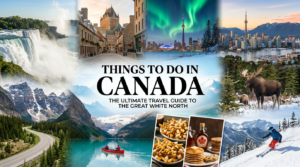
Canada is one of the most breathtaking countries on Earth — a vast, generous nation stretching from the Atlantic to the Pacific, from the Great Lakes to the Arctic Circle, covering nearly 10 million square kilometres of forests, mountains, prairies, coastlines, and some of the most spectacular wilderness anywhere on the planet. It is a country where you can stand in a glass-floored observation tower above one of the world’s most diverse cities in the morning, hike to turquoise glacial lakes in the afternoon, and watch the Northern Lights paint the sky green and violet at night. This complete Canada travel guide covers everything you need to know to plan an extraordinary Canadian adventure.
Why Visit Canada?
Why visit Canada? Because no other country on Earth offers this particular combination — world-class multicultural cities alongside genuinely wild, unspoiled natural landscapes that together span virtually every ecosystem known to the planet. The Canadian Rockies alone would justify an international flight. Add the UNESCO World Heritage Old Town of Quebec City, the multilingual creative energy of Montreal, the Pacific Ocean backdrop of Vancouver, and the thundering power of Niagara Falls, and you begin to understand why Canada tourism continues to grow year after year.
What is Canada famous for? Maple syrup and hockey are the easy answers — but the full picture is much richer. Canada is famous for its extraordinary national parks, its Indigenous First Nations cultures, its reputation for politeness and multicultural hospitality, its vast wilderness experiences, its poutine, its world-class ski resorts, and its position as one of the safest and most welcoming countries in the world for international travelers. This is a country that rewards visitors who go beyond the cities into the wilderness — and equally rewards those who stay in the cities and discover how vibrant, diverse, and genuinely exciting Canadian urban life truly is.
Best Places to Visit in Canada
The best places to visit in Canada span two fundamentally different kinds of experience — urban and wilderness — and the most satisfying Canadian journeys combine both. On the East Coast, Toronto and Niagara Falls anchor Ontario, while Montreal and Quebec City represent French Canada’s extraordinary cultural identity. In the capital, Ottawa provides a dignified blend of politics, museums, and natural beauty. In the West, Vancouver sits at the meeting point of ocean and mountains, while Calgary serves as the gateway to the Canadian Rockies, including Banff National Park — arguably the most beautiful national park in North America.
Cities to visit in Canada are genuinely world-class destinations in their own right. For first-time visitors, Toronto, Vancouver, Montreal, and Quebec City form a classic circuit that reveals Canada’s multicultural urban character and its French and English linguistic duality. For those drawn by nature, Banff, Jasper, and the Canadian Rockies are simply in a class of their own.
Things to Do in Toronto
City Overview
Toronto is Canada’s largest city and one of the most culturally diverse urban centers in the world — a fact that locals celebrate with genuine pride. More than half of Toronto’s residents were born outside Canada, making it arguably the world’s most multicultural major city. Situated on the northwestern shore of Lake Ontario, Toronto combines the ambition and energy of a global financial hub with neighborhoods of extraordinary cultural richness, a world-class food scene, and some of the best museums and galleries in North America.
Top Things to Do in Toronto
Things to do in Toronto begin at the CN Tower — the iconic 553-metre communications tower that dominated the global skyline for over 30 years as the world’s tallest free-standing structure. Today, the EdgeWalk experience allows visitors to walk hands-free along the outside of the tower’s roof at 356 metres, and the glass floor on the main observation deck offers vertiginous views straight down to the streets below. The panoramic views on a clear day extend to Niagara Falls in the distance.
The Royal Ontario Museum (ROM), one of the largest museums in North America, holds an extraordinary collection covering natural history, world cultures, and ancient civilizations. The Art Gallery of Ontario (AGO), redesigned by Toronto-born architect Frank Gehry, houses an exceptional collection of Canadian and international art including an important Group of Seven collection. St. Lawrence Market — a magnificent Victorian food hall that has been operating since 1803 — is one of the greatest food markets in North America, with over 200 vendors selling artisan bread, local cheese, fresh seafood, and international specialties.
The Distillery District, a beautifully restored Victorian industrial complex of brick warehouses and cobblestone streets, is now home to galleries, independent restaurants, boutiques, and one of the best Christmas markets in Canada. Toronto Islands — accessible by a 12-minute ferry from the waterfront — offer beaches, picnic areas, and spectacular skyline views that reveal the city from its best angle.
Best Places to Visit in Toronto
- CN Tower and EdgeWalk experience
- Royal Ontario Museum
- Art Gallery of Ontario
- St. Lawrence Market
- Distillery Historic District
- Kensington Market
- Casa Loma (Gothic Revival castle)
- Toronto Islands
- Hockey Hall of Fame
- High Park
Historical Places in Toronto
Casa Loma, a magnificent 98-room Gothic Revival castle built between 1911 and 1914 by financier Sir Henry Pellatt, is one of Canada’s most extraordinary domestic structures. Fort York National Historic Site — the birthplace of modern Toronto, where the city was founded in 1793 — offers re-enactments and insights into the War of 1812 and early colonial history. The Hockey Hall of Fame in the Financial District preserves the history of Canada’s most beloved sport with extraordinary artifacts and interactive exhibits.
Best Time to Visit Toronto
June through September offers warm, sunny weather perfect for festivals, waterfront activities, and exploring the city on foot. The Toronto International Film Festival in September is one of the world’s most prestigious film events. Spring (April to May) and fall (October to November) are pleasant and less crowded. Winter can be cold, but Toronto’s indoor attractions — world-class museums, the PATH underground city, excellent restaurants — make it a year-round destination.
Is Toronto Safe?
Toronto is consistently ranked among the safest large cities in North America. Its multicultural character creates a broadly welcoming and tolerant urban environment. Standard urban awareness applies — be mindful of your belongings in crowded areas and use reputable transport at night. The main tourist neighborhoods — downtown, the Distillery District, Kensington Market, and the waterfront — are all very safe.
Local Food in Toronto
Canada food and cuisine in Toronto reflects the city’s extraordinary diversity. Try butter tarts — a distinctly Canadian pastry of buttery, sweet filling in a flaky shell, available at St. Lawrence Market. Peameal bacon sandwiches (Canadian back bacon rolled in ground yellow peas, served on a bun) are another Toronto classic, again found at St. Lawrence Market. The city’s neighborhoods offer incredible international dining — Chinatown, Little India, Little Portugal, and Little Italy are all authentic culinary destinations. Craft beer culture is thriving, and Toronto’s cocktail bar scene is world-class.
Toronto Itinerary (3 Days)
- Day 1: CN Tower, Ripley’s Aquarium, Toronto Waterfront, St. Lawrence Market
- Day 2: Royal Ontario Museum, Kensington Market, Distillery District, Casa Loma
- Day 3: Toronto Islands, Art Gallery of Ontario, Hockey Hall of Fame, Niagara Falls day trip
Toronto Travel Cost
Toronto is Canada’s most expensive city, and your overall budget will depend significantly on where you stay and how you choose to dine. Budget travelers who use the excellent TTC transit system, eat at market stalls and local restaurants rather than hotel dining rooms, and focus on the many free attractions (waterfront walks, neighbourhood markets, High Park) can manage very affordably. Mid-range and luxury accommodation options are plentiful throughout the city. The CN Tower, museums, and major attractions carry admission fees that should be factored into your planning.
Things to Do in Vancouver
City Overview
Vancouver is one of the most naturally beautiful cities on Earth — a compact, walkable West Coast metropolis of over 700,000 people (2.5 million in the broader metro area) nestled between the Pacific Ocean and the Coast Mountains, with the North Shore peaks visible from downtown on clear days. It is a city of extraordinary outdoor accessibility — ski slopes are 30 minutes from the city center, ocean kayaking launches from urban beaches, and some of the finest hiking in North America begins just across the harbour.
Top Things to Do in Vancouver
Things to do in Vancouver are defined by the relationship between city and nature. Stanley Park — a 400-hectare peninsula of old-growth forest and seawall promenade jutting into Burrard Inlet — is the great green heart of the city. The 8.8-kilometre seawall around Stanley Park is one of the finest urban walks in the world, with views of the harbour, the mountains, the Lions Gate Bridge, and the ocean that simply never get old. Within the park, the Vancouver Aquarium, totem poles at Brockton Point, and Beaver Lake offer additional discoveries.
Granville Island Public Market — a bustling covered market on a former industrial island beneath the Granville Street Bridge — is one of Canada’s finest food markets. Fresh Pacific salmon, local cheeses, artisan breads, BC wines, and street food from every culinary tradition make this a must-visit experience. The Museum of Anthropology at UBC, designed by Arthur Erickson and housing one of the world’s greatest collections of Northwest Coast Indigenous art, is one of Canada’s finest cultural institutions. Capilano Suspension Bridge — a 137-metre pedestrian bridge swaying 70 metres above the Capilano River canyon — provides a genuine thrill in a beautiful forest setting.
The Vancouver travel guide highlights Whistler, just 120 kilometres north on the spectacular Sea-to-Sky Highway, as one of the world’s premier ski and mountain biking destinations. Grouse Mountain, accessible by gondola from North Vancouver, offers panoramic views over the city and encounters with rescued grizzly bears.
Historical Places in Vancouver
Gastown — Vancouver’s original downtown, named after the “Gassy Jack” Deighton who opened the city’s first saloon in 1867 — is a beautifully restored Victorian neighbourhood with cobblestone streets, boutique shops, and the famous Gastown Steam Clock. Chinatown, one of the oldest and largest in North America, reflects the pivotal role of Chinese immigrant workers in building Canada’s transcontinental railway. The Museum of Anthropology preserves and celebrates the rich pre-contact cultures of the Pacific Northwest Coast peoples.
Best Time to Visit Vancouver
June through September offers the best weather — warm, dry, and sunny. This is the best time for Stanley Park, beach activities, and outdoor adventures. Vancouver’s mild Pacific climate means winters are rainy rather than bitterly cold, making it a year-round city — ski season on the North Shore mountains runs from November through April, often while the city itself remains relatively mild.
Is Vancouver Safe?
Vancouver is generally very safe for tourists. The main visitor neighborhoods — downtown, Gastown, Yaletown, Kitsilano, and the West End — are all safe and welcoming. The Downtown Eastside neighbourhood has significant challenges with homelessness and addiction and is best avoided for tourist exploration. Use standard urban awareness throughout the city.
Local Food in Vancouver
Vancouver’s food scene is defined by exceptional Pacific seafood and outstanding Asian cuisine. Fresh wild salmon — grilled, cedar-planked, or as sashimi — is the quintessential Vancouver food experience. Spot prawns in season (May to June) are extraordinary. The city’s Japanese, Chinese, Korean, Vietnamese, and Indian restaurant scenes are all world-class, reflecting the demographics of the Lower Mainland. Granville Island’s market is the best place to assemble a Pacific Northwest picnic.
Vancouver Itinerary (3 Days)
- Day 1: Stanley Park seawall walk, Granville Island Market, Gastown exploration
- Day 2: Capilano Suspension Bridge, Grouse Mountain gondola, North Shore exploration
- Day 3: Sea-to-Sky Highway drive to Whistler, or Museum of Anthropology + Kitsilano beach
Vancouver Travel Cost
Vancouver is an expensive city — one of the most costly in Canada for accommodation. Budget travelers benefit from excellent hostel options, a comprehensive public transit system, and the fact that many of Vancouver’s greatest pleasures are free — Stanley Park, the seawall, the beaches, and neighbourhood exploration. Granville Island Market provides excellent and affordable food. Overall, your Vancouver budget depends primarily on accommodation choices and how many paid outdoor activities you include.
Things to Do in Quebec City
City Overview
Quebec City is the crown jewel of French Canada — a city of such extraordinary beauty and historical preservation that its Old Town (Vieux-Québec) has been a UNESCO World Heritage Site since 1985. Founded in 1608 by Samuel de Champlain, it is the oldest walled city in North America north of Mexico and the only city in Canada where French is the primary and dominant language. Walking its cobblestone streets, past 17th-century stone buildings and beneath the towering presence of Château Frontenac, is as close as you can get to being in Europe without leaving North America.
Top Things to Do in Quebec City
Things to do in Quebec City begin in the Old Town, which divides naturally into Upper Town (Haute-Ville) — the walled historic center atop the cliff — and Lower Town (Basse-Ville) — the historic commercial district at the base of the cliff. The iconic Château Frontenac, completed in 1893 and one of the most photographed hotels in the world, dominates the Upper Town skyline from its position atop Cap Diamant. Walking the Dufferin Terrace — the broad boardwalk below the château with sweeping views over the St. Lawrence River — is one of the great strolls in Canada.
The Quartier Petit-Champlain in Lower Town, reached via the funicular from the Dufferin Terrace, is an enchanting neighbourhood of boutiques, café terrasses, and stone buildings decorated with trompe-l’œil murals. The Plains of Abraham — the historic battlefield where the fate of North America was decided in the pivotal 1759 battle between British General Wolfe and French General Montcalm — is now a beautiful urban park and national historic site. The Citadelle, a star-shaped fortress still occupied by the Royal 22nd Regiment (the Van Doos), Canada’s only French-language regular infantry regiment, offers tours and the Changing of the Guard ceremony in summer.
Historical Places in Quebec City
Quebec City is essentially one enormous historical site. The fortification walls — the only remaining fortified city walls in North America north of Mexico — enclose the entire Upper Town. The Holy Trinity Anglican Cathedral (1804), the Basilica Cathedral of Notre-Dame-de-Québec (site of the first parish north of Mexico in 1664), the Ursulines Convent and Museum (founded 1639), and the Seminary of Quebec (1663) all reflect the city’s extraordinary depth of colonial history.
Best Time to Visit Quebec City
Summer (June through August) is the most popular time — warm weather, outdoor terrasse dining, and the spectacular Quebec City International Summer Festival. Winter brings its own magic — the Quebec Winter Carnival (Carnaval de Québec) in January and February is one of the world’s largest winter festivals, transforming the city into a celebration of ice sculptures, night parades, and the Bonhomme mascot. Fall foliage in October is spectacular in the surrounding Quebec countryside.
Is Quebec City Safe?
Quebec City is one of the safest cities in Canada. Its compact, walkable nature, strong community character, and low crime rate make it exceptionally comfortable for all types of travelers. The Old Town is extremely well-maintained and tourist-friendly.
Local Food in Quebec City
Quebec City’s food culture is deeply rooted in French Canadian culinary tradition. Poutine — french fries topped with cheese curds and rich beef gravy, invented in Quebec — is an absolute must. The classic version is simple; the elevated versions in Quebec City restaurants are extraordinary. Tourtière (a spiced meat pie traditionally served at Christmas), sugar pie (tarte au sucre — a dense, sweet maple-infused pastry), and cretons (a spiced pork spread served on toast) are all Québécois classics. The city’s restaurant scene on Rue Saint-Jean and in the Old Town is excellent.
Quebec City Itinerary (2 Days)
- Day 1: Château Frontenac, Dufferin Terrace, Quartier Petit-Champlain, funicular, Lower Town
- Day 2: Plains of Abraham, The Citadelle, fortification walls walk, Rue Saint-Jean evening
Quebec City Travel Cost
Quebec City is generally more affordable than Toronto or Vancouver, particularly for accommodation and dining. The Old Town has guesthouses and hotels across a wide range of prices. Dining in local bistros and brasseries is excellent value. The funicular, Citadelle tour, and Plains of Abraham Interpretation Centre are the main paid attractions — all very reasonably priced. Your overall budget depends primarily on accommodation choice — boutique hotels in the Old Town carry premium pricing while guesthouses outside the walls offer much better value.
Things to Do in Montreal
City Overview
Montreal is Canada’s cultural capital — a city of extraordinary energy, creativity, and bilingual joie de vivre that sits on an island in the St. Lawrence River. It is the largest French-speaking city in the Western Hemisphere after Paris, but its identity is much more complex than simply “French Canadian.” Montreal is a city of festivals (more festivals per capita than almost anywhere in the world), of exceptional food, of vibrant nightlife, of world-class universities, and of a creative scene that has produced some of the most influential musicians, comedians, and artists in North America.
Top Things to Do in Montreal
Things to do in Montreal are as varied as the city itself. Old Montreal (Vieux-Montréal) — the historic district of 17th and 18th-century stone buildings along the St. Lawrence waterfront — is the city’s most photographed neighbourhood, with cobblestone streets, art galleries, and one of the finest basilicas in North America. Notre-Dame Basilica (Basilique Notre-Dame), completed in 1829 in Gothic Revival style with an interior of extraordinary gilded and painted wooden detail, is one of the most beautiful interiors in the Americas. The nightly Aura light show projected onto its interior is a genuinely spectacular experience.
Mont Royal Park — the forested mountain at the center of the island, designed by Frederick Law Olmsted (who also designed New York’s Central Park) — offers panoramic views over the city from the Kondiaronk Belvedere lookout. Montreal’s legendary RÉSO underground city, a 33-kilometre network of climate-controlled pedestrian tunnels connecting over 2,000 offices, residences, hotels, and shops, is one of the engineering marvels of modern urban planning — essential for navigating Montreal’s intense winters.
The Jean-Talon Market in Little Italy is one of the finest outdoor markets in Canada, particularly spectacular during harvest season. The Mile End neighbourhood — with its bagel bakeries, trendy cafés, and music venues — captures Montreal’s bohemian creative character perfectly.
Historical Places in Montreal
Pointe-à-Callière Museum, built on the exact site where Montreal was founded in 1642, sits above the archaeological remains of the original colony and offers one of the finest historical narratives of any Canadian city museum. The McGill University campus (founded 1821) and the historic Shaughnessy Village district reflect Montreal’s Victorian-era cultural ambitions. The Mount Royal Cemetery, where many of Montreal’s most significant historical figures are buried, is a surprisingly beautiful and historically rich site.
Best Time to Visit Montreal
Summer (June to August) is peak season and the time of the legendary Montreal Jazz Festival (late June to early July — one of the world’s largest jazz events), the Montreal International Fireworks Competition, and the Just For Laughs Comedy Festival. Fall foliage in October is gorgeous. Winter is cold but the city’s underground network and vibrant indoor scene make it perfectly livable. Spring (May to June) is beautiful with blossoming trees and café terrasses reopening.
Is Montreal Safe?
Montreal is very safe for tourists. Its vibrant street life, extensive metro system, and strong community character make it a welcoming city at all hours. As with any major city, standard awareness applies in quieter areas at night.
Local Food in Montreal
Montreal’s food culture is one of Canada’s greatest. The Montreal bagel — wood-fired, slightly sweet, and denser than New York bagels — from the legendary St-Viateur Bagel or Fairmount Bagel bakeries (both open 24 hours) is a genuine Montreal institution. Smoked meat sandwiches — at Schwartz’s Deli on Boulevard Saint-Laurent, open since 1928 — are one of Canada’s great culinary experiences. Poutine is available everywhere but the classic at La Banquise (open 24 hours) is the benchmark. Montreal also has an extraordinary fine dining scene, with restaurants like Joe Beef setting international standards for farm-to-table excellence.
Montreal Itinerary (3 Days)
- Day 1: Old Montreal, Notre-Dame Basilica Aura show, Old Port waterfront
- Day 2: Mont Royal Park, Mile End bagels, Jean-Talon Market, Plateau-Mont-Royal neighbourhood
- Day 3: Montreal Museum of Fine Arts, Pointe-à-Callière Museum, Montreal Jazz Festival (if in season)
Montreal Travel Cost
Montreal is one of the most affordable major Canadian cities for visitors — particularly for dining and nightlife, which are considerably less expensive than Toronto or Vancouver equivalents. Accommodation ranges from budget hostels in the Plateau neighborhood to luxury hotels in the Old Port. The metro system is excellent and affordable. Overall, Montreal offers genuinely outstanding value for the quality and depth of experience it delivers.
Things to Do in Ottawa
City Overview
Ottawa is Canada’s capital city — a beautifully planned, compact, and cultured city on the Ottawa River at the border between Ontario and Quebec. Often underestimated by travelers who rush through on their way between Toronto and Montreal, Ottawa is in fact a city of extraordinary historical significance, world-class museums (most of them free), a magnificent UNESCO-listed canal system, and a genuine charm that comes from being simultaneously a government hub and a city that takes great pride in its natural spaces and cultural institutions.
Top Things to Do in Ottawa
Things to do in Ottawa are anchored by Parliament Hill — the Gothic Revival complex of Canadian federal government buildings sitting dramatically above the Ottawa River, with the Peace Tower at its center. Free guided tours of the Centre Block are available, and the changing of the Guard ceremony on the front lawn happens daily in summer. The Rideau Canal — a 202-kilometre waterway connecting Ottawa to Kingston on Lake Ontario, completed in 1832 and now a UNESCO World Heritage Site — transforms into the world’s longest naturally refrigerated skating rink (7.8 kilometres) every winter during Winterlude, Ottawa’s spectacular February festival.
The Canadian Museum of History, just across the river in Gatineau, Quebec, is one of the finest history museums in the world — its curved copper and glass structure designed by Douglas Cardinal is as remarkable as its contents. The National Gallery of Canada, designed by Moshe Safdie with its iconic glass lantern tower, houses the finest collection of Canadian art in the world, including an important collection of Group of Seven paintings. The Canadian War Museum delivers a powerfully honest reckoning with Canada’s military history.
Historical Places in Ottawa
Rideau Hall — the official residence of the Governor General of Canada, Canada’s head of state — offers free public tours of its remarkable state rooms and beautiful grounds. The Supreme Court of Canada building and the Library of Parliament, the only part of the original parliamentary complex to survive the catastrophic 1916 fire, are both historically significant. ByWard Market, operating continuously since 1826, is one of the oldest and largest public markets in Canada.
Best Time to Visit Ottawa
May to October is the most pleasant period. The Canadian Tulip Festival in May — celebrating the 100,000 tulips gifted annually from the Netherlands in gratitude for Canada sheltering the Dutch royal family during World War II — is one of Ottawa’s most beautiful events. Winterlude in February is one of Canada’s great winter celebrations. Spring and fall offer comfortable temperatures with fewer crowds than peak summer.
Is Ottawa Safe?
Ottawa is one of the safest cities in Canada. As the nation’s capital, it is very well-policed and maintained. The main tourist areas — Parliament Hill, the Rideau Canal, ByWard Market, and the museum corridor — are all exceptionally safe and welcoming.
Local Food in Ottawa
Ottawa’s food scene has grown considerably in recent years, driven by the ByWard Market area which is full of excellent restaurants, cafés, and food vendors. BeaverTails — a uniquely Canadian fried dough pastry stretched to resemble a beaver’s tail and topped with sweet or savoury toppings, invented in Ottawa — are an Ottawa institution, available at stands along the Rideau Canal. The market area has excellent poutine, local craft beer, and Ontario wine.
Ottawa Itinerary (2 Days)
- Day 1: Parliament Hill tour, Rideau Canal walk, ByWard Market, National Gallery of Canada
- Day 2: Canadian Museum of History (Gatineau), Canadian War Museum, Rideau Hall grounds
Ottawa Travel Cost
Ottawa is a mid-range Canadian city in terms of travel costs. Many of its greatest attractions — Parliament Hill, the National Gallery, the War Museum, and the Museum of History — are free or have very modest admission fees. Accommodation is generally more affordable than Toronto or Vancouver. The city’s compact layout means minimal transport costs for those staying centrally. Overall, Ottawa offers excellent value particularly given the quality of its museum and cultural offering.
Things to Do in Calgary
City Overview
Calgary is Alberta’s largest city and the gateway to the Canadian Rockies — a modern, affluent, energetic city that sits on the Bow River at the edge of the Great Plains, with the Rocky Mountains dramatically visible on the western horizon on clear days. It is a city that combines genuine Western heritage with the ambitions of a 21st-century global city, home to Canada’s oil industry headquarters and one of the most vibrant outdoor culture scenes in the country.
Top Things to Do in Calgary
Things to do in Calgary are divided between the city itself and the extraordinary natural environment accessible from it. The Calgary Tower, a 190-metre telecommunications tower with a glass-floored observation deck and rotating restaurant, offers sweeping views across the flat prairie skyline to the distant Rockies. Calgary Stampede — held every July for 10 days — is one of the greatest outdoor festivals in the world, drawing over a million visitors to witness professional rodeo, chuckwagon races, concerts, and celebrations of Western Canadian heritage in an atmosphere of genuine communal joy.
Heritage Park Historical Village is the largest living history museum in Canada, recreating life in Western Canada from the 1860s to the 1950s with costumed interpreters, antique steam trains, and over 180 heritage buildings. The TELUS Spark Science Centre is an excellent family attraction. Fish Creek Provincial Park, one of the largest urban parks in North America, offers excellent hiking and cycling within the city limits.
From Calgary, the world-famous Banff National Park travel begins — just 90 minutes west on the Trans-Canada Highway. The Icefields Parkway from Banff to Jasper, widely considered one of the most spectacular drives in the world, is accessible from Calgary as a multi-day journey through the Canadian Rockies.
Historical Places in Calgary
The Glenbow Museum in downtown Calgary holds one of the finest collections of Western Canadian and First Nations history and art. Fort Calgary, a National Historic Site at the confluence of the Bow and Elbow Rivers, marks the site where the North-West Mounted Police established their 1875 fort that gave birth to the city. The restored Inglewood neighbourhood, Calgary’s oldest, preserves the character of the early settlement period.
Best Time to Visit Calgary
July brings the legendary Calgary Stampede — the single best reason to time your visit. June through August offers warm, sunny weather ideal for outdoor exploration. January to March is ski season, with Banff and Lake Louise accessible for world-class skiing. Spring (April to May) can be unpredictable with late snows but is beautiful when clear.
Is Calgary Safe?
Calgary is one of Canada’s safest major cities. Its compact downtown and well-maintained public spaces make it comfortable for visitors. Standard precautions apply in any urban environment.
Local Food in Calgary
Calgary’s food scene reflects its Alberta heritage — the city is the heart of Canada’s beef country, and Alberta beef is genuinely outstanding. A perfectly prepared Alberta prime rib or ribeye steak in one of Calgary’s steakhouses is a quintessential experience. The Inglewood neighbourhood has excellent independent restaurants, craft breweries, and coffee roasters. Calgary’s diverse immigrant communities have also created an excellent range of international dining throughout the city.
Calgary Itinerary (2 Days)
- Day 1: Calgary Tower, Heritage Park Historical Village, Inglewood neighbourhood exploration
- Day 2: Drive to Banff — Lake Louise, Bow Valley Parkway, Banff townsite
Calgary Travel Cost
Calgary is a relatively affordable Canadian city outside peak Stampede week (when hotels reach premium prices). Accommodation is generally more reasonable than Vancouver or Toronto. The Stampede itself requires ticket purchases for events. Day trips to Banff add national park fees. Your overall Calgary budget will depend primarily on whether you visit during Stampede season and how many days you spend in the Canadian Rockies.
Things to Do in Banff National Park
Park and Town Overview
Banff National Park is Canada’s first and most famous national park — established in 1885 in the heart of the Canadian Rockies travel zone in Alberta. At 6,641 square kilometres, it encompasses some of the most spectacular mountain scenery in the world, including turquoise glacial lakes, ancient glaciers, forested valleys, and peaks rising to over 3,600 metres. The charming mountain town of Banff sits within the park at 1,383 metres altitude, offering a full range of accommodation, restaurants, and services while being surrounded by absolute wilderness.
Top Things to Do in Banff National Park
Banff National Park travel must include Lake Louise — a turquoise glacial lake surrounded by peaks, crowned by the Victoria Glacier, and fronted by the elegant Fairmont Chateau Lake Louise. The colour of the water — produced by light refracted through glacial flour suspended in the lake — is so extraordinary that first-time visitors often wonder if it has been digitally enhanced in photographs. The lake path walks offer progressively more dramatic views, and the Plain of Six Glaciers tea house hike above the lake is one of Canada’s finest day walks.
Moraine Lake, nearby in the Valley of the Ten Peaks, is even more photogenic than Lake Louise — a narrower, more intimate turquoise lake with a wall of dramatic peaks rising directly behind it. It has appeared on the back of the Canadian $20 bill and is one of the most reproduced images in Canadian photography. Due to its extreme popularity, access requires advance reservation or shuttle booking in peak season.
The Icefields Parkway (Highway 93) from Banff to Jasper — 232 kilometres of mountain highway passing beside glaciers, waterfalls, mountain lakes, and wildlife — is widely considered one of the most scenic drives in the world. The Columbia Icefield, accessible from the Parkway, is one of the largest non-polar icefields in North America, and the Glacier Skywalk — a glass-floored viewing platform extending over the Sunwapta Valley — is one of Canada’s most dramatic natural viewing experiences.
Historical Places in Banff
The Cave and Basin National Historic Site marks where CPR railway workers discovered the hot springs in 1883, leading directly to the establishment of Canada’s national park system. The Banff Park Museum, housed in a 1903 building, is one of Canada’s oldest natural history museums.
Best Time to Visit Banff
June through September is peak season — the lakes are ice-free, trails are open, and wildlife is active. July and August are the busiest months — advance booking for accommodation and popular attractions like Moraine Lake access is essential. October brings golden larch trees that turn the mountainsides spectacular yellow. Winter (November to March) brings ski season at Lake Louise Ski Resort and Sunshine Village, and the magical experience of snow-covered mountain scenery.
Is Banff Safe?
Banff National Park is very safe for visitors. Wildlife awareness is important — bears, elk, and wolves are genuinely wild and require respectful distance. Follow Parks Canada guidelines for wildlife encounters. Trail safety is important in the mountains — always check conditions and carry appropriate gear.
Local Food in Banff
The Banff townsite has an excellent range of restaurants for a mountain town. Bison meat dishes reflect the wildlife heritage of the Canadian Rockies. Local craft beer from Banff Ave Brewing Company is excellent. The Fairmont Banff Springs Hotel and Fairmont Chateau Lake Louise both offer memorable dining experiences in extraordinary settings.
Banff Itinerary (3 Days)
- Day 1: Banff townsite, Bow Falls, Sulphur Mountain Gondola, Cave and Basin
- Day 2: Lake Louise, Plain of Six Glaciers hike, Moraine Lake
- Day 3: Icefields Parkway drive to Jasper — Peyto Lake, Athabasca Falls, Columbia Icefield
Banff Travel Cost
Banff is expensive by Canadian standards — accommodation in the park and townsite commands significant premiums, particularly in peak summer season. Parks Canada fees apply per vehicle per day for national park entry. The America the Beautiful equivalent — the Parks Canada Discovery Pass — covers national park fees for a full year and is excellent value for extended park visits. Restaurant prices in Banff reflect the resort town premium. Your overall budget depends primarily on accommodation choice, with a wide range from hostel bunks to luxury fairmont resort rooms.
Things to Do in Victoria
City Overview
Victoria, the capital of British Columbia on the southern tip of Vancouver Island, is one of Canada’s most charming and livable cities — a place of stately British architecture, beautifully maintained gardens, a temperate climate that produces flowers year-round, and a genuine small-city character that feels completely different from Vancouver despite being only a short distance away by ferry or floatplane. It is an ideal destination for those seeking a more relaxed Canadian experience away from the energy of the major metropolitan centers.
Top Things to Do in Victoria
Things to do in Victoria begin with the Inner Harbour — the heart of the city, where floatplanes land on the water and horse-drawn carriages clip-clop past the magnificent Parliament Buildings and the imposing Empress Hotel. The Butchart Gardens, 21 kilometres from downtown, is one of Canada’s most visited attractions — 22 hectares of magnificently landscaped gardens in a former limestone quarry, with over a million plants representing 700 varieties in bloom throughout the growing season.
Royal BC Museum is one of the finest provincial museums in Canada, with extraordinary First Nations collections, natural history galleries, and a full-scale reconstruction of a turn-of-the-century BC street. Afternoon tea at the Fairmont Empress Hotel — a tradition maintained since the hotel opened in 1908 — is a quintessential Victoria experience. Whale watching in Victoria’s waters (the Salish Sea has one of the world’s largest orca populations) is genuinely spectacular, with over 80 orcas in resident and transient pods.
Best Time to Visit Victoria
Victoria has the mildest climate of any Canadian city — temperatures rarely drop below freezing, and the city receives far less rain than Vancouver. April through October is the prime visiting period. The famous Butchart Gardens is particularly magnificent from June through September when evening illuminations and Saturday fireworks shows are added. Victoria is one of the few Canadian cities that is genuinely pleasant to visit year-round.
Is Victoria Safe?
Victoria is consistently rated among the safest cities in Canada. Its small scale, strong community character, and low crime rates make it an exceptionally comfortable destination for all types of travelers including families and solo travelers.
Local Food in Victoria
Victoria has more restaurants per capita than any other city in Canada — a remarkable distinction for a relatively small city. Pacific seafood is the star — fresh halibut, Dungeness crab, spot prawns, and Pacific oysters from the surrounding waters are exceptional. Vancouver Island craft beer and wine from the Cowichan Valley vineyards are worth exploring. The public market at the Inner Harbour and the restaurants along Government Street offer excellent options at every price point.
Victoria Itinerary (2 Days)
- Day 1: Inner Harbour, BC Parliament Buildings tour, Royal BC Museum, Empress Hotel tea
- Day 2: Butchart Gardens, whale watching tour, Fort Rodd Hill National Historic Site
Victoria Travel Cost
Victoria is generally more affordable than Vancouver for accommodation and dining, though still a premium Canadian destination during peak summer season. The Butchart Gardens entry fee is the main paid attraction cost. Whale watching tours represent a significant but very worthwhile additional expense. Ferry transportation from Vancouver (BC Ferries) or a floatplane adds to total journey costs but is itself a beautiful experience.
Things to Do in Halifax
City Overview
Halifax is the largest city in Atlantic Canada and the capital of Nova Scotia — a maritime city of genuine character built around one of the world’s largest natural harbours, shaped by centuries of seafaring history, Mi’kmaq Indigenous heritage, Scottish immigration, and its tragic connection to the RMS Titanic disaster of 1912. It is a city that wears its history with quiet pride and offers visitors an authentic, unhurried Maritime Canadian experience that feels distinct from anything in central or western Canada.
Top Things to Do in Halifax
Things to do in Halifax begin at the Halifax Waterfront — a beautifully restored historic boardwalk of wooden warehouses, restaurants, craft breweries, and the famous Cow’s Creamery ice cream shop that is a mandatory stop. The Maritime Museum of the Atlantic tells Halifax’s extraordinary maritime story, with a deeply moving Titanic exhibit — Halifax was the closest major port to the disaster site, and the city received 328 bodies recovered from the North Atlantic, 150 of whom are buried in local cemeteries.
The Halifax Citadel National Historic Site — a massive star-shaped Victorian fortress on the hill above the city, built in its current form between 1828 and 1856 — offers tours and the daily firing of the Noon Gun, a Halifax tradition since 1857. Peggy’s Cove, 45 minutes southwest of Halifax, is one of the most photographed fishing villages in Canada — a cluster of brightly painted wooden buildings on wave-swept granite rocks, centred on a red-and-white lighthouse that has become an iconic Canadian image. The Cabot Trail on Cape Breton Island, a 300-kilometre scenic drive through the Cape Breton Highlands National Park with dramatic ocean views and some of the finest coastal scenery in Atlantic Canada, is accessible as a longer excursion from Halifax.
Historical Places in Halifax
Province House (1819) is the oldest legislative building in Canada and a beautiful example of Palladian architecture. The Halifax Explosion Memorial in Fort Needham Memorial Park commemorates the catastrophic 1917 explosion of a munitions ship in the harbour that killed nearly 2,000 people and leveled much of the city’s north end — the largest human-made explosion before the atomic bomb. The Africville Museum commemorates the African Nova Scotian community that was demolished by the City of Halifax in the 1960s to build a bridge.
Best Time to Visit Halifax
June through September offers the best weather for Halifax — warm, with long summer days and the city’s full outdoor scene in operation. The Halifax International Busker Festival in August fills the waterfront with street performers from around the world. October brings spectacular fall foliage across Nova Scotia. Winter in Halifax can be cold and stormy but the city’s Celtic music pub culture provides genuine warmth.
Is Halifax Safe?
Halifax is one of Canada’s safest cities. Its relatively small size (around 450,000 people), strong community character, and maritime culture of openness and hospitality make it extremely welcoming for visitors. The waterfront and downtown areas are very safe.
Local Food in Halifax
Atlantic Canadian seafood reaches its finest expression in Halifax. Lobster rolls (chilled lobster meat, lightly dressed with mayo, in a toasted New England-style bun) are the signature Maritime Canadian food experience — far superior to versions found inland. Fresh Digby scallops, Malpeque oysters, steamed clams, and seafood chowder are all exceptional. The Halifax craft beer scene, centred around several excellent waterfront breweries, is one of the best in Atlantic Canada.
Halifax Itinerary (2 Days)
- Day 1: Halifax Waterfront, Maritime Museum of the Atlantic, Halifax Citadel, Alexander Keith’s Brewery tour
- Day 2: Peggy’s Cove day trip, Titanic grave sites in Fairview Lawn Cemetery
Halifax Travel Cost
Halifax is one of the most affordable major Canadian cities for international visitors. Accommodation, dining, and attractions are all reasonably priced by Canadian standards. Lobster is surprisingly affordable in Halifax compared to what it costs in other parts of the world — eating directly from the source makes a genuine difference. Day trips to Peggy’s Cove require a car or tour arrangement. Overall, Halifax offers excellent value for the quality and authenticity of the Maritime Canadian experience it delivers.
Things to Do in Niagara Falls
City Overview
Niagara Falls, Ontario sits on the Canadian side of one of the world’s most spectacular natural wonders — the three cascades of the Niagara River that together form Niagara Falls. The Canadian (Horseshoe) Falls, at 188 feet high and 2,600 feet wide, are the largest and most dramatic of the three falls and are dramatically superior in power and beauty to the American Falls on the opposite bank. The town of Niagara Falls has built an entire tourist infrastructure around this extraordinary natural spectacle.
Top Things to Do in Niagara Falls
Niagara Falls Canada is most powerfully experienced from as close as possible. The Journey Behind the Falls attraction allows visitors to descend through tunnels cut into the bedrock and emerge behind the curtain of water — an experience of tremendous physical impact as the thunder of millions of litres per second is felt as much as heard. The Hornblower Niagara Cruise (formerly Maid of the Mist) takes passengers in blue ponchos into the heart of the horseshoe — arguably the most exhilarating tourist experience in Ontario.
The Niagara Falls SkyWheel — a 175-foot Ferris wheel with climate-controlled gondolas — offers excellent aerial views. Niagara-on-the-Lake, a beautifully preserved Victorian town 20 minutes north of the falls, is one of the most charming towns in Ontario and the heart of one of Canada’s finest wine regions, the Niagara Peninsula. The Shaw Festival theatre, one of the finest repertory theatres in North America, is based here. The Niagara Wine Route encompasses dozens of wineries producing excellent icewine (Ontario is the world’s largest producer of icewine), Riesling, and Chardonnay.
Historical Places in Niagara Falls
The Battle of Lundy’s Lane National Historic Site marks one of the bloodiest battles of the War of 1812. Fort George National Historic Site in Niagara-on-the-Lake, a beautifully reconstructed British fort from the same war, offers excellent living history demonstrations. Laura Secord’s homestead in Queenston commemorates the Canadian heroine who walked 32 kilometres to warn British forces of an American attack in 1813.
Best Time to Visit Niagara Falls
May through October is the prime visiting season. The Winter Festival of Lights (November through January) illuminates the falls and surrounding area with millions of lights and is surprisingly magical. Summer brings the full suite of boat tours and outdoor experiences. The falls themselves are spectacular year-round — partly frozen in winter, they take on an eerie, dramatic beauty.
Is Niagara Falls Safe?
The Niagara Falls tourist area is generally safe and very well-oriented for visitors. The Clifton Hill entertainment strip can feel chaotic at peak times, but is not dangerous. Standard tourist awareness applies.
Local Food in Niagara Falls
The Niagara region is wine country, and the Niagara Wine Route wineries offer exceptional tastings and restaurant experiences. The town of Niagara-on-the-Lake has excellent restaurants featuring local produce paired with regional wines. The Niagara Culinary Trail connects farm-to-table restaurants throughout the region.
Niagara Falls Itinerary (2 Days)
- Day 1: Journey Behind the Falls, Hornblower Cruise, Table Rock, evening illuminations of the falls
- Day 2: Niagara-on-the-Lake, Fort George, Niagara Wine Route winery visit
Niagara Falls Travel Cost
Niagara Falls accommodation varies from budget motels to luxury hotels with falls-view rooms (which command significant premiums). The boat cruise and Journey Behind the Falls experiences are the primary paid attractions — both excellent value. A falls-view hotel room adds considerably to accommodation cost but delivers an unforgettable experience. Niagara-on-the-Lake restaurants and wine tastings are additional costs worth budgeting for. Overall, Niagara Falls is most affordable for those staying in standard accommodation and most expensive for those seeking the full premium falls-view experience.
Canada National Parks — Must-Visit Natural Wonders
The national parks in Canada represent some of the most extraordinary protected wilderness on Earth. Canada has 48 national parks covering 340,000 square kilometres — a national park system of unmatched beauty and biodiversity.
Banff National Park (Alberta) — Canada’s first and most visited national park, home to Lake Louise, Moraine Lake, and the Icefields Parkway. The quintessential Canadian Rockies travel destination.
Jasper National Park (Alberta) — larger and wilder than Banff, with the Athabasca Glacier, spectacular wildlife, and darker skies for Northern Lights viewing. The northern end of the Icefields Parkway.
Pacific Rim National Park Reserve (Vancouver Island, BC) — a dramatic Pacific Coast wilderness of rainforest, wild beaches, and outstanding surfing at Tofino. The Long Beach Unit and the West Coast Trail are extraordinary.
Gros Morne National Park (Newfoundland) — a UNESCO World Heritage Site of extraordinary geological significance, with fjords, tablelands, and coastal scenery unlike anywhere else in Canada.
Cape Breton Highlands National Park (Nova Scotia) — the wild heart of the Cabot Trail, with dramatic Cape Breton scenery, whale watching, and Celtic cultural heritage.
Glacier National Park (BC) — dense mountain wilderness in the Selkirk Mountains with over 400 glaciers and some of the most spectacular mountain scenery in the Canadian interior.
Recommended First-Timer Canada Itinerary
Canada Itinerary 7 Days — East Canada Classic
- Day 1–2: Toronto — CN Tower, ROM, Distillery District, Niagara Falls day trip
- Day 3: Ottawa — Parliament Hill, Rideau Canal, national museums
- Day 4: Train to Montreal — Old Montreal, Notre-Dame Basilica
- Day 5–6: Montreal — Mont Royal, Jean-Talon Market, St-Viateur bagels
- Day 7: Day trip to Quebec City — Château Frontenac, Old Town walk
Canada Itinerary 7 Days — West Canada Adventure
- Day 1–2: Vancouver — Stanley Park, Granville Island, Gastown
- Day 3: Sea-to-Sky Highway to Whistler
- Day 4–5: Calgary — Calgary Tower, Heritage Park, Stampede (if July)
- Day 6–7: Banff National Park — Lake Louise, Moraine Lake, wildlife
Canada Itinerary 10 Days — Combined Best of Canada
- Day 1–2: Toronto and Niagara Falls
- Day 3: Ottawa
- Day 4–5: Montreal and Quebec City
- Day 6: Fly to Calgary
- Day 7–8: Banff National Park
- Day 9–10: Vancouver and Victoria
Tips for First-Timers: Canada is the second-largest country in the world by land area — domestic flights between eastern and western regions save essential time. VIA Rail trains between Toronto, Ottawa, Montreal, and Quebec City are comfortable and scenic. The Parks Canada Discovery Pass is excellent value for multiple national park visits. Tipping culture in Canada is similar to the USA — 18-20% in restaurants is standard.
Canada Travel Tips and Practical Information
Visa Requirements: Citizens of the USA are exempt from visa and eTA requirements and can enter Canada by land, air, or sea freely. Citizens of over 50 other countries are visa-exempt but must obtain an eTA (Electronic Travel Authorization) before flying to Canada — this is a simple online application. Citizens of most other countries require a visitor visa (Temporary Resident Visa). Check the official IRCC (Immigration, Refugees and Citizenship Canada) website for current requirements based on your nationality. So, do I need a visa for Canada? For most Western passport holders, an eTA or visa exemption applies — but always verify before booking.
Best Time to Visit Canada Overall: Canada is a genuinely four-season country and the best time depends on what you want to experience. Summer (June to August) is ideal for cities, national parks, and outdoor adventure. Winter (December to March) brings ski season in the Rockies, Northern Lights in the Yukon, and Ottawa’s extraordinary Winterlude skating festival. Fall (September to October) delivers stunning foliage across much of the country. Spring (April to May) is unpredictable but beautiful when clear.
Currency: Canada uses the Canadian Dollar (CAD). ATMs are widely available in all cities and tourist areas. Credit cards are accepted everywhere. The Canadian Dollar generally offers favourable exchange rates for visitors from many Western countries.
Getting Around: Canada’s vast geography makes domestic flights essential for moving between regions efficiently. Air Canada, WestJet, and budget carrier Flair connect all major cities. VIA Rail train service connects Toronto, Ottawa, Montreal, and Quebec City in comfort and style. Within cities, public transit is excellent in Toronto (TTC), Vancouver (TransLink), Montreal (STM), and Ottawa (OC Transpo). A rental car is essential for national parks and rural exploration.
Health and Travel Insurance: Canada’s healthcare system covers Canadian residents but not international visitors — comprehensive travel insurance with medical coverage is essential. Medical costs in Canada for uninsured visitors can be substantial.
Safety: Canada is consistently ranked among the world’s safest countries for international travelers. The country has low crime rates, excellent public services, and a deeply welcoming attitude toward visitors from every background.
How to Plan a Trip to Canada
This Canada travel planning guide recommends building your itinerary around either the East (Toronto, Ottawa, Montreal, Quebec City) or the West (Vancouver, Calgary, Banff, Victoria) for a first visit — or combining both for a longer journey. How many days in Canada is enough? Ten to fourteen days allows you to explore one region thoroughly and sample another. Seven days covers the highlights of either eastern or western Canada well. For a complete cross-country experience, three to four weeks is ideal.
Canada trip ideas for different traveler types:
- History and culture lovers: Quebec City, Montreal, Ottawa, Halifax
- Nature and adventure: Banff, Jasper, Pacific Rim, Tofino, Gros Morne
- City explorers: Toronto, Vancouver, Montreal, Victoria
- Winter travel: Whistler, Banff, Quebec City Winter Carnival, Ottawa Winterlude
- Budget travelers: Affordable travel in Canada is most achievable in Montreal and Halifax, where accommodation and dining are significantly cheaper than Vancouver or Toronto. National park camping, hostel accommodation, and local food markets all help stretch budgets further.
Conclusion
Canada is a country that quietly earns its place on every traveler’s lifetime list. It does not announce itself with the self-promotion of some destinations — it simply delivers, consistently and beautifully, experiences that stay with you for the rest of your life. The moment you see Moraine Lake’s impossible turquoise water reflected in the Valley of the Ten Peaks, or walk the cobblestone lanes of Old Quebec City at dusk, or watch a grizzly bear wade across a river in Banff, or eat your first truly fresh Atlantic lobster roll in Halifax — Canada reveals itself as one of the great travel destinations on Earth.
This Canada tourism guide has covered everything from the best places to visit in Canada to practical planning information for every type of traveler. Whether your Canadian adventure begins in the cultural richness of Montreal, the Pacific beauty of Vancouver, the mountain magnificence of Banff, or the maritime charm of Halifax, one thing is certain — you will leave planning your return. Canada does that to people. And that is perhaps the finest endorsement any country can receive.
FAQs — Things to Do in Canada
1. Is Canada good for first-time travelers?
Absolutely. English is spoken nationwide (French in Quebec), infrastructure is excellent, and Canadian hospitality is genuinely warm. Toronto, Vancouver, and Montreal are all ideal starting points.
2. How much does it cost to travel to Canada?
It varies by city. Vancouver and Toronto are expensive; Montreal and Halifax offer much better value. Hostels, national park camping, and local markets keep costs manageable. Internal flights across Canada’s vast distances are often the biggest expense.
3. Is Canada safe for tourists?
Canada is one of the world’s safest countries for travelers. Low crime rates, excellent public services, and a multicultural, welcoming society make it comfortable for visitors from every background.
4. What is the best time to visit Canada?
Summer (June–August) suits cities and national parks. Winter brings ski season and ice festivals. October offers spectacular fall foliage. Spring is beautiful but unpredictable. Canada genuinely rewards visits in every season.
5. Do I need a visa for Canada?
US citizens need neither a visa nor an eTA. Over 50 other nationalities need an eTA (quick online application before flying). Other nationalities require a visitor visa. Check the official IRCC website for your nationality.
6. What are the most famous landmarks in Canada?
Niagara Falls, CN Tower, Château Frontenac, Parliament Hill, Lake Louise, the Canadian Rockies, Stanley Park, and the Northern Lights in the Yukon.
7. How many days in Canada is enough? Seven days covers eastern or western Canada well. Ten to fourteen days allows both coasts plus the Rockies. Three to four weeks gives the full country experience.
8. What is Canadian food culture like?
A wonderful regional patchwork — Quebec poutine, Montreal smoked meat, Ontario butter tarts, Maritime lobster, Alberta beef, and BC Pacific seafood. Maple syrup ties it all together as Canada’s most beloved food product.
9. What is Canadian culture and lifestyle like?
Defined by politeness, multiculturalism, and a deep love of the outdoors. Canadians are passionate about hockey, proud of their identity, and genuinely welcoming. The bilingual English-French character adds a unique cultural richness found nowhere else in North America.
10. What makes Canada different from the USA for travelers?
A more relaxed pace, safer cities, wilder wilderness, and the extraordinary French Canadian culture of Montreal and Quebec City. Canada’s travel experiences lean toward the authentic and natural — which many visitors find deeply refreshing.