
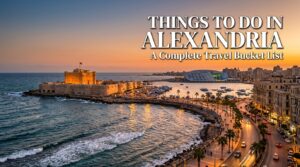
1. Introduction: Why Alexandria Belongs on Every Egypt Traveller’s Bucket List
When travellers plan their Egypt itinerary, Cairo and the pyramids almost always dominate the conversation. Yet just 220 kilometres to the northwest along Egypt’s Mediterranean coast lies a city that rivals Cairo in historical depth, surpasses it in seaside beauty, and offers a completely different dimension of the Egyptian experience. Alexandria — the city Alexander the Great founded in 331 BCE — is one of the ancient world’s most legendary urban centres, and it remains one of the most rewarding and undervisited destinations in all of Egyptian tourism.
For anyone building a list of the best things to do in Alexandria Egypt, the range of experiences on offer is extraordinary. Here is a city where the ancient Library of Alexandria once housed the knowledge of the entire known world, where Cleopatra held court, where Alexander’s own tomb is believed to lie somewhere beneath the modern streets. It is a city where Greek, Roman, Jewish, Christian, and Islamic civilisations layered themselves over centuries, each leaving monuments and traces that survive to this day.
But Alexandria is not only about ancient history. It is Egypt’s second-largest city and its most distinctly Mediterranean destination — a coastal city with a long Corniche promenade, cool sea breezes, and a relaxed, intellectual atmosphere shaped by centuries of cosmopolitan life. The city’s cafes, seafood restaurants, beaches, and street markets all carry a character quite unlike anything else in Egypt. This complete Alexandria travel guide covers every major Alexandria attraction, hidden gem, practical tip, and sample itinerary you need to plan an unforgettable visit.
2. Essential Travel Information Before You Visit
Best Time to Visit Alexandria
Alexandria’s Mediterranean climate makes it one of Egypt’s most comfortable destinations year-round. The ideal period for Alexandria tourism is March through June and September through November, when daytime temperatures sit between 18°C and 28°C, the Mediterranean Sea is warm enough for swimming, and the city’s outdoor spaces are at their most enjoyable. Summer months — July and August — bring heat and significant domestic tourism from Cairo residents seeking the sea breeze, making accommodation harder to book and beaches crowded. Winter months from December to February are cool and occasionally rainy but perfectly fine for sightseeing, with fewer tourists at most Alexandria attractions.
Visa, Currency and Budget
Most nationalities require an Egyptian e-visa, obtainable online before travel or on arrival at Cairo International Airport. The currency is the Egyptian Pound (EGP). Alexandria is one of Egypt’s most affordable destinations — a full day of Alexandria sightseeing including entry to two or three major museums, local meals, and transport along the Corniche, can be managed comfortably for $25 to $40 USD. Mid-range hotel accommodation is significantly cheaper than equivalent options in Cairo, making Alexandria an outstanding choice for budget-conscious travellers visiting Egypt.
How Long Do You Need in Alexandria?
A focused day trip from Cairo allows you to cover the three or four most essential Alexandria attractions. Two full days gives you time to explore the major historical sites, walk the Corniche, visit the beaches, and experience the local food scene properly. Three to five days is ideal for travellers who want to go deeper — exploring lesser-known sites, taking day trips to nearby destinations, and absorbing the relaxed Mediterranean rhythm of Alexandria life.
3. Getting to Alexandria and Getting Around the City
Alexandria is exceptionally well connected to Cairo by multiple transport options:
- Egyptian National Railways — Direct air-conditioned trains run frequently between Cairo Ramses Station and Alexandria Misr Station, with the journey taking 2 to 2.5 hours. First-class tickets are affordable and comfortable and this is the most popular option for both tourists and locals.
- Bus Services — GO Bus premium services connect Cairo to Alexandria in approximately 2.5 to 3 hours from several Cairo departure points. Air-conditioned, comfortable, and extremely affordable.
- Private Car or Taxi — The Cairo to Alexandria Desert Road is a well-maintained dual carriageway. A private taxi or hired car takes approximately 2 to 2.5 hours and offers maximum flexibility.
- Domestic Flight — Short flights connect Cairo International Airport to Borg El Arab Airport (30 km west of central Alexandria), though journey time including airport transfers makes the train a more practical choice for most travellers.
Within Alexandria, getting around is straightforward. Taxis and Uber/Careem are widely available and affordable. The historic tram system — one of Africa’s oldest — offers a slow but atmospheric way to travel between districts. Walking is the best option for exploring the historic centre, the Corniche waterfront, and the area around the Citadel of Qaitbay.
4. Bibliotheca Alexandrina — The Modern Wonder on Ancient Foundations
No list of Alexandria Egypt tourist attractions is complete without beginning at the Bibliotheca Alexandrina — the modern successor to the ancient Library of Alexandria, one of the most celebrated institutions in human intellectual history. The original library, founded in the 3rd century BCE under Ptolemy I, was designed as a universal repository of all human knowledge. At its peak it housed an estimated 400,000 to 700,000 scrolls covering every field of scholarship known to the ancient world, attracting the greatest scholars, mathematicians, poets, and philosophers of the Hellenistic era.
The modern Bibliotheca Alexandrina, inaugurated in 2002, is one of the most architecturally distinguished buildings in Africa and the Arab world. Designed by the Norwegian firm Snohetta, it sits directly on the Alexandria waterfront, its tilted circular roof — clad in Aswan granite inscribed with characters from 120 world scripts — designed to evoke the rising sun over the Mediterranean. The building houses a main reading room capable of accommodating 2,000 readers simultaneously, eight specialised libraries, four museums, and four art galleries.
Key features for visitors include:
- Antiquities Museum — An exceptional collection including Greco-Roman sculptures, Pharaonic artefacts, and objects from Alexandria’s multi-civilisational past.
- Manuscript Museum — Showcasing rare manuscripts and early printed books from across the Islamic, Coptic, and Mediterranean worlds.
- Planetarium Science Centre — A modern interactive science centre, ideal for families and younger visitors.
- The Main Reading Room — Even if you are not there to read, the sheer scale and design of the reading room descending in cascading tiers beneath the great disc roof is one of the most visually impressive interior spaces in Egypt.
Visitor Tip: Allow two to three hours for the Bibliotheca Alexandrina. Guided tours are available and significantly enrich the experience. The cafe overlooking the Mediterranean provides one of the finest views in Alexandria.
5. Citadel of Qaitbay — Where the Ancient Lighthouse Once Stood
The Citadel of Qaitbay is perhaps the most visually iconic of all Alexandria attractions — a dramatic medieval fortress rising from a spit of land that juts into the Mediterranean Sea, built on the precise site of one of the Seven Wonders of the Ancient World. The ancient Lighthouse of Alexandria, one of the tallest structures ever built by human hands at an estimated 100 to 140 metres, stood at this exact location from approximately 280 BCE until it was progressively damaged by a series of earthquakes between the 10th and 14th centuries CE.
The Citadel itself was constructed between 1477 and 1479 CE by Sultan Qaitbay of the Mamluk sultanate, using the stones of the ruined lighthouse as building material — meaning that within the citadel walls, visitors are quite literally in physical contact with remnants of one of antiquity’s greatest structures. The fortress served as a key defensive installation protecting Alexandria’s harbour from Ottoman naval threats and later from European colonial powers.
Today the Citadel of Qaitbay houses a Naval Museum with displays covering Alexandria’s extensive maritime history from antiquity through the modern era. But the principal attraction for most visitors is the setting itself — the walk along the sea walls with the open Mediterranean on three sides, the views back across Alexandria’s harbour and Corniche, and the romantic wind-swept atmosphere that makes this one of the most photographed spots in all of Egyptian coastal tourism.
Pro Tip: Visit late afternoon when the light turns golden over the Mediterranean and the crowds thin. The walk from the Citadel along the Eastern Harbour Corniche back towards the city centre at sunset is one of the finest free experiences in Alexandria.
6. Catacombs of Kom el-Shoqafa — Alexandria’s Underground Marvel
Among all the historical places to visit in Alexandria Egypt, the Catacombs of Kom el-Shoqafa stand apart as the city’s most hauntingly atmospheric site. Discovered accidentally in 1900 when a donkey fell through the ground into the upper chamber, these remarkable underground tombs represent one of the finest surviving examples of the cultural synthesis that defined Alexandria during the Roman period — a seamless blending of ancient Egyptian, Greek, and Roman funerary traditions into a single extraordinary artistic vision.
The catacombs were carved into the rock during the 2nd century CE and were originally intended as the private family tomb of a wealthy Alexandrian. They were subsequently expanded into a public burial site capable of accommodating hundreds of individuals. The complex descends three levels into the earth, connected by a spiral staircase that winds around a central shaft originally used to lower the bodies of the deceased.
The main tomb chamber — the Triclinium — is the artistic centrepiece of the entire complex. Here, carved reliefs depict Egyptian gods and pharaonic iconography rendered in the visual style of classical Roman sculpture. The god Anubis wears Roman armour. Pharaonic mummification scenes are framed by classical columns. This extraordinary fusion of Egyptian theology, Greek artistic conventions, and Roman architectural forms reflects Alexandria’s unique role as the world’s great cultural crossroads during the Hellenistic and Roman periods.
Visitor Tip: The catacombs involve descending narrow spiral staircases and moving through low passages. Not recommended for those with severe claustrophobia. Bring a light jacket — the underground temperature is noticeably cooler than the surface.
7. Pompey’s Pillar and the Temple of Serapis
Rising 27 metres from the crest of Alexandria’s ancient acropolis hill, Pompey’s Pillar is the tallest ancient monument still standing in Egypt outside of the pyramids and obelisks, and one of the most remarkable single surviving objects from the ancient Roman world. Despite its misleading name — applied by medieval Crusader travellers who incorrectly associated it with the Roman general Pompey — the column was in fact erected in 297 CE in honour of the Emperor Diocletian, following his successful suppression of an Alexandrian revolt.
The pillar is a single shaft of polished red Aswan granite, 2.7 metres in diameter at its base, topped by a Corinthian capital that once supported a colossal statue of the emperor. The scale of the engineering achievement — quarrying, transporting, and erecting a single piece of granite of this mass in the 3rd century CE — is striking even by modern standards.
The surrounding archaeological site covers the ruins of the ancient Serapeum — the great Temple of Serapis, one of the most important religious sanctuaries of the Hellenistic world. The Serapeum housed a famous branch of the ancient Library of Alexandria and was a centre of the syncretic Serapis cult that blended Greek and Egyptian religious traditions. The site includes underground galleries, Nilometers, sphinx statues, and scattered architectural fragments that give a sense of the temple’s original magnificence.
8. Alexandria National Museum — Three Floors of Civilisation
The Alexandria National Museum is one of the finest and most thoughtfully curated museums in Egypt, yet it remains significantly less visited than its Cairo counterparts — making it one of the true hidden gems in Alexandria Egypt for serious history travellers. Housed in a beautifully restored early 20th-century Italian-style palace in the heart of the city, the museum presents Alexandria’s extraordinary history across three floors, organising its collection chronologically from the Pharaonic era through Greco-Roman Alexandria to the Coptic and Islamic periods.
The ground floor covers the Pharaonic period with sculptures, jewellery, ritual objects, and architectural fragments from ancient Egyptian sites across the Alexandria region. The first floor is dedicated to the Greco-Roman era — the golden age of Alexandrian civilisation — with an outstanding collection of marble sculptures, bronze figurines, gold jewellery, and objects from the royal court of the Ptolemaic dynasty. Among the highlights is a collection of submerged city artefacts recovered from Alexandria’s sunken royal quarter by underwater archaeologists in the 1990s, including statues and sphinxes that lay on the harbour floor for 1,500 years.
The second floor covers the Coptic and Islamic periods, tracing Alexandria’s transformation from a centre of early Christianity to one of the great cities of the medieval Islamic world. Allow two hours minimum, and consider hiring a museum guide — the stories behind individual objects are frequently extraordinary and not communicated by the display labels alone.
9. The Royal Jewellery Museum — Egypt’s Hidden Gem
Few visitors to Alexandria know about the Royal Jewellery Museum, and those who discover it almost universally describe it as one of the most unexpectedly memorable things to do in Alexandria Egypt. Housed in the former palace of Princess Fatima al-Zahra — a magnificently decorated early 20th-century villa in the upscale Gleem district — the museum displays the personal jewellery collection of Egypt’s royal family from the 19th and 20th centuries, including pieces commissioned from the finest European jewellers of the era.
The collection spans gold and platinum jewellery set with diamonds, emeralds, rubies, and pearls; personal accessories belonging to King Farouk and other members of the royal household; and a famous platinum crown set with 2,159 diamonds. But the building itself is equally remarkable — the palace interiors are decorated with extraordinary painted ceilings, Venetian stained glass, and hand-laid mosaic floors depicting hunting scenes and royal portraits that together constitute one of the finest examples of royal interior decoration surviving in Egypt.
10. Stanley Beach and the Mediterranean Corniche
Alexandria’s seaside identity is central to everything that makes the city distinctive, and no visit to Alexandria is complete without spending meaningful time on the waterfront. The Alexandria Corniche — the long coastal road and promenade that stretches for over 20 kilometres — is the social and physical spine of the city, where Alexandrians of every background walk, cycle, fish, and gather to watch the Mediterranean. It is arguably the finest urban waterfront in Egypt and one of the most pleasant seaside promenades in the entire Arab world.
Stanley Beach is Alexandria’s most celebrated and architecturally distinctive beach destination, immediately recognisable from the ornate Stanley Bridge that arches across the water nearby. The beach itself offers clean sand, calm summer waters, and a range of cafes and restaurants overlooking the sea. Stanley Bridge — built in a neo-Moorish style with green domes and decorative archways — is one of the most photographed structures in Alexandria and makes for a spectacular foreground in seafront photography.
Other notable beaches along the Alexandria coastline include Mamoura Beach (quieter, further east), Miami Beach (popular with younger Alexandrians), and the upmarket San Stefano Beach. For a completely crowd-free experience, the beaches around Abu Qir — 24 kilometres east of the city centre — offer some of the most relaxed and beautiful coastline in the region.
11. Montaza Palace and Gardens — Royal Retreat by the Sea
At the eastern end of Alexandria’s coastline, the Montaza Palace complex offers one of the most beautiful and historically significant settings in Egyptian coastal tourism. Built in 1892 by Khedive Abbas II as a summer retreat, the complex sits within 150 hectares of manicured gardens, pine forests, and private beaches overlooking the Mediterranean — making it one of the most pleasant places to spend an afternoon anywhere in Alexandria.
The complex includes the original Salamlek Palace (now a luxury hotel) and the larger Al-Haramlik Palace, built in a distinctive style combining Florentine and Ottoman architectural influences. The palaces themselves are not open to the general public, but the extensive grounds are accessible and draw both tourists and Alexandrian families seeking shade, sea views, and respite from the urban noise. The private royal beach within the complex is one of the finest and least crowded in Alexandria.
12. Abu Abbas al-Mursi Mosque — Islamic Architecture by the Sea
Standing at the edge of Alexandria’s Western Harbour near the Citadel of Qaitbay, the Abu Abbas al-Mursi Mosque is one of the most beautiful pieces of Islamic architecture in Egypt’s Mediterranean coastal cities and a deeply important spiritual site for Alexandrians. The mosque marks the tomb of Abu Abbas al-Mursi, a 13th-century Andalusian Sufi scholar who became one of Alexandria’s most beloved religious figures and whose tomb has been a place of pilgrimage since his death in 1287 CE.
The current structure was built in the 20th century in a Moorish-Andalusian style, featuring four ornate domes, elaborate geometric tilework, intricately carved mashrabiyya screens, and a slender minaret that serves as a landmark visible across the harbour. The interior features soaring arched galleries, hand-painted ceilings, and the elaborately decorated tomb chamber of Abu Abbas al-Mursi. Non-Muslim visitors are welcome outside of prayer times and are asked to dress modestly and remove shoes before entering.
13. Alexandria’s Greek, Roman and Ancient Heritage
Beyond its headline attractions, Alexandria contains a rich layer of ancient Roman and Greek history waiting to be explored by curious visitors willing to venture off the standard sightseeing route. The ancient city — founded by Alexander himself and planned on a rational grid system — lies largely beneath the modern streets, but significant remnants surface across the city for those who seek them.
Key sites for lovers of classical antiquity include:
- Kom el-Dikka Roman Theatre — A beautifully preserved Roman-era Odeon with thirteen marble tiers still intact, discovered in the 1960s. The surrounding site also contains remains of Roman baths, a colonnaded street, and villas with exceptional mosaic floors.
- The Greco-Roman Museum — Currently undergoing major renovation and expansion, this museum houses one of the finest collections of Hellenistic and Roman-era artefacts in the Mediterranean world.
- Underwater Royal Quarter — The remains of Cleopatra’s royal palace complex lie beneath Alexandria’s Eastern Harbour, submerged by ancient earthquakes. Objects recovered from this site are displayed in the Alexandria National Museum.
- Ancient Necropolis of Mustafa Kamel — Four Hellenistic-era underground tombs with well-preserved painted decorations depicting scenes from Greek mythology and daily life in ancient Alexandria.
14. Alexandria Local Food and Cuisine — What to Eat
Alexandria local food and culture is one of the great undiscovered pleasures of Egyptian travel. The city’s cuisine reflects its Mediterranean coastal location, its layered cultural history, and its deep tradition of fishing and seafood preparation that stretches back to antiquity. Eating in Alexandria is an experience quite distinct from eating in Cairo, and exploring the local food scene should be a high priority on any Alexandria itinerary.
Essential Dishes to Try in Alexandria
- Sayyadiya — Alexandria’s most iconic fish dish: white fish slow-cooked over a fragrant base of caramelised onions, tomatoes, and spices, served on a bed of golden spiced rice. Each restaurant has its own closely guarded version — trying multiple is highly recommended.
- Grilled Mediterranean Seafood — Fresh prawns, calamari, sea bass, mullet, and red snapper grilled over charcoal and served simply with lemon, tahini, and baladi bread. The fish market restaurants along the Anfushi waterfront offer some of the freshest and most affordable seafood in Egypt.
- Koshary — Egypt’s beloved national street food of layered rice, lentils, pasta, and spiced tomato sauce is found across Alexandria and makes for an outstanding budget meal.
- Hawawshi — Spiced minced meat baked inside a crispy bread shell — a beloved Alexandrian street food snack available from bakeries across the city.
- Konafa and Basbousa — Alexandria is particularly celebrated for its sweets. Konafa — shredded wheat pastry soaked in sugar syrup and stuffed with clotted cream or cheese — is made fresh at dedicated sweet shops and should be eaten warm.
- Fresh Juice and Sugarcane — The Corniche and main shopping streets are lined with juice bars offering freshly pressed sugarcane, mango, guava, and pomegranate juice at extremely affordable prices.
Best Cafes in Alexandria Egypt
Alexandria has one of the richest cafe cultures in Egypt, rooted in the cosmopolitan European-influenced coffee house tradition of the 20th century. The legendary Athineos Cafe near the Cecil Hotel is one of the oldest and most atmospheric coffee houses in the city, a relic of the era when Alexandria was home to significant Greek and Italian communities. For sea views alongside your coffee, the cafe at the Bibliotheca Alexandrina and several rooftop establishments along the Corniche offer some of the finest settings in the city.
15. Alexandria at Night — Evening Experiences and Nightlife
Alexandria at night takes on an entirely different character from its daytime atmosphere. The heat of the day dissipates, the sea breeze strengthens along the Corniche, and the city’s social life moves outdoors in a way that feels distinctly Mediterranean. Alexandria nightlife is quieter and more culturally conservative than Cairo, but it offers a range of genuinely memorable evening experiences for visitors.
- Evening Walk on the Corniche — The most quintessential Alexandrian experience. As the sun sets over the Western Harbour and the street lights along the Corniche come on, thousands of locals take to the waterfront promenade for their evening walk. The atmosphere is warm, sociable, and completely safe — one of the finest free evening experiences in Egypt.
- Seafood Dinner in Anfushi — The Anfushi district near the Eastern Harbour is home to a cluster of legendary seafood restaurants where fresh fish is displayed on ice at the entrance for you to select, then grilled to order. An evening seafood dinner here is one of the most memorable meals available anywhere in Egyptian tourism.
- Sayed Darwish Theatre — Alexandria’s main opera house hosts regular performances of Arabic music, classical concerts, and theatrical productions, offering a window into Alexandria’s living cultural traditions.
- Shisha and Rooftop Cafes — Several rooftop cafes in the downtown area and along the Corniche offer shisha, Egyptian coffee, and sea views after dark. The atmosphere is relaxed and family-friendly.
- Citadel of Qaitbay by Night — The fortress is illuminated after dark and the walk along the sea wall at night — with the lights of the harbour reflected in the Mediterranean — is genuinely romantic and one of Alexandria’s finest free experiences.
16. Day Trips from Alexandria
Alexandria’s location on Egypt’s Mediterranean coast makes it an excellent base for exploring several compelling nearby destinations that most Egypt travel itineraries overlook entirely.
Abu Mena — UNESCO World Heritage Early Christian Site
Located approximately 45 kilometres southwest of Alexandria, Abu Mena is one of the most important early Christian pilgrimage sites in the world and a UNESCO World Heritage Site. The ruins include the remains of a great basilica built over the tomb of Saint Menas — a revered 4th-century Christian martyr — along with extensive early Christian settlement remains. The site is relatively unvisited and deeply atmospheric, offering a powerful sense of connection to Egypt’s pre-Islamic Christian heritage.
El Alamein — World War II Battlefield and Memorials
Approximately 105 kilometres west of Alexandria lies El Alamein, the site of the pivotal 1942 North Africa campaign battles that turned the course of the Second World War. The town contains three major war cemeteries — Commonwealth, German, and Italian — each maintained with extraordinary care and solemnity, along with a comprehensive War Museum displaying tanks, artillery, uniforms, and personal accounts from both sides of the conflict. It is one of the finest military history destinations in the Middle East and a deeply moving place to visit.
Abu Qir — Seafood Village and Naval History
Just 24 kilometres east of Alexandria, the small fishing town of Abu Qir sits on the bay where Admiral Horatio Nelson destroyed Napoleon’s fleet at the Battle of the Nile in 1798. Today Abu Qir is primarily celebrated for its outstanding seafood restaurants, clustered along the waterfront and serving the freshest fish in the Alexandria region. The beaches at Abu Qir are also significantly less crowded than those within the city.
17. Practical Tips for First-Time Visitors to Alexandria
Dress Code and Cultural Respect
Alexandria is a more conservative city than its cosmopolitan reputation might suggest. Modest dress is strongly recommended throughout the city, particularly when visiting mosques, the Catacombs, and traditional market areas. For women, covered shoulders and knees are the appropriate standard at all religious sites. The beach areas and Corniche promenade are more relaxed in dress expectations, but modesty remains the respectful default choice across Alexandria.
Safety and Practical Considerations
- Alexandria is generally very safe for tourists. Violent crime against visitors is extremely rare.
- Always agree on taxi fares before entering an unmarked vehicle, or use Uber and Careem for transparent pricing.
- Near major tourist sites, persistent offers of unsolicited guided tours from unlicensed individuals are common. Arrange guides through your hotel or a reputable tour operator.
- Drink bottled water throughout your visit. Tap water is not recommended for visitors not accustomed to it.
- Carry Egyptian Pounds in small denominations for markets, street food, tipping, and museum entry fees.
- Tipping (baksheesh) is culturally embedded and forms an important part of service workers’ incomes. Budget a small supply of small-denomination notes.
- The national emergency number is 122 (police) and 123 (ambulance).
18. Sample Alexandria Travel Itineraries — 1 Day to 5 Days
What to Do in Alexandria in 1 Day — The Essential Highlights
- Morning: Bibliotheca Alexandrina (2 to 3 hours)
- Late Morning: Walk the Eastern Harbour Corniche to the Citadel of Qaitbay
- Afternoon: Catacombs of Kom el-Shoqafa, then Pompey’s Pillar and the Serapeum
- Evening: Seafood dinner in Anfushi, sunset walk along the Corniche
What to Do in Alexandria in 2 Days — Deeper Exploration
- Day 1: Bibliotheca Alexandrina, Eastern Harbour Corniche, Citadel of Qaitbay, Abu Abbas al-Mursi Mosque, Anfushi seafood dinner
- Day 2: Alexandria National Museum, Catacombs of Kom el-Shoqafa, Pompey’s Pillar, Royal Jewellery Museum, Stanley Beach and Stanley Bridge, Corniche evening walk
5-Day Alexandria Itinerary — Best Places to Visit in Alexandria Egypt with Family
- Day 1: Bibliotheca Alexandrina, Eastern Harbour, Citadel of Qaitbay, Abu Abbas Mosque
- Day 2: Alexandria National Museum, Catacombs, Pompey’s Pillar, Roman Theatre at Kom el-Dikka
- Day 3: Royal Jewellery Museum, Stanley Beach, Montaza Palace Gardens, San Stefano area
- Day 4: Day trip to El Alamein War Museum and Cemeteries
- Day 5: Abu Qir seafood lunch and beach, return for final Corniche walk and dinner
19. Conclusion: Is Alexandria Worth Visiting in 2026?
The answer is an unqualified yes. Alexandria in 2026 is a city that has everything a serious traveller could want: extraordinary historical depth spanning three thousand years of continuous civilisation, a world-class modern cultural institution in the Bibliotheca Alexandrina, a dramatically beautiful Mediterranean coastal setting, outstanding food, and a genuine human warmth that only the city itself can truly deliver.
What sets Alexandria apart from other Egyptian destinations is not simply what it contains but what it feels like. It is a city that wears its history lightly — where ancient Roman ruins sit at street level alongside modern coffee shops, where the Mediterranean light falls on minarets and sea walls in equal measure, and where the evening Corniche walk has been a shared civic ritual for generations. The Alexandria modern vs ancient city experience is unlike anywhere else in Egypt, and indeed unlike anywhere else in the world.
Whether you are drawn by the ancient Roman and Greek history in Alexandria, the cultural heritage sites of the Islamic and Coptic periods, the Mediterranean coastal scenery, the seafood, or the romantic atmospheric quality of a city that has been one of the world’s great urban centres since the 4th century BCE — Alexandria will exceed your expectations and almost certainly bring you back. Plan your visit, book your train from Cairo, and let one of history’s most legendary cities surprise you all over again.
20. Frequently Asked Questions
(FAQs)