
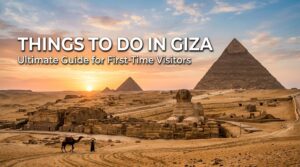
1. Introduction: Why Giza Belongs on Every Traveller’s Bucket List
There are destinations that live up to their reputation, and then there is Giza. No photograph, no film, no travel documentary — however spectacular — fully prepares a first-time visitor for the physical reality of standing at the base of the Great Pyramid of Khufu and looking upward. The sheer mass of the structure, the precision of its geometry, the weight of its 4,500-year history pressing down through the desert air — these are things that must be experienced in person to be genuinely understood.
The Giza Plateau, located on the southwestern edge of Cairo on the desert plateau of Giza, is home to the only surviving monument among the original Seven Wonders of the Ancient World. It is a UNESCO World Heritage Site Egypt, one of the most visited archaeological sites in Egypt, and the single most recognisable symbol of Egyptian civilisation history in existence. For anyone planning an Egypt itinerary, Giza is not optional — it is the cornerstone around which everything else is built.
But the best things to do in Giza Egypt extend far beyond simply standing in front of three famous pyramids. The Giza Plateau contains a complex of temples, causeways, subsidiary pyramids, workers’ cemeteries, and tombs that together constitute one of the most important concentrations of ancient burial structures Egypt has ever produced. Nearby, the Grand Egyptian Museum houses the most comprehensive display of Egyptian civilisation history ever assembled. The surrounding desert offers camel rides, Giza desert safari experiences, and views that stretch to the horizon. And at night, the Pyramid Sound and Light Show transforms the plateau into one of the most atmospheric evening experiences in all of Egyptian tourism.
This complete Giza Egypt travel guide for first-time visitors covers everything — from the practical logistics of getting to the plateau and navigating it safely, to the historical context of each major monument, to the hidden gems in Giza Egypt that most visitors never find. Whether you have half a day or three full days to spend in this extraordinary place, this guide ensures every hour is used well.
2. Essential Travel Information Before You Visit Giza
Best Time to Visit Giza
The best time to visit Giza Egypt is between October and April, when daytime temperatures on the desert plateau range from 15°C to 26°C (59°F to 79°F). These months offer comfortable conditions for extended outdoor exploration of the Giza Plateau, which involves significant walking across open, sun-exposed limestone terrain. The summer months of June through August are intensely hot — regularly exceeding 38°C to 42°C — making extended sightseeing genuinely demanding and requiring extraordinary attention to sun protection and hydration. If summer is your only option, begin your visit at gate opening time (8:00 AM) and plan to be off the plateau by 11:00 AM.
The absolute finest times of day on the plateau, regardless of season, are early morning and late afternoon. Early morning visits offer the thinnest crowds, the lowest temperatures, and the most dramatic photographic light — the sun rising behind the pyramids produces one of the most breathtaking natural spectacles in all of Giza tourism. Late afternoon — the golden hour before sunset — offers equally spectacular light and the added bonus of the sunset view of pyramids of Giza experience, which many visitors describe as the single most memorable moment of their entire Egypt journey.
Visa, Currency and Entry Fees
Most nationalities require an Egyptian e-visa, obtainable online before travel or on arrival at Cairo International Airport. The currency is the Egyptian Pound (EGP). Entry to the Giza Plateau for international visitors costs approximately $15 to $20 USD. Separate tickets are required for entering the interior of the Great Pyramid of Khufu (additional fee), the Pyramid of Menkaure interior, the Solar Boat Museum, and the sphinx enclosure. Budget approximately $40 to $60 USD for a comprehensive single-day Giza pyramids tour covering all major interior access points.
Budget Travel Guide to Giza Egypt
For budget-conscious travellers, Giza is genuinely accessible on a modest daily allowance. Plateau entry, local transport, and a full day of Egyptian monuments sightseeing can be managed for approximately $30 to $50 USD excluding meals. Hiring a licensed guide directly at the site adds cost but significantly enhances the educational value of the visit. Avoid unlicensed touts near the gates — their fees are unregulated and their historical knowledge frequently unreliable.
3. Getting to Giza and Getting Around the Plateau
The Giza Plateau is located approximately 20 kilometres southwest of central Cairo, making it an easy and fast connection from virtually any accommodation in the Cairo metropolitan area. The following options cover every budget and preference:
- Cairo Metro Line 2 — The most affordable option. The metro runs directly from central Cairo to the Giza Station, from which a short taxi, Uber, or tuk-tuk ride reaches the plateau entrance in approximately 10 minutes. The total journey from central Cairo takes 30 to 40 minutes and costs a fraction of a taxi fare.
- Uber and Careem — App-based ridesharing services offer transparent pricing, no fare negotiation, and door-to-door service from any Cairo hotel directly to the plateau entrance. Highly recommended for comfort and convenience.
- Private Tour Vehicle — For a full Cairo and Giza itinerary combining the plateau with other Cairo day trips such as the Grand Egyptian Museum, Saqqara, or Islamic Cairo, a private driver with a licensed tour guide is the most efficient option and allows full flexibility over timing and pace.
- Official Tourist Taxi — Available at major Cairo hotels. Agree on the fare in advance before entering the vehicle.
- Organised Egypt Pyramids Tour — Numerous reputable tour operators offer half-day and full-day organised Egypt pyramids tour packages departing from central Cairo hotels, typically including a licensed Egyptologist guide, all transport, and entrance fees.
Getting Around the Giza Plateau
The Giza Plateau is larger than most first-time visitors expect. The three main pyramids are spread across a significant area of open limestone desert, and walking between them — particularly in summer heat — is physically demanding. Horse-drawn carriages and official plateau vehicles offer paid transport between the main monuments for those who prefer not to walk the full distance. Comfortable, closed-toe walking shoes are essential. The plateau surface is uneven limestone, and sections near the pyramid bases involve loose stone rubble.
4. The Great Pyramid of Khufu — The Last Surviving Ancient Wonder
The Great Pyramid of Giza — built for Pharaoh Khufu (also known by the Greek name Cheops) around 2560 BCE — is the oldest and largest of the three pyramids on the Giza Plateau and the sole surviving monument among the original Seven Wonders of the Ancient World. It stands 138.5 metres tall today (originally 146.6 metres before the loss of its limestone casing stones and apex) and held the record as the world’s tallest man-made structure for an astonishing 3,800 years — a record not surpassed until the construction of Lincoln Cathedral in England in the 14th century CE.
The scale of the pharaoh tomb architecture here is almost incomprehensible in human terms. The Great Pyramid is constructed from approximately 2.3 million individual stone blocks, each weighing an average of 2.5 to 15 tonnes. The total mass of the structure is estimated at 5.9 million tonnes. The precision of its construction — the base is level to within 2.1 centimetres across its full 230-metre side length, and the four sides are oriented to true north, south, east, and west with an accuracy of less than four minutes of arc — represents a feat of Egyptian pyramid engineering that continues to astonish archaeologists, architects, and engineers to this day.
Visitors to the Great Pyramid of Giza can enter the interior through the original robber’s tunnel and the Ascending Passage — a low, narrow corridor that climbs at a 26-degree angle toward the Grand Gallery and ultimately the King’s Chamber, where Khufu’s red granite sarcophagus still rests. The interior experience is physically demanding — the passages are narrow, low, and warm — but the sensation of being inside a structure built 4,500 years ago by a civilisation that predates the Roman Empire by 2,000 years is unlike anything else available in world travel.
Pro Tip: Only 300 interior entry tickets are sold daily for the Great Pyramid — 150 at gate opening and 150 at 1:00 PM. Arrive at 7:30 AM before the gates open at 8:00 AM to secure your ticket. These sell out quickly, particularly during peak season between October and March.
5. The Pyramid of Khafre — Majesty on the Elevated Plateau
The Pyramid of Khafre — built for Pharaoh Khafre, son of Khufu, around 2530 BCE — is the second-largest pyramid on the Giza Plateau and perhaps the most visually impressive of the three when viewed from a distance. Although it stands at 136 metres tall — slightly shorter than the Great Pyramid of Khufu — it is built on elevated bedrock that makes it appear taller than its neighbour from most vantage points. The most distinctive and immediately recognisable feature of the Pyramid of Khafre is the band of original smooth Tura limestone casing stones that survive intact near the apex, offering a vivid glimpse of how all three Giza pyramids once appeared in antiquity — gleaming brilliant white across the desert plateau, visible for enormous distances.
The interior of the Pyramid of Khafre is accessible to visitors and contains two descending corridors leading to the burial chamber, where Khafre’s empty black granite sarcophagus still sits in its original position. The Khafre complex also includes a well-preserved Valley Temple — a massive granite and limestone structure connected to the pyramid by a 494-metre causeway — which is one of the finest surviving examples of Old Kingdom temple architecture in Egypt. The Valley Temple was likely the site where Khafre’s mummification rituals were performed before his body was transported up the causeway for entombment.
6. The Pyramid of Menkaure — The Quieter Giant
The Pyramid of Menkaure — the smallest of the three principal pyramids on the Giza Plateau at approximately 65 metres tall — is the pyramid most overlooked by visitors in a hurry to photograph the two larger structures. This is a significant mistake. The Pyramid of Menkaure, built for Pharaoh Menkaure around 2510 BCE, offers a genuinely different and often more rewarding experience than its larger neighbours precisely because of what it lacks: crowds.
While the Great Pyramid and Pyramid of Khafre draw the majority of visitor attention, the Pyramid of Menkaure is often surprisingly quiet — giving visitors the opportunity to stand at the base of one of the great ancient wonders of the world in something approaching solitude, a rare and genuinely moving experience in the context of Giza sightseeing. The interior chambers are accessible and less claustrophobic than those of the larger pyramids, making this a good choice for visitors who want the experience of entering an ancient burial structure Egypt without the confined passages of Khufu’s pyramid.
The Menkaure complex includes three subsidiary pyramids — likely built for Menkaure’s queens — as well as a largely unexcavated mortuary temple. The lower courses of the Pyramid of Menkaure are clad in red Aswan granite rather than the white limestone used on the upper sections, giving the base a distinctive colouring visible from across the plateau. Three magnificent slate triads depicting Menkaure flanked by the goddess Hathor and regional deities — among the finest examples of Old Kingdom royal sculpture ever found — were discovered in the Valley Temple and are now displayed in the Egyptian Museum in Cairo and the Museum of Fine Arts in Boston.
7. The Great Sphinx of Giza — Guardian of the Plateau
The Great Sphinx of Giza is one of the most recognisable and mysterious sculptures in human history — a colossal recumbent lion with a human head, carved directly from a single natural ridge of limestone bedrock on the Giza Plateau. It stands 20 metres tall, stretches 73 metres in length, and with a width of 19 metres at its widest point, represents the largest monolithic sculpture ever created in ancient Egypt.
The Sphinx Egypt monument was carved during the reign of Pharaoh Khafre around 2500 BCE — the human face is most likely a portrait of Khafre himself, positioned to serve as an eternal guardian of the royal necropolis and the eastern approach to the Giza Plateau. The Sphinx faces due east, directly aligned with the rising sun at the equinoxes, a positioning widely interpreted as a deliberate cosmological statement linking the pharaoh with the sun god Ra and the horizon deity Hor-em-akhet (Horus of the Horizon), whose name the ancient Egyptians applied to the Sphinx.
The mysteries surrounding the Great Sphinx are numerous and genuinely fascinating. The original nose — visible in historical drawings and broken fragments — was apparently deliberately removed, likely during the medieval period. A carved granite stele placed between the Sphinx’s paws by Pharaoh Thutmose IV around 1400 BCE — the Dream Stele — records a vision in which the Sphinx appeared to Thutmose as a young prince, promising him the throne of Egypt if he cleared the sand that had buried the monument up to its neck. The surrounding Sphinx enclosure, cut deep into the bedrock, is covered with erosion patterns whose origin — wind erosion versus water erosion — has been the subject of active debate among geologists and Egyptologists.
The best viewing point for the Great Sphinx of Giza is from the eastern end of the sphinx enclosure, where visitors can stand directly in front of the monument at close range and look back toward the Pyramid of Khafre rising behind it. The classic panoramic view — both pyramids framing the Sphinx — is best photographed from the southeastern elevated viewpoint accessible via the plateau road.
8. Inside the Giza Plateau — What Else to See
Beyond the three principal pyramids and the Great Sphinx, the Giza Plateau contains a substantial number of additional archaeological features and monuments that together reveal the full complexity of this extraordinary ancient site. Most first-time visitors focus exclusively on the headline structures and miss much of what makes Giza one of the world’s most significant archaeological sites in Egypt.
The Solar Boat Museum (Khufu Ship Museum)
Located on the south side of the Great Pyramid, the Solar Boat Museum (now officially part of the Grand Egyptian Museum complex as its outdoor annex) houses the reconstructed cedar wood solar barque of Khufu — a 43.4-metre ancient boat discovered in 1954 in a sealed pit cut into the bedrock at the base of the Great Pyramid. The boat was found dismantled into 1,224 individual pieces and required 14 years of painstaking work to reassemble. It is the oldest intact ship ever discovered anywhere in the world and is believed to have been used either to transport the pharaoh’s body to Giza during his funeral or to carry him symbolically through the sky in the afterlife.
The Valley Temples
Each of the three main pyramids was connected to a Valley Temple at the desert edge by a long stone causeway. The Valley Temple of Khafre is the best preserved of the three and is still substantially intact, its interior walls and floors clad in finely polished red Aswan granite. It is one of the finest surviving examples of pharaoh tomb architecture from the Old Kingdom period and is included in the general Giza Plateau entry ticket.
Queens’ Pyramids and Subsidiary Structures
Six subsidiary pyramids — three on the eastern side of the Great Pyramid built for Khufu’s queens, and three associated with the Menkaure complex — are located on the plateau. While smaller in scale, these structures are important components of the overall Giza necropolis and are often overlooked by visitors focused on the three principal monuments.
The Workers’ Village and Cemetery
Perhaps the most historically significant discovery at Giza in recent decades is the Workers’ Village — an extensive settlement complex located south of the Sphinx, excavated since the 1990s by archaeologist Mark Lehner. The site overturns the ancient myth of slave-built pyramids: the evidence clearly shows that the pyramid builders were organised, well-fed, and respected Egyptian workers who received medical care, were buried with honour near the monuments they built, and took genuine civic pride in their extraordinary labour.
9. The Grand Egyptian Museum — World’s Largest Archaeological Museum
Located just two kilometres from the Giza Plateau entrance, the Grand Egyptian Museum (GEM) is one of the most significant cultural institutions built anywhere in the world in the 21st century and an essential component of any Giza sightseeing itinerary. Purpose-built to house Egypt’s complete national archaeological collection — over 100,000 artefacts — in a single world-class facility, the GEM represents the most comprehensive display of ancient Egypt history and Egyptian civilisation history ever assembled in one place.
The undisputed centrepiece is the complete treasure of Tutankhamun — the boy pharaoh whose tomb was discovered intact by Howard Carter in the Valley of the Kings in 1922. For the first time in history, all 5,000-plus objects from the tomb — including the legendary solid gold funerary mask, his ceremonial throne inlaid with gold and semi-precious stones, chariots, gilded couches, ritual statuettes, jewellery, and canopic jars — are displayed together in a dedicated multi-room gallery sequence. This single collection justifies the visit to the Grand Egyptian Museum independently of everything else the building contains.
The Grand Atrium features a 12-metre tall ancient statue of Ramesses II as its dramatic centrepiece, and the exterior approach along a 500-metre avenue lined with sphinx statues and featuring a suspended obelisk sets the tone for the experience within. For families, the Grand Egyptian Museum contains thoughtfully designed children’s galleries and interactive educational zones that make it one of the most genuinely family-friendly things to do in Giza Egypt.
Visitor Tip: Pre-book tickets online at least 48 hours in advance. Allow a minimum of four to five hours for a thorough visit. An audio guide or licensed Egyptologist guide transforms the experience from a visual walk-through into a genuinely educational journey through 3,000 years of Egyptian civilisation history. The GEM is best combined with a morning at the Giza Plateau in a single full-day itinerary — plateau first at 8:00 AM, museum from 1:00 PM onward.
10. Camel Ride at the Pyramids — The Classic Giza Experience
A camel ride at pyramids of Giza is one of the most iconic and photographically compelling experiences available anywhere in Egyptian tourism — and for many first-time visitors, a ride along the desert ridge overlooking all three pyramids simultaneously represents the defining image of their entire Egypt journey. The panoramic viewpoint on the plateau’s southwestern edge, reached by camel or horse along the desert rim, offers the most spectacular and comprehensive view of all three pyramids together — the only vantage point from which Khufu, Khafre, and Menkaure can all be seen in a single unobstructed frame.
Camel and horse rides are offered by licensed operators within the plateau boundaries. Agree on the duration and price clearly before mounting — specify whether the quoted price is per person or for the group, whether it covers a return journey, and whether a tip for the handler is included. Typical prices for a 30-minute camel ride covering the panoramic viewpoint range from 150 to 400 EGP per person, though negotiation is standard and expected. Licensed operators within the official plateau boundary are generally more reliable than those who approach visitors outside the gates.
11. Giza Desert Safari — Beyond the Plateau
For visitors seeking a Giza experience that extends beyond the plateau monuments into the broader desert landscape, a Giza desert safari offers one of the most memorable and visually dramatic activities available in Egyptian tourism. The desert surrounding the Giza Plateau stretches westward into the vast Sahara without interruption, and the landscape of rippling golden sand dunes, rocky limestone escarpments, and open sky provides a setting of extraordinary natural drama.
Organised Giza desert safari experiences typically depart from the plateau’s western boundary in the late afternoon, allowing participants to ride camels or quad bikes into the desert as the sun descends toward the horizon. The sunset view of pyramids of Giza from the desert to the west — watching the three structures turn from golden to amber to deep orange-red as the sun drops — is almost universally described by participants as the most visually stunning experience of their entire Egypt visit. Several operators offer private sunset camel trek packages that combine the desert ride with a traditional Bedouin tea service and photography assistance.
12. The Pyramid Sound and Light Show
The Pyramid Sound and Light Show at Giza is one of Egypt’s longest-running and most theatrically ambitious evening entertainments — a 60-minute audiovisual production staged on the Giza Plateau after dark, using the pyramids and sphinx as its backdrop. The show begins at the sphinx enclosure, where spectators sit in tiered outdoor seating and watch as the plateau monuments are illuminated dramatically by coloured lights while a narration — available in multiple languages including English, French, Spanish, Arabic, and Japanese — tells the story of ancient Egyptian civilisation history, the pharaohs who built the pyramids, and the mythology of the gods who watched over them.
The show runs multiple times each evening with different language performances on a rotating schedule. Tickets are available online and at the site box office. The atmosphere of sitting in the Egyptian desert at night with the Great Pyramid of Giza illuminated against the stars overhead is genuinely extraordinary, and for many visitors the Sound and Light Show creates a more emotionally resonant encounter with the pyramids than the daytime visit — the darkness strips away the surrounding city context and allows the monuments to communicate their true antiquity and scale without distraction.
Practical Note: Bring a warm layer for evening performances even in summer — the desert plateau cools rapidly after sunset. Insect repellent is advisable. Book tickets in advance during peak season (October to March) as evening performances can sell out, particularly for the English-language shows.
13. Hidden Gems in Giza Egypt
Beyond the famous monuments, the Giza area contains several hidden gems in Giza Egypt that reward curious travellers willing to look beyond the standard tourist circuit.
The Tomb of Qar and Idu
Located in the Eastern Cemetery of the Giza Plateau, the connected tombs of Qar (an Old Kingdom official who served under multiple pharaohs) and Idu (his son) contain some of the finest painted and carved relief decoration on the entire plateau. The figures of tomb owners and their families — depicted in hunting, fishing, and feasting scenes of extraordinary detail and vitality — are painted in vivid colours that have survived four and a half thousand years in remarkable condition. These tombs are included in the general plateau ticket and are frequently empty of other visitors.
The Mastaba of Meresankh III
The Mastaba of Meresankh III — granddaughter of Khufu and wife of Khafre — contains some of the most celebrated painted reliefs in all of ancient Egyptian art, including a famous scene of the queen and her mother in a papyrus skiff and a chamber lined with ten carved female figures emerging from the stone walls. It is one of the most intimate and visually rewarding of all the cultural heritage of Egypt sites on the plateau.
The Panoramic Desert Viewpoint
Accessible on foot from the plateau’s southwestern edge, this elevated viewpoint overlooking the open Sahara with all three pyramids arranged in a diagonal line behind you is the classic panoramic photograph location and one of the most emotionally powerful spots on the entire plateau. Most visitors race to this point for photographs and leave immediately — those who linger for 20 to 30 minutes as the light changes are invariably rewarded.
14. Day Trips from Giza — Saqqara, Dahshur and Memphis
Giza’s position in the southwestern corner of the Cairo metropolitan area makes it an ideal base for Cairo day trips to three of Egypt’s most significant and rewarding archaeological sites beyond the plateau itself.
Saqqara — Egypt’s Oldest Pyramid and Finest Tomb Paintings
Located 30 kilometres south of Giza, Saqqara is the site of the world’s oldest surviving pyramid — the Step Pyramid of Djoser, designed by the architect Imhotep around 2650 BCE and the direct architectural ancestor of the Giza pyramids. The surrounding necropolis contains dozens of mastaba tombs with extraordinarily well-preserved painted reliefs depicting daily life in ancient Egypt — hunting, fishing, agriculture, music, and ritual — in colours that still glow after four thousand years. The recently reopened tombs of Mehu and Mereruka contain some of the finest painted decoration in all of ancient Egypt.
Dahshur — The Bent Pyramid and Red Pyramid
A short drive south of Saqqara, Dahshur contains two of Egypt’s most architecturally significant and least-visited pyramids. The Bent Pyramid — whose angle changes dramatically halfway up the structure, suggesting the builders modified their plans mid-construction — is one of the most unusual ancient burial structures Egypt has produced and is now open for interior visits. The Red Pyramid, built immediately afterward, is Egypt’s first geometrically smooth-sided true pyramid and the direct predecessor of the Great Pyramid of Khufu. Both sites receive a fraction of Giza’s visitors, offering an extraordinary sense of private access to some of Egypt’s greatest pharaoh tomb architecture.
Memphis — Egypt’s Ancient Capital
Memphis, located near Saqqara, was Egypt’s first capital city — the administrative and cultural centre of the unified kingdom from approximately 3100 BCE. Today the open-air museum at Mit Rahina houses the most significant surviving objects from the ancient city, including a colossal recumbent limestone statue of Ramesses II — 10 metres long and among the most impressive royal sculptures surviving from ancient Egypt. The alabaster sphinx at Memphis, weighing 80 tonnes, is the second-largest sphinx in Egypt after the Great Sphinx of Giza itself.
15. Cairo and Giza Combined — 2-Day Itinerary
For first-time visitors planning a things to do in Giza and Cairo in 2 days itinerary, the following schedule covers the essential highlights of both destinations efficiently and without sacrifice:
Day 1 — Giza Plateau and Grand Egyptian Museum
- 7:30 AM: Arrive at Giza Plateau gates before opening, purchase interior pyramid tickets
- 8:00 AM: Enter Great Pyramid of Khufu interior (ticket numbers strictly limited)
- 9:30 AM: Pyramid of Khafre exterior, Valley Temple of Khafre
- 11:00 AM: Great Sphinx of Giza and sphinx enclosure
- 12:00 PM: Pyramid of Menkaure and subsidiary pyramids, Solar Boat Museum
- 1:30 PM: Transfer to Grand Egyptian Museum (2 km from plateau)
- 2:00 PM to 6:00 PM: Grand Egyptian Museum — Tutankhamun galleries, Grand Atrium, Royal Mummies Hall
- Evening: Dinner at local restaurant near Giza, optional Pyramid Sound and Light Show
Day 2 — Islamic Cairo, Egyptian Museum and Nile River Cruise
- 9:00 AM: Egyptian Museum at Tahrir Square — Royal Mummies, Tutankhamun legacy collection
- 11:30 AM: Islamic Cairo walking tour — Al-Azhar Mosque, Sultan Hassan Mosque, Al-Muizz Street
- 1:30 PM: Khan el-Khalili bazaar, lunch at El-Fishawi coffee house
- 4:00 PM: Cairo Citadel and Mohamed Ali Mosque for panoramic Cairo and pyramid views
- 6:30 PM: Sunset Nile river cruise Cairo — felucca or dinner cruise with views of the illuminated city
- Evening: Return to hotel, optional evening walk along the Nile Corniche
16. Egyptian Street Food Near Giza — What to Eat
The streets and markets surrounding the Giza Plateau offer an outstanding introduction to Egyptian street food near Giza that rewards visitors willing to eat where the locals eat rather than the tourist-facing restaurants clustered at the plateau entrance. Egyptian food is deeply satisfying, rooted in the same agricultural traditions that fed the builders of the pyramids, and available at extremely affordable prices throughout the Giza neighbourhood.
- Koshary — Egypt’s beloved national dish: a deeply satisfying combination of rice, brown lentils, pasta, crispy fried onions, and spiced tomato sauce finished with a garlic vinegar drizzle. Dedicated koshary restaurants are found throughout the streets around Giza and serve enormous portions for the equivalent of less than $1 USD.
- Ful Medames and Ta’ameya — The quintessential Egyptian breakfast of slow-cooked fava beans and Egyptian falafel (made with fava beans rather than chickpeas) served with warm baladi flatbread, tomato, and cucumber. Available at street stalls from early morning throughout the Giza neighbourhood.
- Hawawshi — Spiced minced meat seasoned with onions, peppers, and herbs, baked inside a crispy bread envelope and served hot from the oven. One of the finest Egyptian street food snacks and widely available near the plateau.
- Fiteer — A large, multi-layered Egyptian flatbread available in savoury versions (with cheese, eggs, or minced meat) or sweet versions (with honey, jam, or powdered sugar). Made fresh to order in open storefronts and consumed as a meal or snack throughout the day.
- Fresh Juice and Sugarcane — Street juice vendors throughout the Giza area offer fresh sugarcane juice, mango, guava, and pomegranate at minimal cost. Essential hydration after a morning on the plateau.
- Grilled Corn and Sweet Potato — Vendors with charcoal braziers set up near the plateau entrance and throughout the surrounding streets, offering roasted corn cobs and sweet potatoes for a few Egyptian pounds.
17. Best Hotels Near Giza Pyramids
Staying near the Giza Plateau rather than in central Cairo offers a significant practical advantage for visitors prioritising the pyramids: early morning arrival at the gates before the crowds build is far easier when your hotel is 5 to 15 minutes away rather than 45 minutes across Cairo traffic. The following categories cover every budget level for best hotels near Giza pyramids:
Luxury Options
The Marriott Mena House Oberoi sits within the Giza Plateau perimeter fence and offers the single most extraordinary hotel setting in Egypt — some rooms and suites have direct, unobstructed views of the Great Pyramid from their windows and terraces. Originally built as a hunting lodge for Khedive Ismail in 1869, the property combines historic architectural character with modern luxury facilities. The Sheraton Cairo Hotel and the Four Seasons at Nile Plaza (slightly further toward central Cairo) offer alternative luxury options with Nile river and city views.
Mid-Range and Budget Options
Numerous mid-range and budget hotels are clustered in the Pyramids Road (Sharia al-Haram) corridor between Giza and the plateau entrance, offering clean, functional accommodation within easy taxi or Uber distance of the site. When booking, always check whether the quoted price includes breakfast and clarify the hotel’s location relative to the plateau entrance — some properties market themselves as ‘near the pyramids’ while being significantly further than their advertising implies.
18. Practical Tips — How to Visit Pyramids of Giza Safely and Easily
Timing and Logistics
- Arrive at the Giza Plateau gates at 7:30 AM to be first in line for the 8:00 AM opening. Early arrival is essential for securing interior pyramid tickets (especially Khufu) and for beating the tour group arrivals that begin around 9:00 AM.
- Wear comfortable closed-toe walking shoes with thick soles. The plateau surface is uneven limestone with loose stone rubble, particularly near pyramid bases.
- Bring your own water — at least one litre per person for a morning visit, two litres per person for a full day in summer. Water vendors operate inside the plateau but at significantly inflated prices.
- Apply high-factor (SPF 50+) sun protection before arrival and reapply during your visit. The plateau offers virtually no shade across most of its area.
- A hat or cap is essential, particularly between April and October.
- Photographing at the Giza Plateau is entirely permitted with personal cameras and smartphones. Tripods require a separate permit. Video cameras at certain interior locations may be charged an additional fee.
Safety and Scam Awareness
- Always agree on camel and horse ride prices clearly before mounting. Confirm the duration, the route, and whether the price covers the return journey.
- Persistent offers of ‘free’ gifts, scarves, or souvenirs from vendors near the monuments are rarely free. A gift accepted creates a strong social pressure for payment.
- Licensed guides can be arranged through your hotel, a reputable tour operator, or the official guide association at the plateau entrance. Licensed guides wear official ID badges.
- Do not accept offers from individuals at the entrance offering to ‘show you the way’ inside — you do not need a guide to navigate the plateau, and unlicensed individuals will demand payment for unrequested services.
- The national emergency number in Egypt is 122 (police) and 123 (ambulance). Tourist police are stationed throughout the Giza Plateau.
19. Sample Giza Itineraries — Half Day to 3 Days
What to Do in Giza in One Day — The Complete Plateau Experience
- 7:30 AM: Arrive at plateau gates, purchase tickets including Khufu interior
- 8:00 AM: Enter Great Pyramid of Khufu interior
- 9:30 AM: Pyramid of Khafre exterior and Valley Temple
- 11:00 AM: Great Sphinx of Giza, sphinx enclosure, and Dream Stele
- 12:00 PM: Pyramid of Menkaure and subsidiary pyramids
- 1:00 PM: Solar Boat Museum
- 2:00 PM: Lunch break near plateau entrance, rest from midday heat
- 3:30 PM: Camel ride to panoramic desert viewpoint for sunset photographs
- Evening: Grand Egyptian Museum (open until 9:00 PM) or Pyramid Sound and Light Show
3-Day Giza Egypt Travel Guide Itinerary
- Day 1: Full Giza Plateau experience as above — all three pyramids, Sphinx, Solar Boat Museum, evening Sound and Light Show
- Day 2: Grand Egyptian Museum (full day — 5 hours minimum), evening felucca or dinner cruise on the Nile river Cairo
- Day 3: Day trip to Saqqara (Step Pyramid, mastaba tombs, recently opened tombs), Dahshur (Bent Pyramid, Red Pyramid), and Memphis open-air museum
20. Conclusion: Is Giza Worth Visiting in 2026?
The question answers itself. The Giza Plateau is not simply a tourist destination — it is the physical survival of the most ambitious building project in human history, the last intact monument from a list of ancient wonders that otherwise exist only in written descriptions and imagination. Giza in 2026 is more accessible, better documented, and better supported for international visitors than at any point in its modern tourism history.
The opening of the Grand Egyptian Museum has given the Giza experience a second extraordinary dimension — the greatest archaeological collection in the world now sits two kilometres from the greatest surviving ancient monument in the world, allowing visitors to stand before the pyramids in the morning and stand before Tutankhamun’s gold mask in the afternoon. No other destination on Earth offers that combination.
Whether you are drawn by the ancient Egypt history encoded in every stone of the Great Pyramid, the mystery of the Great Sphinx of Giza, the golden light of a Sahara sunset turning the pyramids to fire, or simply the desire to stand in a place that has moved and astonished human beings for forty-five centuries — Giza will deliver an experience that genuinely cannot be replicated anywhere else on Earth. Plan your visit carefully, arrive early, and allow the sheer weight of ancient Egyptian civilisation to do what it has always done: humble, inspire, and utterly transform the traveller who stands before it.
21. Frequently Asked Questions (FAQs)
Q1. What are the best things to do in Giza for first-time visitors?
Visit the Great Pyramids of Giza, the Great Sphinx, the Grand Egyptian Museum, enjoy a camel ride, and watch the Pyramid Sound and Light Show.
Q2. Can I explore Giza in one day?
Yes. One day is enough to visit the pyramids, Sphinx, Solar Boat Museum, and enjoy a desert viewpoint experience.
Q3. How much does it cost to visit the Pyramids of Giza?
The cost varies depending on the tickets and attractions you choose, with extra fees for pyramid interiors and museums.
Q4. Is Giza safe for tourists?
Yes. Giza is a popular tourist destination with security around major attractions. Be cautious of unofficial vendors and guides.
Q5. Can visitors enter the Great Pyramid of Khufu?
Yes, visitors can enter the Great Pyramid with a separate ticket, but the narrow passages may be challenging for some travelers.
Q6. What is the best time to visit the Pyramids of Giza?
The best time is from October to April. Early morning and late afternoon offer cooler weather and better photography.
Q7. Is the Grand Egyptian Museum worth visiting?
Yes. It offers an impressive collection of ancient Egyptian artifacts, including the famous treasures of Tutankhamun.
Q8. What are some hidden gems in Giza?
Explore ancient tombs, the Workers’ Village, the Khafre Valley Temple, and panoramic desert viewpoints for a unique experience.