
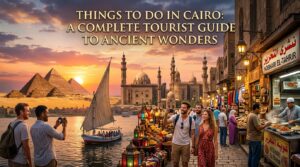
1. Introduction: Why Cairo Belongs on Every Traveller’s Bucket List
When people think of Egypt tourism, the first image is often the pyramids rising from the desert. But Cairo is much more than that. It is a vibrant capital where ancient Egyptian civilisation meets modern city life at every turn. The call to prayer echoes over centuries-old markets, while the Nile River continues to shape daily life just as it has for thousands of years.
For first-time visitors exploring the best things to do in Egypt, Cairo is the ideal starting point. It is home to major UNESCO World Heritage Sites, world-famous pharaoh artefacts, and a rich cultural and food scene that suits every type of traveller.
This Egypt travel guide covers everything from the Giza Pyramids and Great Sphinx of Giza to Nile felucca rides, Islamic Cairo architecture, and the lively Khan el-Khalili bazaar. Whether you have 48 hours or a full 7-day Egypt travel itinerary, Cairo offers an unforgettable introduction to one of the world’s most historic cities.
2. Essential Travel Information Before You Visit
Best Time to Visit Egypt
Egypt is a year-round destination, but the most comfortable period for Egypt sightseeing is October through April, when daytime temperatures range from 15°C to 28°C (59°F to 82°F). Summer months — particularly June through August — are intense, with Cairo regularly exceeding 38°C (100°F). Spring and autumn offer ideal conditions, though October and December bring the largest tourist crowds to major Egypt tourist attractions.
Visiting during Ramadan provides a unique cultural experience — the evenings come alive with communal iftar meals, lantern-lit streets, and a warmth in the city that is hard to replicate. However, some restaurants and sites may have reduced hours, so plan accordingly on your Egypt itinerary.
Visa, Currency & Budget
Most nationalities can obtain an Egyptian e-visa online before travelling or receive a visa on arrival at Cairo International Airport. The currency is the Egyptian Pound (EGP). Egypt remains one of the world’s most affordable Egypt holiday destinations — a full day of Egypt sightseeing, including entry to the Giza Plateau, a local lunch, and transport, can be done comfortably for under $30 USD if you plan ahead. This affordable Egypt travel guide approach means even budget travellers can access the country’s greatest wonders without compromise.
How Long Do You Need?
For a focused Egypt holiday, three days in Cairo allows you to cover the major highlights thoroughly. A full Egypt travel itinerary 7 days gives you the opportunity to explore Cairo in depth, add a day trip to Saqqara, and include either Luxor or the Red Sea coast as an extension. For families, couples, and solo travellers alike, seven days remains the most popular and rewarding timeframe for things to do in Egypt.
3. Getting to Cairo and Getting Around the City
Cairo International Airport (CAI) is Africa’s busiest airport and connects to virtually all major global hubs with direct and connecting flights. Once you arrive, official airport taxis, Uber, Careem, and pre-booked hotel transfers are the safest and most reliable options into the city centre, typically a 30 to 45-minute journey depending on traffic.
Transport Within Cairo
Getting around efficiently is essential for making the most of your Egypt itinerary in Cairo. The following options cover every need and budget:
- Cairo Metro — Fast, air-conditioned, and extremely affordable. Line 2 directly connects central Cairo to the Giza neighbourhood, making it ideal for pyramid-bound travellers.
- Uber and Careem — App-based ridesharing services operate reliably across Cairo. Prices are transparent, drivers are trackable, and it removes the hassle of fare negotiation with street taxis.
- Private Tour Vehicle — For full-day Egypt sightseeing trips to Giza, Saqqara, Dahshur, and the Grand Egyptian Museum, a private driver with a licensed tour guide is the most efficient and enriching option.
- Tuk-Tuks and Walking — Ideal for navigating the narrow medieval alleyways of Islamic Cairo and the Coptic quarter, where cars cannot reach.
4. Pyramids of Giza and the Great Sphinx — The Last Surviving Ancient Wonder
No Egypt travel guide — and no Egypt itinerary of any length — is complete without an extended visit to the Giza Plateau. The pyramids of Giza are the most recognisable structures on Earth and the cornerstone of ancient Egyptian civilisation. They are the sole surviving monument among the original Seven Wonders of the Ancient World, and standing at their base for the first time is one of those rare travel experiences that genuinely lives up to its reputation.
The Three Great Pyramids
The Giza complex contains three main pyramids, each constructed for a different pharaoh of the Old Kingdom and each offering a distinct experience for visitors:
- The Great Pyramid of Khufu (Cheops) — Built around 2560 BCE, it stands 138.5 metres tall and held the record as the world’s tallest man-made structure for nearly 4,000 years. Visitors can enter the interior chambers, though the ascending passages are narrow and the experience is physically demanding. The view from inside — knowing you are within a structure built without modern machinery — is extraordinary.
- The Pyramid of Khafre — Slightly smaller than Khufu’s but appearing taller due to its elevated position on the plateau. The original limestone casing stones are still visible near the apex, offering a glimpse of how all three pyramids looked when newly completed — gleaming white against the desert sky.
- The Pyramid of Menkaure — The smallest of the three, standing at approximately 65 metres. It is often less crowded than the others, making it ideal for a quieter and more contemplative visit.
The Great Sphinx of Giza
Carved directly from a single ridge of natural limestone, the Great Sphinx of Giza is one of the most recognised sculptures in human history. It stands 20 metres tall and stretches 73 metres in length, with the face most likely modelled on Pharaoh Khafre. Dating to approximately 2500 BCE, it guards the eastern approach to the Giza necropolis. The mystery surrounding its precise age, original appearance, and intended symbolic role continues to fascinate Egyptologists and travellers alike.
Pro Tip: Arrive at the Giza Plateau at 8:00 AM when the gates open. Early morning visits offer the thinnest crowds, the best photographic light, and the coolest temperatures. Bring sun protection, plenty of water, and comfortable walking shoes.
5. Grand Egyptian Museum — The World’s Largest Archaeological Museum
The Grand Egyptian Museum (GEM), located near the Giza Plateau, is one of the most significant cultural openings of the 21st century and a must-visit on any list of Egypt tourist attractions. Purpose-built to house Egypt’s complete archaeological collection — over 100,000 artefacts — in a single world-class facility, GEM represents the most comprehensive display of ancient Egyptian civilisation ever assembled in one place.
The undisputed centrepiece is the complete treasure of Tutankhamun, the boy pharaoh whose intact tomb was discovered by Howard Carter in the Valley of the Kings in 1922. For the first time in history, all 5,000-plus objects from the tomb — including the legendary gold funerary mask, his ceremonial throne, chariots, jewellery, ritual items, and canopic jars — are displayed together in a dedicated gallery sequence. For anyone with a serious interest in pharaoh history and ancient Egyptian civilisation, this alone justifies the entire trip to Cairo.
- The Grand Atrium — An immense glass and steel entrance hall featuring a 12-metre tall statue of Ramesses II as its centrepiece, setting the tone for what lies ahead.
- Tutankhamun Galleries — A multi-room sequence housing every object from the most famous tomb in Egyptological history, presented chronologically with detailed context.
- Children’s Museum and Educational Zones — Thoughtfully designed interactive areas that make GEM one of the most family-friendly things to do in Egypt for visitors of all ages.
- The Exterior Walkway — A 500-metre long pathway lined with sphinx statues and featuring an authentic hanging obelisk leads visitors from the entrance to the main building.
Visitor Tip: Pre-book tickets online. Allow a minimum of 4 to 5 hours. An audio guide or licensed Egyptologist guide transforms the experience from a visual walk-through into a genuinely educational journey through 3,000 years of Egyptian history.
6. Egyptian Museum at Tahrir Square — Cairo’s Original Cultural Landmark
While the Grand Egyptian Museum has assumed the headline role for international visitors, the original Egyptian Museum in Tahrir Square remains a deeply rewarding Cairo tourist attraction and an essential stop for anyone serious about pharaoh history. Opened in 1902 and housing over 120,000 artefacts across 107 halls, it is one of the world’s great repositories of ancient objects.
The Royal Mummy Hall is the museum’s most powerful and humbling experience. It contains the preserved remains of some of Egypt’s most powerful and celebrated rulers, including Ramesses II, Seti I, Thutmose III, and Hatshepsut. Standing metres away from the actual physical remains of rulers who shaped the ancient world is an experience unlike anything else available in Egypt tourism. Tahrir Square itself, historically significant as the epicentre of Egypt’s 2011 revolution, surrounds the museum and is worth taking in as a piece of modern Egyptian history alongside the ancient artefacts within.
7. Islamic Cairo — The Medieval Soul of the City
If the pyramids represent ancient Egyptian civilisation in its most monumental form, Islamic Cairo represents something equally extraordinary: a medieval urban environment that has survived almost intact for over a thousand years. Designated a UNESCO World Heritage Site, this district showcases centuries of extraordinary Islamic Cairo architecture and remains one of the most atmospheric and culturally rich places to visit in Egypt.
Walking the narrow, stone-paved streets of Islamic Cairo — past copper workshops and spice merchants, beneath elaborately carved mashrabiyya window screens, within earshot of the muezzin’s call from a dozen different minarets — is an immersive experience that no museum can replicate.
Al-Azhar Mosque and University
Founded in 970 CE, Al-Azhar is not only one of Cairo’s most beautiful mosques but also one of the oldest continuously operating universities in the world. It remains the leading centre of Sunni Islamic scholarship globally, drawing students from across the Muslim world. The tranquil central courtyard offers a welcome space for quiet reflection amid the surrounding city energy. Non-Muslim visitors are welcome outside of prayer times.
Sultan Hassan Mosque
Built between 1356 and 1363 CE during the Mamluk sultanate, the Sultan Hassan Mosque is widely regarded as one of the finest examples of medieval Islamic architecture anywhere in the world. Its entrance portal stands over 37 metres tall — taller than many European cathedrals. The interior contains four iwans (vaulted halls) representing the four main schools of Sunni Islamic jurisprudence, and the craftsmanship of its carved marble, geometric tilework, and bronze-fitted doors is breathtaking.
Ibn Tulun Mosque
The oldest and largest mosque in Cairo, Ibn Tulun was constructed between 876 and 879 CE and survives in virtually its original form — a remarkable achievement for a structure well over a thousand years old. Its distinctive spiral minaret, unique in Egypt and inspired by the Great Mosque of Samarra in Iraq, is one of the most photographed elements of Islamic Cairo architecture. The vast courtyard, nearly four hectares in area, conveys a powerful sense of spiritual space and historical continuity.
Al-Muizz Street — A UNESCO-Listed Living Museum
Running through the heart of Islamic Cairo, Al-Muizz Street is one of the most architecturally significant streets in the Islamic world. Lined with Fatimid, Mamluk, and Ottoman monuments from the 10th through 18th centuries, it offers a compressed journey through a thousand years of Cairo’s urban history. Walking it at night, when the medieval buildings are dramatically illuminated and the daytime crowds have thinned, is one of the most atmospheric Egypt sightseeing experiences available to any visitor.
8. Khan el-Khalili Bazaar — Cairo’s Legendary Marketplace
Trading continuously since the 14th century, Khan el-Khalili is one of the oldest and most storied souqs (markets) in the Arab world. For visitors building a list of things to do in Cairo Egypt, it is both a cultural landmark and an unmissable sensory experience. The bazaar sprawls through a labyrinth of alleyways — each historically dedicated to a specific trade — and the atmosphere is as much about the sights, sounds, and smells as it is about the shopping.
Gold and silver jewellery, hand-blown glass lanterns in jewel colours, papyrus artwork, leather goods, hand-woven textiles, spices, essential oils, and handcrafted copper and brass items fill the stalls and workshops. Bargaining is not just accepted — it is an expected and enjoyable part of the cultural exchange between buyer and seller.
El-Fishawi Coffee House
Pause your shopping at El-Fishawi, a legendary coffee house that has been open almost continuously since 1773. It is the place where Nobel Prize-winning Egyptian novelist Naguib Mahfouz spent years writing, observing, and thinking. Order a glass of hot mint tea or a traditional ahwa (Egyptian coffee), find a table among the antique mirrors and hanging lanterns, and watch the bazaar pulse around you. It is one of the most iconic and genuinely relaxing experiences Cairo has to offer.
Shopping Tip: For papyrus artwork, always purchase from established shops and ask the vendor to demonstrate the flexibility test — real papyrus bends without cracking, while banana-leaf imitations (sold widely by street vendors) are brittle and fade quickly. Budget two to three hours minimum for a thorough Khan el-Khalili exploration.
9. Coptic Cairo — Egypt’s Early Christian Heritage
Long before the Arab conquest of the 7th century CE, Egypt was one of the most important centres of early Christianity in the world, and the Coptic Church of Egypt is among the oldest Christian communities on Earth. The Coptic Cairo neighbourhood, located in the historic southern part of the city, preserves the most significant remnants of this era in a compact, walkable, and remarkably peaceful district.
- The Hanging Church (Al-Muallaqah) — One of Egypt’s oldest and most beloved churches, built suspended above the gatehouse towers of a Roman-era fortress. Its magnificent wooden roof, carved ivory inlay screens, and collection of Coptic icons make it both a place of active worship and a living museum of early Christian art.
- Coptic Museum — Houses the world’s largest and most comprehensive collection of Coptic Christian art and artefacts, including illuminated manuscripts, textiles, painted icons, and intricately carved stonework spanning the 1st through 13th centuries.
- Ben Ezra Synagogue — A beautifully restored 9th-century synagogue traditionally believed to mark the site where the infant Moses was found among the reeds of the Nile, and where the Holy Family sought refuge during their flight into Egypt.
- Church of St. Sergius and Bacchus — One of Egypt’s oldest churches, built above a crypt revered in Coptic tradition as the resting place of the Holy Family during their sojourn in Egypt.
10. The Cairo Citadel — History, Architecture and Panoramic Views
Perched dramatically on the rocky promontory of the Muqattam Hills, the Cairo Citadel (Qal’at Salah el-Din) is one of the great medieval fortifications of the Islamic world and a landmark on every Egypt holiday destination map. Construction was ordered by the celebrated military commander Saladin beginning in 1176 CE, primarily to defend Cairo and its surrounding region against Crusader incursions from the north. For nearly 700 years after its completion, the Citadel served as the seat of Egyptian government.
Mohamed Ali Mosque
The most dominant landmark within the Citadel complex is the Mosque of Mohamed Ali, an Ottoman-style structure completed in 1848 and clad throughout in fine alabaster stone quarried from Beni Suef. Its twin pencil minarets and central dome dominate Cairo’s skyline and are visible from virtually any elevated point in the city. The interior is equally impressive, featuring a massive central dome, elaborate brass chandeliers, and a serene, light-filled atmosphere. The terrace in front of the mosque offers what many consider the finest panoramic view in Cairo — stretching across the city’s rooftops, minarets, and the Nile, to the Giza Plateau and pyramids on the distant western horizon.
11. Saqqara and Dahshur — Egypt’s Other Pyramid Fields
For travellers interested in the full arc of ancient Egyptian pyramid architecture — and for those seeking Egypt historical places to visit away from the concentrated crowds of Giza — Saqqara and Dahshur are essential and deeply rewarding additions to any Egypt itinerary.
Saqqara
Located 30 kilometres south of Cairo, Saqqara is the site of Egypt’s oldest pyramid and one of the most historically significant archaeological sites in the world. The Step Pyramid of Djoser, constructed around 2650 BCE under the genius architect Imhotep, is the world’s oldest large-scale stone construction and the direct architectural ancestor of every pyramid that followed. The surrounding necropolis contains dozens of mastaba tombs with extraordinarily well-preserved painted reliefs depicting scenes of daily life, hunting, agriculture, and ritual in ancient Egypt — painted in vivid colours that still glow after more than four thousand years.
Dahshur
Dahshur, a short drive further south from Saqqara, contains two of Egypt’s most architecturally fascinating pyramids. The Bent Pyramid — so named because its angle changes midway up the structure, suggesting the builders altered their plans mid-construction — is one of the most unusual monuments in Egypt. The Red Pyramid nearby is Egypt’s first true geometrically smooth-sided pyramid, built immediately after the Bent Pyramid and representing the direct predecessor of Khufu’s Great Pyramid at Giza. Both sites are considerably less visited than Giza, making them ideal for a quieter, more immersive Egypt sightseeing experience.
12. Nile River Experiences — Cruises, Feluccas and the Waterfront
The Nile River is not simply a backdrop to Cairo — it is the pulse of the city, the reason Cairo exists where it does, and the source of the agricultural abundance that sustained ancient Egyptian civilisation for three thousand years. Experiencing the Nile River from the water is one of the most memorable things to do in Egypt, and it does not need to be an expensive undertaking.
- Sunset Felucca Ride — A felucca is a traditional wooden Egyptian sailboat, and an hour or two on the Nile at sunset is the most romantic and unhurried way to experience Cairo’s riverfront. Feluccas depart from multiple points along the Corniche and the price is negotiable directly with the captain.
- Nile Dinner Cruise — A popular evening activity combining a two-hour river journey with dinner, live Egyptian music, and a Whirling Dervish or belly dancing performance. Numerous operators offer this experience at varying price points.
- Mamsha Ahl Misr Promenade — A modern riverfront pedestrian promenade along the eastern bank of the Nile, lined with cafes, restaurants, and family-friendly open spaces. Excellent for an evening walk with views of the illuminated bridges and opposite bank.
- Multi-Day Nile Cruise from Luxor to Aswan — For travellers extending beyond Cairo, a traditional Nile cruise Egypt experience sailing between Luxor and Aswan allows access to the Valley of the Kings, Luxor Temple, Edfu, and the Philae Temple complex — a comprehensive journey through the heartland of ancient Egyptian civilisation.
13. Cairo Tower — 360-Degree Views over the City
For a completely different perspective on Cairo — one that puts the entire city and its geography into visual context — the Cairo Tower (Burj al-Qahira) on Gezira Island is an easy and rewarding addition to any Egypt itinerary. Rising 187 metres above the surface of the Nile, its observation deck offers a sweeping 360-degree panorama that simultaneously shows the Giza Plateau and its pyramids to the west, Islamic Cairo’s dense forest of minarets to the east, the full silver ribbon of the Nile stretching north and south, and the vast urban sprawl of the world’s largest African city extending in every direction. At sunrise or during the golden hour before sunset, the photographic opportunities are exceptional and genuinely hard to replicate from ground level.
14. Egyptian Food and Cuisine — What to Eat in Cairo
Egyptian cuisine is among the oldest and most underrated in the Middle East, rooted in the same fertile agricultural traditions that fed the builders of the pyramids and sustained one of history’s most enduring civilisations. Eating your way through Cairo is one of the great pleasures of any Egypt holiday.
Essential Dishes to Try
- Koshary — Egypt’s beloved national street food: a deeply satisfying layered combination of rice, lentils, pasta, fried onions, and spiced tomato sauce, finished with a dash of garlic vinegar. Cheap, filling, and available at dedicated koshary restaurants across Cairo.
- Ful Medames — Slow-cooked fava beans dressed with olive oil, lemon juice, and cumin, served alongside warm baladi flatbread. The quintessential Egyptian breakfast, eaten by millions every morning.
- Ta’ameya — Egypt’s distinctive version of falafel, made with fava beans rather than chickpeas. The result is lighter, greener, and more delicate in flavour than its Lebanese counterpart.
- Mahshi — Vegetables — courgette, aubergine, sweet peppers, grape leaves — stuffed with seasoned rice, herbs, and occasionally minced meat. A cornerstone of Egyptian home cooking and a dish that varies beautifully from family to family.
- Feteer Meshaltet — A flaky, multi-layered Egyptian pastry available in sweet versions (with honey, jam, or Nutella) or savoury versions (with cheese, minced meat, or eggs). A Cairo street food essential.
- Om Ali — Egypt’s rich and deeply comforting bread pudding, baked with cream, nuts, coconut, and raisins. The most beloved traditional Egyptian dessert.
Drink Tip: Fresh sugarcane juice (asab) from street vendors is refreshing, cheap, and quintessentially Egyptian. Also seek out karkade (hibiscus tea served hot or iced) and traditional ahwa (Egyptian coffee), which is thick, unfiltered, and often lightly spiced with cardamom.
15. Cairo at Night — Evening Experiences and Nightlife
Cairo after dark has a character entirely its own. The heat of the day softens, the energy of the streets shifts from commercial bustle to social warmth, and several of the city’s most memorable experiences become available only after sunset.
- Walk Al-Muizz Street at Night — The medieval street is dramatically illuminated after dark, significantly less crowded than during daytime hours, and genuinely atmospheric in a way that few places on Earth can match. This is arguably the single best free experience available in Cairo.
- Whirling Dervish Show (Sufi Sema Performance) — Held regularly at the Al-Ghouri Cultural Centre in Islamic Cairo, these Sufi devotional performances are free to attend, begin in the early evening, and are a genuinely moving and culturally rich experience that many visitors cite as a highlight of their entire Egypt holiday.
- Cairo Opera House — Located on Gezira Island in the Nile, the Opera House hosts international and Egyptian performing arts, ballet, orchestral concerts, and theatrical productions throughout the year. An evening here offers a window into contemporary Egyptian cultural life.
- Rooftop Cafes and Shisha Bars — Cairo has a thriving rooftop culture, particularly in the Zamalek and Downtown districts, offering spectacular views of the city and Nile alongside shisha, Egyptian mezze, and live music on select evenings.
16. Day Trips from Cairo — Expanding Your Egypt Itinerary
Cairo’s central position within Egypt makes it an outstanding base for extending your Egypt travel itinerary to some of the country’s most significant Egypt historical places to visit. The following are the most rewarding and practical options:
Alexandria — Egypt’s Mediterranean City (2.5–3 Hours)
Founded by Alexander the Great in 331 BCE and once one of the most intellectually vibrant cities in the ancient world, Alexandria offers a profoundly different atmosphere to Cairo. Key Egypt tourist attractions include the Catacombs of Kom el-Shoqafa (a remarkable Roman-era underground necropolis blending Egyptian, Greek, and Roman funerary traditions), the Qaitbay Citadel (built on the precise site of the ancient Lighthouse of Alexandria, one of the original Seven Wonders), and the magnificent Bibliotheca Alexandrina — a 21st-century tribute to the ancient Library of Alexandria housing millions of volumes and hosting regular cultural exhibitions.
Luxor — The Valley of Kings and Egypt’s Temple City
Luxor is Egypt’s second great cultural destination and belongs on any serious Egypt travel itinerary. The Valley of the Kings — carved into the limestone cliffs of the West Bank — contains over 60 royal tombs, including the intact tomb of Tutankhamun discovered by Howard Carter in 1922. Karnak Temple, the largest religious complex ever constructed in the ancient world, covers over 100 hectares of magnificent columns, obelisks, and sanctuary halls. Luxor Temple, illuminated dramatically at night and set directly on the banks of the Nile, is one of the most beautiful things to see in Egypt. Most visitors combine Luxor with a Nile River cruise Egypt itinerary sailing south to Aswan.
White Desert — Overnight Desert Safari Egypt
Southwest of Cairo lies one of the most surreal landscapes on Earth: the White Desert, where millennia of wind erosion have sculpted chalk-white rock formations into extraordinary organic shapes — towering mushrooms, inselbergs, and abstract sculptures scattered across a brilliantly white plain. An overnight desert safari Egypt experience in the White Desert — arriving at sunset, cooking over an open fire, sleeping under a sky unpolluted by city light, and waking before dawn to watch the formations glow amber and pink — is widely cited by travellers as the single most memorable experience of their entire Egypt holiday.
17. Red Sea Resorts — Beaches, Diving and Family Activities
For travellers extending their Egypt itinerary beyond the historical sites, Egypt’s Red Sea coast offers world-class beach and water sport experiences that represent some of the most family-friendly things to do in Egypt. Hurghada (approximately 6 hours from Cairo by road, 1 hour by air) and Sharm el-Sheikh are the two principal Red Sea resorts in Egypt’s tourism landscape.
Red Sea diving Egypt is globally celebrated among the diving community. The reefs are among the healthiest and most biodiverse in the world, offering underwater visibility of up to 30 metres and encounters with reef sharks, manta rays, sea turtles, barracuda, and spectacular coral gardens. Even travellers who do not dive can enjoy outstanding snorkelling directly from the beach at many resort locations. The calm, warm, clear waters also make these resorts among the most popular family-friendly things to do in Egypt for visitors travelling with young children.
18. Practical Tips for First-Time Visitors to Cairo
Dress Code and Cultural Respect
Egypt is a predominantly Muslim country, and dressing modestly shows genuine cultural respect and simplifies entry to mosques and religious sites. For both men and women, covered shoulders and knees are the appropriate standard when visiting Islamic sites. Women will typically be offered a headscarf at mosque entrances if they are not already wearing one. In tourist areas and modern neighbourhoods such as Zamalek, dress codes are more relaxed, but modesty remains the courteous choice throughout the city.
Tipping Culture — Understanding Baksheesh
Tipping (known as baksheesh) is deeply embedded in Egyptian culture and forms an important part of the income for many workers in the service and tourism industries. Budget a supply of small denomination local currency notes for washroom attendants, informal site assistants, and guards who open special areas or allow photography. Restaurant tipping of 10 to 15 percent is standard. Being generous in this regard enriches your interactions considerably and is appreciated warmly.
Staying Safe and Avoiding Common Scams
- Always agree on taxi fares before entering the vehicle, or use Uber and Careem for transparent metered pricing.
- Persistent offers of free tours, free camel rides, or free gifts near the Giza Plateau are never genuinely free. Establish all fees clearly and in advance.
- Purchase papyrus artwork only from established shops — street vendors almost invariably sell low-quality banana-leaf imitations that fade and crack within months.
- Hire licensed guides through your hotel, a reputable tour operator, or the official guide association at each site. Unlicensed guides near popular attractions vary enormously in quality and reliability.
Health and Practical Considerations
- Drink bottled water throughout your visit. Tap water in Cairo is not recommended for travellers not accustomed to it.
- Apply high-factor sun protection and carry it with you at all times when visiting outdoor sites such as the Giza Plateau, Saqqara, and the Cairo Citadel.
- Carry cash in Egyptian Pounds for markets, street food, tipping, and smaller attractions. ATMs are widely available in central Cairo and at the airport.
19. Sample Egypt Travel Itineraries — 2 Days to 7 Days
Cairo in 2 Days — The Essential Highlights
- Day 1: Giza Plateau (Great Pyramids of Giza, Great Sphinx of Giza, Solar Boat Museum), afternoon at the Grand Egyptian Museum.
- Day 2: Islamic Cairo (Al-Azhar Mosque, Sultan Hassan Mosque, Al-Muizz Street), Khan el-Khalili bazaar, evening sunset felucca ride on the Nile.
Egypt Travel Itinerary — 7 Days
- Days 1–2: Cairo — Giza Plateau, Grand Egyptian Museum, Egyptian Museum at Tahrir Square.
- Day 3: Islamic Cairo, Coptic Cairo, Cairo Citadel, evening at Khan el-Khalili.
- Day 4: Day trip to Saqqara and Dahshur pyramid fields.
- Days 5–6: Fly or take the overnight train to Luxor — Valley of the Kings, Luxor Temple, Karnak Temple, Nile River cruise.
- Day 7: Return to Cairo or extend to Hurghada for Red Sea diving and beach activities.
Affordable Egypt Travel Guide Tip: Book the overnight train between Cairo and Luxor for the most affordable and memorable option. First class sleeper carriages are comfortable and the journey through the Egyptian countryside saves a night’s hotel cost. Book through Egyptian National Railways or via a local Cairo travel agent.
20. Conclusion: Is Cairo Worth Visiting in 2026?
The answer is a clear yes. Cairo remains one of the world’s most remarkable travel destinations, where ancient history and modern life exist side by side.
In 2026, the city will be more accessible and better prepared for international visitors than ever before. The opening of the Grand Egyptian Museum has added a world-class cultural highlight, while ongoing improvements in transport and tourist areas have made sightseeing smoother and more comfortable.
From the Giza Plateau and Islamic Cairo to its vibrant food scene and historic landmarks, Cairo offers something for every type of traveller — whether you’re interested in history, photography, culture, or family experiences.
With a well-planned Egypt itinerary and an open mind, Cairo delivers an unforgettable journey into the heart of ancient Egyptian civilization, and it’s a place many visitors are eager to return to again.
Frequently Asked Questions
Q1. What are the best things to do in Cairo for first-time visitors?
Visit the Giza Pyramids & Sphinx, Grand Egyptian Museum, Islamic Cairo (Al-Muizz Street), Khan el-Khalili bazaar, and take a Nile felucca ride.
Q2. How many days do I need in Cairo?
3 days is minimum for main sights. 5–7 days is ideal for deeper exploration and day trips.
Q3. Is Cairo safe for tourists in 2026?
Yes, generally safe in tourist areas. Just be aware of petty scams and use trusted guides and transport.
Q4. What is the best time to visit Egypt?
October to April is best due to mild, comfortable weather. Summer is very hot.
Q5. How much does it cost to visit the Pyramids of Giza?
Around $15–$20 USD for entry. Extra fees apply for pyramid interiors and guides.
Q6. Is the Grand Egyptian Museum worth visiting?
Yes, it’s one of the world’s top museums, especially for the Tutankhamun collection. Plan 4–5 hours.
Q7. What is the best 7-day Egypt itinerary?
3 days Cairo, 1 day Saqqara/Dahshur, 2 days Luxor, and optional Red Sea or return to Cairo.
Q8. Can I do a Nile cruise from Cairo?
Short Nile cruises are available in Cairo, but main multi-day cruises run between Luxor and Aswan.
Q9. What should I wear in Cairo?
Modest, lightweight clothing. Shoulders and knees covered for religious sites.
Q10. What are the best family-friendly things to do in Egypt?
Grand Egyptian Museum, Giza camel rides, Red Sea resorts, and Nile cruises are ideal for families.