Travel Route Hub

Discover the Best of Morocco

From Marrakech’s souks and Fez’s ancient medina to Chefchaouen’s blue streets and Sahara Desert nights under the stars, this Morocco travel guide packs imperial cities, mountains, coast, and desert into one extraordinary trip.

POPULAR TOURIST PLACES IN MOROCCO

WHY VISIT MOROCCO

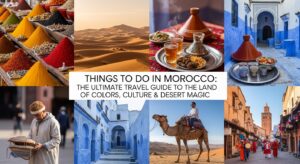
Morocco compresses an unusual range of landscapes and cultures into a genuinely compact, well-connected country — exactly what makes things to do in Morocco such a broad, rewarding search to begin with. A proper Marrakech travel guide starts at the classic entry point — the Red City’s Jemaa el-Fnaa square, Jardin Majorelle, and labyrinthine souks make it Morocco’s most sensory-heavy stop. A Fez Morocco travel guide covers the oldest of the country’s four imperial cities, trading Marrakech’s energy for a thousand-year-old medina built around the world’s oldest continuously operating university, with the Chouara Tanneries as its most photographed sight. North in the Rif Mountains, Chefchaouen blue city offers something calmer, while an Essaouira Morocco travel guide points you to the Atlantic coast’s UNESCO-listed ramparts and some of the world’s best kitesurfing conditions. Further east, a well-planned Sahara Desert tour Morocco through the golden dunes of Merzouga delivers camel treks and desert camps under skies with almost no light pollution. A fast, comfortable train network (ONCF, including the high-speed Al Boraq line) connects most of these directly, so a 7 to 10 day loop through imperial cities, mountains, coast, and desert rarely feels rushed.

Six essential experiences

Marrakech's Medina & Jemaa el-Fnaa

The legendary central square transforms from daytime market to open-air night festival paired with the souks, Bahia Palace, and Jardin Majorelle's cobalt-blue gardens. The heart of any Jemaa el-Fnaa Marrakech visit.

Fez's Ancient Medina & Tanneries

The world's largest car-free urban area, home to over 9,000 narrow streets and the centuries-old Fez tanneries, best viewed from a rooftop leather shop.

Chefchaouen's Blue City

Every wall, staircase, and alley painted in shades of blue, framed by the Rif Mountains the Spanish Mosque viewpoint is best at sunset.

Sahara Desert Camp, Merzouga

A camel trek into the Erg Chebbi dunes at sunset, followed by a night at a Merzouga desert camp under some of the clearest stargazing skies anywhere.

Essaouira's Ramparts & Coast

UNESCO-listed sea ramparts, a working fishing port for fresh-grilled seafood, and one of the world's premier kitesurfing beaches.

Hassan II Mosque, Casablanca

One of the largest mosques in the world, built partially over the Atlantic Ocean the Hassan II Mosque Casablanca is one of the few mosques in Morocco open to non-Muslim visitors, and a highlight for anyone researching Casablanca things to do.

Practical details

Plan your visit

Best time to visit

March to May and September to November offer the most comfortable temperatures across most of Morocco, the best time to visit Morocco whether you’re headed to the imperial cities or the mountains. Summer (June–August) is hot inland, especially in Marrakech and Fez, though the Atlantic coast (Essaouira, Agadir) stays cooler. The Sahara and Merzouga are best visited October to April, avoiding the extreme desert summer heat.

Getting around

Morocco’s ONCF train travel network connects Casablanca, Rabat, Meknes, Fez, Tangier, and Marrakech efficiently, with the high-speed Al Boraq line linking Tangier to Casablanca in just over two hours. CTM buses cover routes not served by rail; for the south and Sahara, a rental car or organized tour is the standard option. A Rabat Morocco travel guide or Tangier Morocco travel guide is worth adding to your research too, since both cities sit directly on this rail line and make easy add-ons to a Marrakech or Fez-based trip.

Where to stay

Riads in Marrakech traditional courtyard guesthouses inside the medina are the classic choice, along with similar options in Fez and Chefchaouen, ranging from budget-friendly to genuinely luxurious. In Merzouga, desert camp packages typically bundle camel trek, accommodation, and meals together. An Agadir Morocco travel guide points beach-focused travelers toward Essaouira and Agadir for a coastal, resort-style stay instead.

Continue exploring

Good to know

Frequently asked questions

Morocco is best known for its ancient medinas and souks, the blue city of Chefchaouen, the Sahara Desert, the Atlas Mountains, and its distinctive cuisine and handicraft traditions.


Most international visitors fly into Marrakech Menara Airport or Casablanca’s Mohammed V Airport. Most Western passport holders (EU, US, UK, Canada, Australia) can enter visa-free for up to 90 days.


Seven days covers a core imperial city circuit (Marrakech, Fez, Chefchaouen). Ten days allows a Sahara or coastal add-on; two weeks gives a fuller loop combining imperial cities, desert, and coast.


March to May or September to November, when temperatures are comfortable for both the cities and the mountains, and before or after the extreme summer heat.


Marrakech and Fez’s medinas draw heavy crowds and persistent touts in peak season. Rabat, Meknes, and Chefchaouen stay noticeably calmer for travelers wanting a less pressured pace.