
1. Introduction: What Is Aswan Famous For and Why Visit?
Aswan is Egypt’s southernmost major city and one of the most quietly extraordinary destinations in the entire country. Positioned on the east bank of the Nile River at the first cataract — the ancient natural boundary between Egypt proper and the land of Nubia to the south — Aswan has served as a strategic gateway, a trading crossroads, and a spiritual and cultural centre for over five thousand years. It is a city of extraordinary beauty: the Nile here is at its narrowest and most dramatic, compressed between golden granite boulders and emerald islands before spreading into the calm blue expanse of Lake Nasser behind the Aswan High Dam.
What is Aswan famous for? The list is remarkable in its range and depth. It is famous for the Philae Temple — an ancient Egyptian temple dedicated to the goddess Isis, relocated to its island setting in one of the greatest archaeological rescue operations in history. It is famous for Abu Simbel, the two colossal rock-cut temples of Ramesses II that were physically moved to save them from the rising waters of Lake Nasser — a feat of 20th-century engineering almost as astonishing as the ancient achievement they preserved. It is famous for the Aswan High Dam, one of the largest engineering projects of the 20th century, which transformed Egypt’s agriculture and electricity supply but also submerged an entire ancient landscape beneath the waters of Africa’s largest artificial lake.
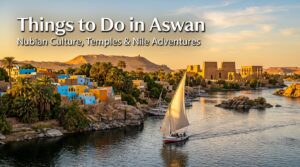
But above all, and perhaps most distinctively, Aswan is famous for its Nubian culture and heritage — the living culture of the Nubian people, one of Africa’s oldest and most artistically vibrant civilisations, whose colourful villages, extraordinary music, distinctive cuisine, and centuries-deep traditions of hospitality give Aswan a warmth and character that sets it apart from every other destination in Egyptian tourism. The traditional Nubian villages along the Nile banks, with their brightly painted houses decorated with crocodile motifs and geometric patterns, their women in brilliantly coloured robes, and their legendary generosity toward visitors, are one of the most genuinely moving cultural experiences available anywhere along the Nile River.
This complete Aswan Egypt travel guide covers every major Aswan attraction — from the ancient Egyptian temples in Aswan and the magnificent Unfinished Obelisk to the felucca ride Aswan experience on the Nile at sunset, from the Nubian Museum and Elephantine Island to the extraordinary day trip to Abu Simbel from Aswan. Whether you have one day or four, this guide ensures you experience everything that makes Aswan one of Egypt’s most irreplaceable and emotionally resonant destinations.
2. Essential Travel Information Before You Visit Aswan
Best Time to Visit Aswan Egypt
The best time to visit Aswan Egypt is between October and April, when daytime temperatures range from 22°C to 32°C (72°F to 90°F) and the conditions for outdoor sightseeing, felucca rides, and temple visits are genuinely comfortable. Aswan is one of the hottest and driest cities in the world — it receives almost no rainfall and summer temperatures between June and August regularly exceed 42°C to 46°C, making sustained outdoor sightseeing extremely demanding. Aswan’s winter months — November through February — are particularly pleasant, with warm sunny days, cool evenings, and the city at its most lively as domestic and international visitors fill the Corniche.
January and February are the peak months for Nile cruise Aswan itineraries, when the river temperature and surrounding landscape are at their most beautiful and the majority of international visitors combine Aswan with Luxor on organised cruise packages. The Abu Simbel Sun Festival — when the rising sun illuminates the innermost sanctuary of the Great Temple of Ramesses II — occurs on 22 February and 22 October each year, drawing significant additional visitors to Abu Simbel on those two specific dates.
Visa, Currency and Budget Overview
Most nationalities require an Egyptian e-visa, obtainable online before travel or on arrival at Aswan Airport or Cairo International Airport. The currency is the Egyptian Pound (EGP). Aswan is generally slightly more affordable than Cairo for accommodation and dining, though entry fees to the major monuments — particularly the Abu Simbel Temples — are significant. Budget approximately $25 to $35 USD for the Philae Temple boat and entry, $50 to $80 USD for the Abu Simbel day trip including transport, and $5 to $10 USD each for the Unfinished Obelisk and Aswan High Dam. Overall daily budget for a comfortable visit to Aswan, including accommodation, meals, transport, and site entry, ranges from $70 to $150 USD per person depending on travel style.
How Many Days Should I Spend in Aswan?
Two full days in Aswan covers the principal Aswan attractions comfortably: one day for the major temples, dam, and obelisk, and one day for the Nubian cultural experiences — Elephantine Island, Nubian Village, felucca ride, and the Nubian Museum. Three days allows for the Abu Simbel day trip (which in itself requires a full day) plus a relaxed exploration of the city’s markets, scenic spots, and Nile experiences. Four days gives serious travellers the opportunity to add day trips to Kom Ombo and Edfu and fully absorb the extraordinary atmosphere that Aswan — perhaps more than any other city in Egypt — rewards slow, unhurried exploration.
3. Getting to Aswan and Getting Around the City
Getting to Aswan
Aswan is well connected to the rest of Egypt and accessible by several comfortable transport options:
- Domestic Flight — The fastest option from Cairo, with multiple daily flights operated by EgyptAir and other carriers to Aswan International Airport. The journey takes approximately 1.5 hours. This is the most practical option for visitors combining Aswan with Cairo on a limited itinerary.
- Overnight Sleeper Train — The overnight train from Cairo Ramses Station to Aswan is one of Egypt’s most popular and atmospheric travel experiences. The journey takes approximately 12 to 14 hours, arriving in Aswan in the morning and saving a night’s hotel cost. First-class sleeper cabins are comfortable and include meals.
- Nile Cruise — The most immersive and luxurious option. Multi-day Nile cruises between Luxor and Aswan — the classic four or seven-night package — follow the river past Edfu, Esna, and Kom Ombo before arriving in Aswan. This format combines sightseeing with travel in the most elegant way possible and is one of the great travel experiences in Egypt adventure travel.
- From Luxor by Train or Bus — Regular daytime trains and bus services connect Luxor and Aswan in approximately three to four hours, making Aswan easily accessible as an extension of a Luxor visit.
Getting Around Aswan
Within Aswan, the principal transport options are taxis (negotiate fare in advance), Uber, and the public motor ferry between the Corniche and Elephantine Island. Private motorboats are the standard transport to the Philae Temple island and can be hired from the boat landing near the Old Dam. Bicycles are available for hire and are an excellent way to explore the Corniche, the area around the Unfinished Obelisk, and the quieter streets south of the city. For the Nubian Village, felucca sailing is the most atmospheric approach. For Abu Simbel, organised day tour coaches or private car hire from the city centre are the standard options.
4. Philae Temple — The Jewel of the Nile
The Philae Temple is the crown jewel of Aswan tourism and one of the most hauntingly beautiful and historically poignant ancient Egyptian temples in existence. Dedicated to the goddess Isis — the great mother goddess of Egyptian mythology, patroness of magic, healing, and resurrection — the Philae Temple was the last functioning ancient Egyptian temple in the world, with worship continuing at the site until at least 550 CE, centuries after the rest of Egypt had converted to Christianity. The temple’s longevity as a centre of Isis worship made it one of the most important religious sites in the ancient Mediterranean world, attracting pilgrims from across Egypt, Greece, Rome, and the broader Hellenistic world.
The Philae Temple’s current location on Agilkia Island — carefully manicured to recreate the original island’s topography — is the result of one of the most ambitious archaeological rescue operations in human history. When the construction of the Aswan High Dam in the 1960s threatened to permanently submerge the original Philae Island beneath the waters of Lake Nasser, UNESCO coordinated an international effort to dismantle the entire temple complex stone by stone, move it to the higher ground of the neighbouring Agilkia Island, and reassemble it with meticulous precision. Between 1972 and 1980, approximately 40,000 blocks of stone were transported, catalogued, and rebuilt — a feat that preserved this extraordinary monument for all future generations.
Access to the Philae Temple is by motorboat from the landing at Shellal, just south of the Aswan Low Dam. The boat journey across the reservoir — past partially submerged granite boulders and smaller temples emerging from the water — is itself a dramatically beautiful introduction to what lies ahead. The temple complex on Agilkia Island includes the main Temple of Isis, the smaller Temple of Hathor, the elegant Kiosk of Trajan (one of the most graceful pieces of pharaonic architecture surviving from the Roman period), and a long colonnaded entrance walkway offering sweeping views across the water in both directions.
The wall reliefs and inscriptions of the Philae Temple span an extraordinary chronological range — from the Ptolemaic period of the 3rd century BCE through the Roman imperial period — and include fascinating evidence of the temple’s conversion into a Coptic Christian church in the 6th century CE, when Christian symbols were carved over some of the ancient Egyptian relief scenes. The Philae Sound and Light Show, held on three evenings each week, is considered by many visitors to be the finest of Egypt’s three major sound and light productions, with the island setting providing an intimate and atmospheric quality that the larger Giza and Karnak shows cannot match.
Visitor Tip: Visit the Philae Temple in the early morning before the tour group boats arrive, or in the late afternoon when the light on the Nile and the warm stone of the temple creates extraordinary photographic conditions. The boat landing area can become congested at midday — arriving before 9:00 AM or after 3:00 PM is strongly recommended.
5. Abu Simbel Temples — Egypt’s Most Dramatic Monument
The Abu Simbel Temples are among the most dramatic, ambitious, and awe-inspiring monuments in the entire ancient world — two enormous rock-cut temples carved directly into a sandstone cliff face on the west bank of the Nile approximately 280 kilometres south of Aswan, built by Pharaoh Ramesses II around 1264 BCE at the southern frontier of his empire. They were intended simultaneously as a monument to his divine status, a religious sanctuary dedicated to the gods Amun, Ra-Horakhty, and Ptah, a declaration of Egyptian imperial power to the Nubian kingdoms to the south, and a monument to his Great Royal Wife Nefertari — who received the honour of having the smaller of the two temples dedicated to her in a gesture without parallel in Egyptian royal history.
The Great Temple of Ramesses II at Abu Simbel is fronted by four colossal seated statues of the pharaoh, each standing 20 metres tall — the same height as the Great Sphinx of Giza — carved directly from the living sandstone cliff. The precision of their proportion and the power of their expression, maintained after 3,300 years of desert weathering, is extraordinary. The interior of the temple descends 60 metres into the cliff through a series of chambers whose walls are covered in painted carved reliefs depicting the Battle of Kadesh — Ramesses II’s greatest military campaign against the Hittites — in spectacular detail across an entire wall of the main hall.
The most remarkable feature of the Great Temple’s design is its solar alignment: twice a year — on 22 February (approximately Ramesses II’s birthday) and 22 October (approximately the date of his coronation) — the rising sun penetrates the full 60-metre length of the temple and illuminates three of the four statues in the innermost sanctuary. The fourth statue — the god Ptah, associated with darkness and the underworld — remains permanently in shadow. This astronomical precision, maintained across 3,300 years, required extraordinary mathematical and architectural calculation by the ancient Egyptian builders.
Like the Philae Temple, the Abu Simbel Temples were rescued from submersion by the UNESCO international campaign — in an engineering feat even more technically challenging than the Philae relocation. Between 1964 and 1968, both temples were cut into over 1,000 blocks of stone weighing up to 30 tonnes each, moved 65 metres higher up the cliff face and 210 metres further back from the river, and reassembled in an artificial mountain constructed to match the original landscape. The solar alignment was maintained to within a day’s precision. It remains one of the greatest engineering and archaeological achievements of the 20th century.
The answer to ‘Can you visit Abu Simbel from Aswan?’ is unequivocally yes — and for any serious visitor to Aswan, it should be considered essential rather than optional. Abu Simbel is one of the most extraordinary places in the world and the 280-kilometre journey from Aswan through the Western Desert alongside Lake Nasser is a dramatic journey in itself. Most visitors take the organised early morning convoy coach from Aswan (departing around 4:00 AM, returning by early afternoon) or fly on the short domestic flight from Aswan Airport. A private car hire is more expensive but allows a flexible schedule and the option to spend more time at the site.
6. Aswan High Dam — Engineering Wonder of the Modern World
The Aswan High Dam is one of the largest and most consequential engineering projects of the 20th century — a structure that fundamentally transformed Egypt’s landscape, agriculture, economy, and relationship with the Nile River in ways that continue to shape the country today. Built between 1960 and 1970 with Soviet technical and financial assistance after Egypt’s decision to nationalise the Suez Canal led the United States and United Kingdom to withdraw their original offers of funding, the High Dam represents a pivotal moment in modern Egyptian and African history.
The statistics of the Aswan High Dam are staggering. The dam is 3,830 metres long and 111 metres tall, containing 43 million cubic metres of material — seventeen times the volume of the Great Pyramid of Khufu. Its construction created Lake Nasser — Africa’s largest man-made lake and one of the largest artificial lakes in the world — stretching 550 kilometres south into Sudan and containing approximately 162 cubic kilometres of water. The dam’s twelve turbines generate approximately 2,100 megawatts of electricity, which at the time of its opening provided roughly half of Egypt’s total electrical power.
The consequences of the dam were profound and not universally positive. It ended the annual Nile flood that had deposited fertile silt on Egypt’s agricultural land for thousands of years, necessitating the increasingly intensive use of artificial fertilisers. It submerged the ancient Nubian homeland — over 100,000 Nubians were displaced from their ancestral villages in both Egypt and Sudan, a displacement whose human and cultural consequences continue to be felt by the Nubian community to this day. And it submerged dozens of ancient temples, monuments, and archaeological sites beneath the waters of Lake Nasser — though many were rescued by the UNESCO international campaign.
Visitors to the Aswan High Dam can walk or drive across its crest, view the turbine houses, and look south across the vast expanse of Lake Nasser toward the Sudanese horizon. The Soviet-Egyptian Friendship Monument near the dam entrance — an enormous lotus-flower-shaped tower built to commemorate the collaboration — is one of Aswan’s more striking modern landmarks. Entry to the dam area is included in the general Aswan site ticket and requires presentation of passport identification.
7. The Unfinished Obelisk — Ancient Egypt’s Greatest Abandoned Project
The Unfinished Obelisk is one of the most intellectually fascinating and historically illuminating archaeological sites in all of Egypt — a monument that, paradoxically, teaches more about ancient Egyptian civilisation precisely because it was never completed. Located in the northern granite quarries of Aswan — the source of the red and grey Aswan granite used for the obelisks, statues, sarcophagi, and architectural elements of temples and royal monuments across Egypt — the Unfinished Obelisk lies still attached to the bedrock from which it was being carved when an extensive crack appeared in the granite and the project was abandoned in place, probably during the reign of Hatshepsut around 1450 BCE.
Had it been completed and erected, the Unfinished Obelisk would have stood approximately 42 metres tall and weighed an estimated 1,200 tonnes — the largest single stone object ever attempted in the ancient world and nearly one third taller than any obelisk that was successfully erected and transported. Its abandoned presence in the quarry floor provides an extraordinary window into the technical methods of ancient Egyptian stone working — the marks of the workers’ tools are still clearly visible on the surface of the stone, rows of rounded pounding balls used to shape the granite by systematic percussion, and the channels cut around the obelisk’s perimeter to separate it from the bedrock.
For anyone interested in how the ancient Egyptians actually built their monuments — a question that continues to fascinate archaeologists, engineers, and the general public alike — the Unfinished Obelisk is an unmissable Aswan landmark. It is one of the most important pieces of archaeological evidence for understanding the logistics of ancient Egyptian pyramid engineering and monument construction, and the site is significantly less visited and more contemplative than the major temples, making it an excellent early morning or late afternoon visit.
8. Elephantine Island — Aswan’s Ancient Heart
Elephantine Island sits in the middle of the Nile directly opposite Aswan’s East Bank Corniche and has been continuously inhabited for at least 5,000 years — making it one of the oldest permanently settled sites in the Nile Valley civilization. Its ancient Egyptian name was Abu, meaning ‘elephant’ — likely a reference either to the large granite boulders at the island’s southern tip that resemble elephants bathing in the river, or to the ivory trade that passed through this strategic frontier post between Egypt and Nubia in antiquity.
Elephantine Island contains one of the most significant archaeological sites in southern Egypt: the ruins of the ancient town of Abu, which was the principal city of the first nome (administrative district) of ancient Egypt and the cult centre of the ram-headed god Khnum, who was believed to fashion human beings on his potter’s wheel and to control the annual Nile flood from a cave on the island. The archaeological zone on the southern tip of the island contains the ruins of temples, houses, administrative buildings, and the Nilometer — an ancient measuring device used to record the annual flood level of the Nile and calculate the agricultural taxes for the year ahead.
The Elephantine Island Museum, located on the island and containing artefacts recovered from the surrounding excavations, is a compact and well-presented collection with some exceptional objects including a perfectly preserved wooden statue of Khnum’s high priest and ancient papyrus documents in Aramaic written by the Jewish garrison that was stationed on the island during the Persian period (5th century BCE). The island is also home to two traditional Nubian villages — Siou and Khonou — where visitors can experience the authentic Nubian way of life in an organic, non-staged setting.
Visitor Tip: Access to Elephantine Island is by the public motor ferry from the Corniche (extremely cheap and runs continuously) or by private motorboat. Allow two to three hours to walk the archaeological site, visit the museum, and explore the village lanes. The northern end of the island offers some of the finest Aswan photography spots on the entire Nile, with views of the Corniche skyline, the pink granite boulders, and the feluccas sailing in both directions.
9. Nubian Village — Living Culture on the Nile
A visit to a traditional Nubian village on the west bank of the Nile near Aswan is one of the most culturally enriching and personally moving experiences available in all of Egyptian tourism — an encounter not with ancient history encased in stone but with a living, vibrant, contemporary culture that has maintained its distinctive identity, language, art, music, and traditions across centuries of displacement, marginalisation, and cultural pressure.
The Nubian people are among the oldest civilised communities on Earth. The Kingdom of Kush — the great Nubian civilisation centred further south in modern Sudan — conquered and ruled Egypt itself for nearly a century (the 25th Dynasty, approximately 747 to 656 BCE), and the Nubians of the Aswan region have maintained an unbroken cultural tradition linking them to this ancient heritage. The forced displacement of over 100,000 Nubians from their ancestral homeland along the Nile banks during the construction of the Aswan High Dam in the 1960s was a traumatic rupture whose consequences the Nubian community continues to navigate — and the surviving traditional Nubian villages near Aswan are treasured by their inhabitants and increasingly recognised by Egypt’s tourism sector as one of the country’s most authentic and distinctive cultural assets.
The most visited traditional Nubian villages near Aswan are located on the west bank accessible by felucca, and on the Aswan Corniche road toward Gharb Soheil village, which is considered the most authentic and least commercialised of the major Nubian settlements near the city. The houses of a traditional Nubian village are immediately identifiable by their extraordinary colour — painted in vivid blues, yellows, pinks, and greens, with facades decorated with hand-painted murals depicting crocodiles (an important protective symbol in Nubian culture), fish, birds, and geometric patterns inherited from ancient Nubian artistic traditions.
Visitors to a Nubian village are typically invited into family homes for tea and conversation, given the opportunity to observe traditional crafts including weaving, pottery, and jewellery making, and treated to examples of Nubian music — a joyful, rhythmically complex tradition drawing on both ancient African and Islamic musical influences that is quite unlike anything else heard in Egypt. The food offered in Nubian homes and village restaurants is equally distinctive: dishes such as mulukhiya (a green herb stew), grilled Nile fish, and date-based sweets reflect a culinary tradition shaped by the desert river landscape. Approaching Nubian village visits with genuine respect, curiosity, and the understanding that you are a guest in a living community — not a themed attraction — is essential to making the experience mutually enriching.
10. The Nubian Museum — Celebrating a Civilisation
The Nubian Museum in Aswan is one of the finest regional museums in Egypt and one of the most important cultural institutions in all of Africa — a beautifully designed and intelligently curated museum dedicated entirely to the history, archaeology, art, and living culture of the Nubian people from prehistoric times to the present day. Opened in 1997 in partnership with UNESCO as part of the broader international effort to preserve and celebrate Nubian heritage following the cultural disruption caused by the construction of the Aswan High Dam, the museum occupies a magnificent purpose-built building on the hillside above Aswan’s southern Corniche, with panoramic views across the Nile toward the western desert.
The museum’s collection spans an extraordinary chronological range — from prehistoric stone tools and rock art found in the Nubian desert, through the remarkable artefacts of the Kingdom of Kush and the Meroitic civilisation of ancient Sudan, to objects recovered from the Nubian villages submerged by Lake Nasser in the 1960s. The display of daily life objects from the drowned villages — clothing, household utensils, photographs, and personal items belonging to the families displaced by the dam’s construction — is one of the most poignant and humanly immediate museum experiences in Egypt, giving a face and a voice to the thousands of individuals whose homes and ancestral land now lie beneath the waters of Lake Nasser.
The outdoor exhibition areas of the Nubian Museum are particularly rewarding, with reconstructed cave paintings, rock inscriptions, ancient Nubian temples, and a landscape garden presenting the natural environment of the Nubian Nile Valley. Allow two to three hours for a thorough visit. The museum is open daily except Tuesdays and is located within walking distance of the southern end of Aswan’s Corniche.
11. Lake Nasser — Africa’s Largest Man-Made Lake
Lake Nasser stretches 550 kilometres south from the Aswan High Dam into northern Sudan, covering an area of approximately 5,250 square kilometres and containing waters of extraordinary clarity and depth. Created by the damming of the Nile between 1960 and 1970, it is Africa’s largest man-made lake and one of the largest artificial reservoirs anywhere in the world. While the lake’s creation came at an enormous human and cultural cost — the displacement of 100,000 Nubians and the submersion of an irreplaceable ancient landscape — Lake Nasser has also become a destination of remarkable natural beauty and a haven for wildlife.
The lake supports one of the most diverse and productive freshwater fisheries in Africa, with enormous Nile perch (reaching over 100 kilograms), tilapia, tiger fish, and the famous vundu catfish present in extraordinary numbers. Fishing tourism on Lake Nasser has grown significantly in recent years, with specialist operators offering multi-day live-aboard fishing safaris across the lake’s remotest reaches. The lake’s shores support significant populations of Nile crocodile — the largest surviving population in Egypt — as well as African fish eagle, Goliath heron, various kingfisher species, and large herds of Nubian ibex in the surrounding desert hills.
Multi-day Lake Nasser cruises — departing from the dock near the High Dam and sailing south past the Abu Simbel Temples to the Sudanese border — represent one of Egypt’s most exclusive and remote travel experiences. These cruises visit rescued temples along the lake shore — including Amada, Dakka, and Wadi al-Seboua — that most Egypt visitors never encounter, in a landscape of total desert wilderness interrupted only by the occasional shimmer of water. The experience of sailing Lake Nasser at dawn, with the desert silence broken only by bird calls and the lap of water, is profoundly different from anything else available in Egyptian tourism.
12. Felucca Ride Aswan — Sailing the Ancient Nile
Are felucca rides in Aswan worth it? The answer, for almost every visitor who has experienced one, is an emphatic yes — and the felucca ride Aswan experience is widely considered the finest version of this quintessentially Egyptian activity available anywhere along the Nile. The reasons are straightforward: at Aswan the Nile is at its most dramatically beautiful, compressed between pink granite islands and boulders with the golden desert escarpment on the west bank and the green-and-gold city of Aswan on the east. The traditional wooden felucca sailboats — unchanged in their essential design for thousands of years — catch the reliable northern wind that blows through Aswan and glide between the islands with a silence and elegance that motorised boats cannot replicate.
The classic felucca ride Aswan experience involves sailing between the islands of the first cataract — Elephantine Island, Kitchener’s Island (Botanical Garden Island), and the smaller granite outcrops — in a journey of two to four hours that typically includes a stop at Kitchener’s Island to visit the extraordinarily lush botanical garden established by the British general Lord Kitchener in the late 19th century. The garden — filled with tropical plants, exotic trees, and brilliantly coloured birds collected from across the British Empire — is one of Aswan’s most unexpected and delightful attractions, a pocket of intense green life in the surrounding desert landscape.
Sunset felucca rides from the Aswan Corniche are among the most photographically spectacular experiences in Egyptian tourism. As the sun descends over the western desert, the Nile turns from blue to silver to gold, the pink granite of the islands catches the last light, and the silhouettes of the felucca sails against the glowing western horizon create one of the most iconic and enduringly beautiful images of Nile River experiences in Aswan. Felucca captains can be hired directly from the landing points along the Corniche; agree on the duration, destination, and price before boarding.
13. Nile Cruise Aswan — From Aswan to Luxor
The Nile cruise Aswan to Luxor journey — 215 kilometres of river connecting Egypt’s two greatest ancient cities — is one of the world’s classic travel experiences and the finest way to appreciate the full magnificence of the Nile Valley civilization landscape. Cruise vessels of every standard, from budget dahabiya sailing boats to spectacular five-star floating hotels with swimming pools and gourmet restaurants, make this journey continuously throughout the October to April season, stopping at the temples of Edfu, Esna, and Kom Ombo along the way.
The standard Nile cruise Aswan to Luxor itinerary covers three to four nights, departing from Aswan’s dock area near the High Dam and arriving in Luxor after stops at the Temple of Philae (if departing from Aswan), the Kom Ombo Temple dedicated to the crocodile god Sobek and the falcon god Horus, the Temple of Edfu — the best-preserved ancient Egyptian temple in the country, dedicated to Horus and built during the Ptolemaic period — and the Esna Temple, whose late Ptolemaic and Roman-period hypostyle hall is currently undergoing excavation and cleaning that has revealed extraordinary painted decoration hidden for centuries beneath ancient soot and debris.
A dahabiya cruise — a traditional two-masted Egyptian river sailing vessel carrying eight to twelve passengers in elegant private cabins — is the most intimate and historically authentic version of the Nile cruise experience. Dahabiyas sail under wind power wherever possible, stopping at riverside villages and lesser-visited sites that the larger cruise ships cannot access, and providing a pace of travel that allows the landscape and history to register fully. They represent a significantly higher investment than the standard cruise ships but are widely considered among the finest travel experiences available in Egypt.
14. Aswan Local Markets — Spices, Crafts and Nubian Colour
The Aswan local markets are among the most colourful, fragrant, and genuinely engaging shopping and cultural experiences in southern Egypt — a world away from the tourist-facing souvenir markets of Cairo and Giza, and deeply rooted in the living trading traditions of the Nubian and Upper Egyptian communities. The main souk area runs through the streets behind the Corniche in the central city, and the range of goods on offer reflects Aswan’s position as a commercial hub between Egypt and sub-Saharan Africa.
Aswan’s most distinctive market product is its extraordinary range of spices, herbal medicines, and dried goods. The spice merchants of Aswan — operating from open-fronted shops whose goods spill out onto the pavement in sacks and baskets of vivid colour — carry varieties of cumin, coriander, fenugreek, dried hibiscus flowers (karkade), black seed (nigella), henna, frankincense, myrrh, and dozens of other aromatic products from across the African continent. Dried hibiscus (karkade) — the brilliant crimson flower used to make Egypt’s most popular herbal tea — is particularly celebrated in Aswan and makes an excellent, lightweight souvenir.
Nubian crafts and jewellery are the other principal attraction of the Aswan local markets: brightly beaded bracelets and necklaces, hand-woven textiles in the characteristic geometric patterns of Nubian design, small crocodile sculptures in carved wood or alabaster, and distinctive Nubian musical instruments. Quality varies considerably between stalls and shops; taking time to browse and compare before committing is worthwhile. Bargaining is standard, expected, and generally conducted with good humour by both parties.
15. Aswan Photography Spots and Scenic Nile Views
Aswan offers some of the most spectacular scenic Nile River destinations and photography opportunities anywhere along the entire length of the river, and it is widely regarded among photographers and travel writers as the most visually beautiful city in Egypt. The combination of the deep blue Nile, the pink granite boulders and islands, the golden desert escarpment on the west bank, and the graceful white sails of the feluccas creates a landscape of extraordinary colour and composition that rewards photography at virtually every hour of the day and season of the year.
The finest Aswan photography spots include: the Corniche waterfront at sunrise, when the light turns the Nile and the western cliffs gold; the roof terrace of the Old Cataract Hotel, one of the most celebrated viewpoints in Africa, looking south across the first cataract and the Elephantine Island rooftops toward the desert horizon; the northern tip of Elephantine Island, looking toward the Corniche from water level; the approach to the Philae Temple by motorboat, when the temple rises from the water in the early morning light; and the desert ridge above the Tombs of the Nobles, where a short walk above Aswan’s northern Corniche reveals a panoramic view across the entire city, the Nile, and the western desert that is among the finest urban viewpoints in Egypt.
16. Hidden Gems in Aswan Egypt
Beyond the principal Aswan landmarks, the city and its surroundings contain a number of hidden gems in Aswan Egypt that reward the curious traveller with extraordinary encounters in settings of genuine tranquillity.
The Tombs of the Nobles
Cut into the steep golden sandstone cliff of the west bank directly opposite Aswan’s Corniche, the Tombs of the Nobles contain the rock-cut burial chambers of the governors and high officials of ancient Elephantine from the Old Kingdom and First Intermediate Period (approximately 2200 to 2000 BCE). The painted decoration in several of the tombs is beautifully preserved and provides an intimate and rarely crowded encounter with ancient Egyptian tomb art in an extraordinary desert setting. The view from the top of the cliff across the entire city of Aswan, the Nile, and the surrounding desert is one of the finest panoramas in southern Egypt.
Kitchener’s Island Botanical Garden
One of Aswan’s most unexpected and delightful attractions, Kitchener’s Island — officially known as Botanical Garden Island — was given to Lord Kitchener as a personal gift during the British occupation of Egypt and was transformed by him into a remarkable botanical garden filled with exotic trees, tropical plants, and specimens collected from across Asia, Africa, and the Americas. Today the garden is a tranquil green oasis in the middle of the Nile, accessible by felucca or rowing boat from Elephantine Island, and home to extraordinary birdlife including various heron species, kingfishers, and hoopoes. It is one of the most peaceful and least crowded attractions in Aswan.
The Temple of Kalabsha
The Temple of Kalabsha, reassembled on a promontory near the Aswan High Dam after its rescue from Lake Nasser’s rising waters, is one of the best-preserved Nubian temples and one of the largest free-standing rock-cut temples in ancient Nubia. Dedicated to the Nubian sun god Mandulis and built during the reign of Augustus, it is rarely included in standard Aswan sightseeing itineraries but rewards the small number of visitors who make the short trip from the dam area with extraordinary carved reliefs and an atmospheric lakeside setting.
The Old Cataract Hotel
Even visitors not staying at the Old Cataract Hotel — the legendary pink sandstone Victorian palace built in 1899 that has hosted Agatha Christie, Winston Churchill, Howard Carter, and the Shah of Iran — should make time to visit its terrace for afternoon tea or a sunset drink. The view from the hotel’s south-facing terrace across the first cataract, the pink granite boulders, and the feluccas on the Nile is widely considered the finest single viewpoint in Aswan and one of the most beautiful hotel views in Africa.
17. Family-Friendly Attractions in Aswan
Aswan is one of Egypt’s most genuinely family-friendly destinations, with a combination of accessible outdoor activities, engaging cultural experiences, and a relaxed pace that suits families with children of all ages better than the more intense and physically demanding destinations of Cairo and Giza. The following family-friendly attractions in Aswan are particularly recommended:
- Felucca ride on the Nile — The gentle sailing experience between the granite islands is universally enjoyed by children and adults alike, with the combination of open water, islands to explore, and the novelty of traditional sail transport creating an adventure that requires no historical knowledge to fully appreciate.
- Nubian Village visit — The colourful houses, friendly community atmosphere, and the opportunity to interact with domesticated Nile crocodiles (kept as pets in some Nubian homes, though always approach with care and adult supervision) make the Nubian village one of the most memorable experiences for younger visitors.
- Kitchener’s Island Botanical Garden — The lush green island with its exotic trees, tropical plants, and abundant birdlife provides a peaceful and engaging natural environment that contrasts refreshingly with the surrounding desert landscape.
- Elephantine Island — The combination of ancient ruins, a compact museum, traditional village lanes, and accessible waterfront makes Elephantine Island an excellent half-day family excursion.
- Nubian Museum — The well-designed galleries, outdoor recreations of ancient rock art, and interpretive displays make the Nubian Museum one of the most child-accessible museums in Egypt.
- Aswan High Dam — The scale of the engineering achievement is impressive and engaging for older children with an interest in how things work, and the view across Lake Nasser is dramatically impressive for visitors of all ages.
18. Budget-Friendly Things to Do in Aswan
Aswan is one of Egypt’s most accessible destinations on a limited budget, and many of its most memorable experiences cost very little. The following budget-friendly things to do in Aswan provide an outstanding experience without significant financial outlay:
- Corniche Walk at Sunrise or Sunset — The most beautiful urban waterfront in Egypt costs nothing to walk and offers extraordinary views at both golden hours. The 3-kilometre promenade between the Old Cataract Hotel and the Ferial Garden is one of the finest free experiences in Egyptian tourism.
- Public Ferry to Elephantine Island — The Nile crossing to Elephantine Island costs a few Egyptian pounds and provides access to the island’s archaeological sites, museum, and Nubian village lanes.
- Tombs of the Nobles — Entry costs a few dollars and the experience — ancient painted tomb chambers on a desert cliff with panoramic views across Aswan — is extraordinary value.
- Aswan Souk — Browsing the spice market, watching the craftsmen, and experiencing the sensory richness of the Aswan local markets costs nothing and is one of the most genuinely engaging cultural experiences in the city.
- Felucca Ride — A one-hour felucca sail from the Corniche can be negotiated for a very modest sum and provides one of the most beautiful and relaxing experiences in Aswan.
- Nile Sunset Viewing — Finding a quiet spot on the Corniche, the roof of a budget guesthouse, or the terrace of one of the Corniche cafes to watch the sunset over the western desert and the Nile costs nothing and delivers one of the most spectacular natural shows in Egypt.
19. Best Time to Visit Aswan Egypt
October through April is the universally recommended window for visiting Aswan Egypt, with the specific months offering slightly different advantages depending on your priorities. October and November offer post-summer quiet, comfortable temperatures, and excellent light for photography as the summer haze clears. December and January are the peak months, with the highest volume of international visitors and the most pleasant weather — warm days, cool evenings, and occasional light breezes from the north. February and March are excellent months that combine good weather with slightly reduced crowds, and the Abu Simbel Sun Festival on 22 February draws significant additional visitors to the Abu Simbel day trip from Aswan.
April is a transitional month with increasingly warm temperatures but still manageable for morning sightseeing. May signals the beginning of the hot season, and June through September are extremely hot — temperatures in Aswan regularly exceed 42°C to 45°C during the day. If visiting in summer, plan all outdoor activities for the first two hours after sunrise (before 8:00 AM), take a long midday rest, and use the early evening hours for the Corniche walk and felucca ride.
20. Best Hotels in Aswan Egypt
The best hotels in Aswan Egypt are concentrated along the East Bank Corniche, with several exceptional options at different price points that take advantage of the extraordinary Nile views.
Luxury
The Sofitel Legend Old Cataract Hotel is the iconic luxury choice — a Victorian-era pink sandstone palace built in 1899 on a granite promontory overlooking the first cataract, combining historic grandeur with modern luxury facilities in the most spectacular setting of any hotel in southern Egypt. Its guest list spans Agatha Christie, Winston Churchill, Howard Carter, and Princess Diana. The terrace view from its south-facing rooms and public spaces across the Nile and the granite islands is the finest hotel view in Aswan. The Movenpick Resort Aswan on Elephantine Island offers a different but equally exceptional experience — a modern luxury resort accessible only by hotel boat, with panoramic 360-degree views of the Nile from every side of the island.
Mid-Range and Budget
Several clean, comfortable mid-range hotels along the Corniche offer Nile-view rooms at $40 to $80 USD per night — significantly more affordable than equivalent Nile-view accommodation in Cairo or Luxor. Budget guesthouses behind the Corniche in the city centre area start from $15 to $25 USD per night. On the West Bank, a small number of characterful Nubian-run guesthouses offer an authentically local accommodation experience within a traditional Nubian building, providing an unforgettable and affordable base for West Bank sightseeing.
21. Practical Travel Tips for Aswan
Aswan Travel Tips — Health and Climate
- Carry at least two litres of water per person for any morning of outdoor sightseeing in Aswan. The desert heat and low humidity cause rapid dehydration even when temperatures feel manageable.
- Apply high-factor (SPF 50+) sun protection before departure and reapply every two hours. The light reflected off the Nile surface doubles the UV exposure compared to inland desert settings.
- A sun hat, UV-protective lightweight clothing, and sunglasses with UV protection are essential items for any visit between April and October.
- Malaria risk in Aswan is low but not zero — consult your travel doctor about prophylaxis if visiting between June and October when the risk is marginally elevated.
Cultural Respect and Safety
- Dress modestly at all times in Aswan — covered shoulders and knees are appropriate for both men and women when visiting temples, the Nubian Museum, and any residential areas including Nubian villages.
- When visiting traditional Nubian villages, always ask permission before photographing individuals and respect any refusal. The Nubian community’s hospitality is genuine and deserves reciprocal respect.
- Agree on all felucca, taxi, and tour prices before committing. Write down agreed prices if necessary to avoid disputes at journey’s end.
- The security situation in Aswan is generally very good. Tourist police are present at all major monuments and the city is widely regarded as one of Egypt’s safest for international visitors.
- Carry Egyptian Pounds in small denominations for markets, tipping, ferry fares, and small entry fees. ATMs are available on the Corniche and at the train station.
22. Sample Aswan Itineraries — 1 Day to 4 Days
Things to Do in Aswan in One Day — The Essential Experience
- 7:00 AM: Unfinished Obelisk — arrive early before the heat builds
- 8:30 AM: Aswan High Dam and view across Lake Nasser
- 10:00 AM: Motorboat to Philae Temple — allow two hours for the temple and surroundings
- 1:00 PM: Lunch on the Corniche, rest during peak afternoon heat
- 3:30 PM: Public ferry to Elephantine Island — archaeological site, museum, and Nubian village
- 6:00 PM: Sunset felucca ride from the Corniche between the granite islands
- Evening: Dinner at a Corniche restaurant, optional Philae Sound and Light Show
Things to Do in Aswan in Two Days — Recommended Itinerary
Day 1 — Ancient Monuments and Nile Experiences
- 7:00 AM: Unfinished Obelisk and granite quarries
- 8:30 AM: Aswan High Dam
- 10:00 AM: Philae Temple by motorboat
- 1:00 PM: Lunch and rest
- 3:30 PM: Felucca ride including Kitchener’s Island Botanical Garden
- Evening: Corniche walk, dinner, Philae Sound and Light Show
Day 2 — Nubian Culture and Hidden Gems
- 8:00 AM: Nubian Museum (two to three hours)
- 11:00 AM: Elephantine Island — archaeological site, museum, and Nubian village of Siou or Khonou
- 1:30 PM: Lunch at a Nubian village restaurant on Elephantine Island
- 3:00 PM: West Bank visit — Tombs of the Nobles and panoramic viewpoint
- 5:00 PM: Gharb Soheil Nubian Village visit by felucca from the Corniche
- Evening: Aswan local market and souk, dinner, Corniche sunset walk
4-Day Aswan Itinerary — Full Experience
- Day 1: Ancient monuments — Unfinished Obelisk, High Dam, Philae Temple, sunset felucca
- Day 2: Nubian culture — Nubian Museum, Elephantine Island, Gharb Soheil village, Tombs of the Nobles
- Day 3: Abu Simbel full day — early morning coach or flight (280 km round trip), return by afternoon
- Day 4: Aswan day trips — Kom Ombo Temple (65 km north) and Edfu Temple (100 km north), returning to Aswan for final evening; optional Aswan local market shopping and Nile dinner cruise
23. Aswan Day Trips — Kom Ombo and Edfu
Aswan’s position in southern Egypt makes it an excellent base for Aswan day trips to two of the most remarkable and best-preserved temples in the country — temples that most Egypt travel itineraries include as cruise stops but which are equally accessible and rewarding as day trips from Aswan by private car or taxi.
Kom Ombo Temple — The Dual Temple of Sobek and Horus
Located 65 kilometres north of Aswan on a bend in the Nile, the Temple of Kom Ombo is one of Egypt’s most architecturally unusual and visually distinctive ancient temples — a double temple, almost perfectly symmetrical, dedicated simultaneously to two gods who were natural enemies in Egyptian mythology: Sobek the crocodile god (deity of the Nile, fertility, and military strength) on the south side, and Haroeris (Horus the Elder, god of sky and kingship) on the north side. Every architectural element of the temple — pylons, hypostyle halls, sanctuaries, and side chapels — is exactly doubled, with each deity receiving his own processional axis, his own sanctuary, and his own set of ritual rooms.
The Crocodile Museum adjacent to the temple contains dozens of mummified crocodiles recovered from the surrounding area — including some with their young wrapped alongside them — offering a fascinating glimpse into the ancient Egyptian practice of animal mummification associated with Sobek worship. The temple’s riverside setting, with the Nile visible on one side and the desert hills on the other, makes it one of the most scenically located temples in Egypt and an outstanding Aswan photography spot.
Edfu Temple — The Best-Preserved Temple in Egypt
Located 100 kilometres north of Aswan, the Temple of Edfu is the best-preserved ancient Egyptian temple in the entire country and the second-largest after Karnak — a magnificent Ptolemaic-period temple dedicated to Horus, built between 237 and 57 BCE and preserved in extraordinary condition beneath accumulated silt that buried it to roof level for nearly two thousand years. The 36-metre-tall First Pylon — larger than the pylon of any pharaonic temple — is among the most impressive single architectural elements in Egyptian temple architecture, and the temple’s interior retains virtually all its original roofing, creating a dramatic contrast of deep shadow and shafted light that gives an authentic sense of what all ancient Egyptian temples originally felt like from the inside.
The walls of the Edfu Temple carry the most complete surviving account of the ancient Egyptian Horus and Seth mythology — the foundational myth of divine kingship in Egyptian religion — in a series of inscribed scenes covering hundreds of metres of wall surface. The Naos (granite sanctuary) in the innermost chamber houses a beautifully preserved shrine and a life-size granite statue of Horus as a falcon, considered one of the finest royal bird sculptures surviving from the ancient world.
24. Conclusion: Is Aswan Worth Visiting in 2026?
Is Aswan worth visiting? The answer is not merely yes — it is that Aswan represents one of those rare travel experiences that consistently surprises and moves visitors in ways they did not anticipate. Many travellers arrive in Aswan expecting an extension of the temple-and-pyramid circuit they have experienced in Cairo and Luxor, and discover something entirely different: a city of extraordinary natural beauty, a living cultural tradition of remarkable depth and vitality in its Nubian community, a pace and atmosphere quite unlike the intensity of Egypt’s more visited destinations, and a relationship with the Nile River that is more intimate, more visible, and more emotionally powerful than anywhere else along the river’s length.
The top tourist attractions in Aswan — the Philae Temple, the Abu Simbel Temples, the Unfinished Obelisk, the Nubian Museum — are world-class in their historical significance and visitor experience. The felucca ride Aswan experience at sunset is one of the most beautiful and enduringly memorable activities available anywhere along the Nile. The traditional Nubian village experience is one of the most genuinely warm and culturally authentic encounters available in Egyptian cultural tourism. And the Abu Simbel day trip from Aswan is one of those travel experiences — like the Giza pyramids or the Valley of the Kings — that changes something in the traveller who makes it.
Whether you are drawn by the UNESCO heritage attractions near Aswan, the extraordinary southern Egypt attractions of Lake Nasser and the desert landscape, the living Nubian culture and heritage, or the simple beauty of the Nile River at its most magnificent — Aswan will exceed every expectation. Give it two days at minimum, three if you can, and let Egypt’s most beautiful and most human city show you a dimension of this extraordinary country that no other destination along the Nile can offer.
25. Frequently Asked Questions