
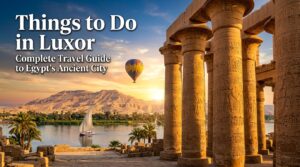
1. Introduction: Why Luxor Is the World’s Greatest Open-Air Museum
There is a phrase that every serious traveller eventually encounters when researching Egypt, and it applies with more justice to Luxor than to any other city on Earth: the world’s greatest open-air museum. It is not an idle boast. Luxor, located on the east bank of the Nile River approximately 670 kilometres south of Cairo, was the capital of ancient Egypt during its most powerful and artistically brilliant era — the New Kingdom period spanning roughly 1550 to 1070 BCE. During those five centuries, the pharaohs of the 18th, 19th, and 20th dynasties transformed the city known to the ancient world as Thebes into the most magnificent religious and royal capital on Earth.
The ancient city of Thebes, Egypt — known to the ancient Egyptians as Waset and to the Greeks as Thebes — was a city that Homer described in the Iliad as a place of ‘hundred gates,’ through each of which two hundred warriors could ride with their horses and chariots. Modern archaeology has confirmed the scale of what once stood here: the Karnak Temple Complex, which took over two thousand years to build and covers 100 hectares, is the largest religious structure ever constructed in the ancient world. The Luxor Temple, the Valley of the Kings where over 60 royal tombs cut deep into the limestone cliffs of the West Bank, the Hatshepsut Temple built into the face of a sheer escarpment, the painted royal burial chambers whose ancient tomb paintings Egypt has produced stand among the greatest works of art in human history — all of this and much more is concentrated in and around a modern city of roughly half a million people.
For anyone planning an Egypt itinerary, Luxor is not a secondary destination after Cairo and Giza — it is an equal and in many ways surpassing one. The best things to do in Luxor Egypt span multiple days of genuinely astonishing sightseeing: temple complexes that dwarf anything in the classical world, royal tomb chambers painted with Egyptian mythology and temples imagery of extraordinary beauty and precision, a Nile River Luxor cruise that connects East Bank and West Bank attractions across the legendary river, a hot air balloon ride in Luxor Egypt at sunrise that delivers one of the most spectacular views available anywhere in world travel, and a living city whose markets, food, and human warmth offer a cultural experience that is entirely its own.
This complete Luxor Egypt travel guide for first-time visitors covers every major Luxor attraction, practical logistics, budget planning, hidden gem, and day-by-day itinerary you need to plan a visit that does full justice to one of humanity’s most extraordinary places.
2. Essential Travel Information Before You Visit Luxor
Best Time to Visit Luxor Egypt for Sightseeing
The best time to visit Luxor Egypt for sightseeing is between October and April, when daytime temperatures range from 18°C to 30°C (64°F to 86°F) and the conditions for extended outdoor exploration of the temples, tombs, and plateau sites are genuinely comfortable. Luxor sits in one of the hottest and driest climates in the world — summer temperatures between June and August regularly exceed 40°C to 45°C in the Valley of the Kings, where the limestone cliffs trap and intensify the desert heat to a level that makes sustained sightseeing genuinely dangerous without extreme precautions. If you must visit in summer, limit outdoor activities to the first two hours after sunrise and plan museum and tomb visits for the late morning and afternoon.
For hot air balloon Luxor sunrise experiences specifically, October through March offers the clearest skies and most stable morning wind conditions — essential for safe balloon operations and the spectacular visibility across the Nile Valley that makes this experience so remarkable. Balloon flights operate year-round but are occasionally cancelled in summer due to high wind and heat conditions.
Visa, Currency and Entry Fees
Most nationalities require an Egyptian e-visa, obtainable online before travel or on arrival at Luxor International Airport or Cairo International Airport. The currency is the Egyptian Pound (EGP). Entry fees to individual Luxor sites are charged separately — there is no single combined ticket covering all West Bank and East Bank attractions. The Valley of the Kings entry fee covers three tomb visits and costs approximately $15 to $20 USD; popular tombs such as Tutankhamun’s and the tomb of Seti I require additional supplementary tickets. Karnak Temple entry costs approximately $10 to $15 USD, Luxor Temple $6 to $10 USD, and Hatshepsut Temple approximately $12 to $16 USD.
How Long Do You Need in Luxor?
A minimum of two days is required to cover the essential highlights of both the East Bank Luxor and West Bank Luxor without feeling severely rushed. Three days allows for a thorough and unhurried exploration of all major Luxor attractions plus one or two additional sites or experiences. Four days or more is ideal for serious history travellers who want to explore lesser-visited sites, visit the Luxor Museum in depth, experience both the hot air balloon at sunrise and an evening Nile river cruise, and venture into the surrounding Luxor desert experience.
3. Understanding Luxor — The East Bank and
West Bank Division
The most important conceptual framework for understanding and planning Luxor tourism is the ancient Egyptian division of the Nile Valley into two distinct realms: the East Bank of the Nile, which was the realm of the living, and the West Bank of the Nile, which was the realm of the dead. This division was not arbitrary — it followed the movement of the sun, which rose in the east (birth and life) and set in the west (death and the underworld). The pharaohs of the New Kingdom built their great temples of worship and state on the East Bank, and their royal tombs, mortuary temples, and funerary complexes on the West Bank.
This ancient philosophical and cosmological division still organises the modern Luxor sightseeing experience. The East Bank and West Bank Luxor attractions remain geographically and thematically distinct, and planning a Luxor itinerary requires deliberately allocating separate days — or at minimum separate halves of days — to each side of the river. The Nile River Luxor crossing between the two banks is made by local ferry (extremely cheap and quick) or by private motorboat, and is a pleasurable journey in itself, with views of the green agricultural floodplain against the desert escarpment that have changed very little over four thousand years.
East Bank Luxor contains: Karnak Temple Complex, Luxor Temple, the Luxor Museum, and the living city with its markets, restaurants, hotels, and the Luxor Corniche waterfront. West Bank Luxor contains: the Valley of the Kings, the Valley of the Queens, Hatshepsut Temple (Deir el-Bahri), the Colossi of Memnon, the Ramesseum, Medinet Habu, and dozens of nobles’ tombs — all located in the limestone desert plateau of the West Bank, whose ancient name was Djamet.
4. Getting to Luxor and Getting Around the City
Getting to Luxor
Luxor is well connected to Cairo and the rest of Egypt by several transport options:
- Domestic Flight — The fastest option. Egyptian airlines operate multiple daily flights between Cairo International Airport and Luxor International Airport, with a flight time of approximately one hour. This is the most practical option for visitors on a limited itinerary, particularly those doing a Luxor day tour from Cairo.
- Overnight Sleeper Train — One of Egypt’s most popular and romantically atmospheric travel experiences. The overnight sleeper train from Cairo Ramses Station to Luxor departs in the evening and arrives the following morning, saving a night’s hotel cost while covering 670 kilometres of Nile Valley landscape. First-class sleeper cabins are comfortable and include dinner and breakfast service.
- Nile Cruise — The most immersive and leisurely option. Multi-day Nile cruises departing from Luxor or Aswan connect the two cities with stops at Esna, Edfu, and Kom Ombo, providing a genuinely extraordinary experience of the Nile Valley civilization at a pace that allows the landscape and history to fully register.
- Private Car — Available from Cairo but the 670-kilometre journey makes this impractical for most visitors compared to the train or flight options.
Getting Around Luxor
Within Luxor, the principal transport options are: taxis and Uber for East Bank travel; the local Nile ferry or private motorboat for West Bank crossings; bicycle hire for exploring the relatively flat West Bank plateau roads between sites; and organised tour vehicles with licensed Egyptologist guides for comprehensive half-day and full-day tour packages covering the Valley of the Kings and associated West Bank sites. Horse-drawn calèche carriages are a traditional and pleasurable way to travel along the East Bank Corniche between Karnak and Luxor Temple in the evenings.
5. Karnak Temple Complex — The Largest Religious Structure Ever Built
The Karnak Temple Complex is the most extraordinary single religious site surviving from the ancient world — a vast, layered, incomprehensibly ambitious accumulation of temples, sanctuaries, pylons, obelisks, sacred lakes, and processional avenues built over a period of approximately 2,000 years by successive pharaohs of ancient Egypt, each determined to surpass the contribution of their predecessors. The complex covers over 100 hectares — the equivalent of ten average European city blocks — and required the labour of generations of architects, sculptors, painters, and craftsmen across two millennia of continuous construction.
The Karnak Temple Complex is dedicated primarily to the god Amun-Ra — the king of the Egyptian gods during the New Kingdom period and the divine patron of Thebes and the Egyptian pharaohs themselves. The complex contains three main enclosures: the Precinct of Amun-Ra (the largest and most visited), the Precinct of Mut, and the Precinct of Montu. The Avenue of Sphinxes — a 3-kilometre processional road lined with hundreds of ram-headed sphinx statues — connects Karnak Temple to Luxor Temple to the south, and was the route taken by the sacred barque of Amun during the great Opet Festival, the most important religious ceremony in the Egyptian calendar.
The Great Hypostyle Hall of Karnak is the single most stunning interior space surviving from the ancient world. Covering 5,000 square metres, it contains 134 massive sandstone columns arranged in 16 rows — the 12 central columns stand 21 metres tall and are so wide that 10 people standing with outstretched arms cannot encircle them. Every surface of every column, every wall, and every ceiling is covered in painted carved reliefs depicting religious ceremonies, royal victories, and offerings to the gods — the accumulated artistry of dozens of pharaohs over centuries of continuous embellishment. Standing inside the Great Hypostyle Hall for the first time is a genuinely overwhelming experience that few structures anywhere in the world can match.
Additional highlights within the Karnak Temple Complex include:
- The Obelisks of Hatshepsut — Two of the tallest obelisks ever erected in ancient Egypt, carved from single pieces of Aswan granite on the orders of Pharaoh Hatshepsut. One still stands at 29 metres; the other lies fallen nearby. Their surfaces are inscribed in electrum (a gold-silver alloy) hieroglyphic text visible from great distances.
- The Sacred Lake — A large rectangular lake used for ritual purifications and naval processions of the divine barque. The sunrise reflection of the surrounding temple columns in the Sacred Lake is one of the most photographed views at Karnak.
- The Open-Air Museum — Contains reconstructed chapels and gate structures from the Middle Kingdom period, including the beautiful Red Chapel of Hatshepsut and the White Chapel of Senusret I, both assembled from thousands of individual carved blocks discovered hidden inside later pylons.
- The Karnak Sound and Light Show — An evening audiovisual experience staged at the Karnak complex, taking visitors on a narrated walk through the illuminated temples and sacred lake. Considered by many visitors superior to the Giza Sound and Light Show due to the intimacy and scale of the setting.
Visitor Tip: Arrive at Karnak at 6:00 AM when the gates open. The complex is vast — allow a minimum of three hours for a thorough visit. An Egyptologist guide is strongly recommended for this site; without one, the sheer volume of structures and inscriptions can feel overwhelming and the extraordinary stories encoded in the reliefs will be entirely lost.
6. Luxor Temple — The Sacred Heart of Ancient Thebes
Luxor Temple stands at the very heart of the modern city — its enormous sandstone pylons and colonnade rising directly from the riverfront Corniche in a way that makes the temple inseparable from the living city around it. Unlike Karnak, which is a vast complex of multiple structures accumulated over two millennia, Luxor Temple is a single, beautifully unified structure built primarily during the reigns of Amenhotep III (around 1390 BCE) and Ramesses II (around 1250 BCE), with the primary purpose of celebrating the divine nature of the pharaoh and providing a setting for the annual Opet Festival.
The First Pylon — the great gateway — was built by Ramesses II and is decorated with colossal battle reliefs depicting his campaigns against the Hittites at the Battle of Kadesh, one of the most extensively documented military engagements in ancient history. In front of the pylon, Ramesses placed six colossal statues of himself and two obelisks; today only one obelisk remains at Luxor Temple — the other was removed to Paris in 1836 and now stands in the Place de la Concorde.
The colonnade of Amenhotep III — a breathtaking avenue of 14 towering papyrus columns rising 16 metres — is the architectural centrepiece of Luxor Temple and one of the most photographed and painted spaces in ancient Egyptian architecture. The walls of the colonnade are covered in extraordinary painted reliefs depicting the Opet Festival procession, in which the divine statues of Amun, Mut, and Khonsu were transported by river from Karnak Temple to Luxor Temple in gilded sacred barques, accompanied by priests, musicians, soldiers, and thousands of ordinary Theban citizens celebrating the renewal of divine and royal power.
Luxor Temple is most dramatically beautiful after dark, and the Luxor night view from the East Bank Corniche — the illuminated pylons and colonnades reflected in the Nile, the remaining obelisk silhouetted against the night sky — is one of the finest free spectacles in Egyptian tourism. The temple is open in the evenings and the floodlit interior, with far fewer visitors than the daytime hours, provides one of the most atmospheric ancient monument experiences in all of Luxor sightseeing.
7. Valley of the Kings — Egypt’s Royal Burial Ground
The Valley of the Kings is the most celebrated pharaoh burial site Egypt has ever produced, and one of the most visited and archaeologically significant sites in the entire world. Cut into the limestone cliffs of the West Bank desert plateau approximately six kilometres from the Nile, the valley served as the royal necropolis of ancient Egypt for nearly five centuries — from the early 18th Dynasty (around 1539 BCE) through the end of the 20th Dynasty (around 1070 BCE). During that period, at least 64 tombs were excavated in the valley, ranging from small single-chamber pits to enormous multi-chambered complexes descending more than 100 metres into the living rock.
The decision to abandon the pyramid form of royal burial in favour of these hidden rock-cut tombs was deliberate and pragmatic: the massive pyramids of the Old and Middle Kingdom periods had proven impossible to protect against tomb robbery, and the pharaohs of the New Kingdom sought to conceal their burial chambers within the natural limestone of the desert cliffs while building their mortuary temples — the public-facing religious structures associated with their funerary cults — separately on the valley floor below.
The ancient tomb paintings Egypt is most famous for are concentrated in the Valley of the Kings. The decorated burial chambers of the royal tombs are covered floor to ceiling with extraordinarily detailed and vibrantly coloured painted reliefs drawn from the great religious texts of the Egyptian New Kingdom history — the Book of the Dead, the Amduat (the ‘Book of What Is in the Underworld’), the Book of Gates, and the Book of Caverns. These texts describe the pharaoh’s nocturnal journey through the twelve hours of the underworld, his battles with the serpent god Apophis, and his eventual resurrection with the rising sun — a cosmological narrative of extraordinary complexity and visual beauty that took decades to paint and represents the pinnacle of ancient Egyptian artistic achievement.
The Most Important Tombs
- Tomb of Tutankhamun (KV62) — The most famous tomb in Egyptological history, discovered intact by Howard Carter in 1922. Paradoxically one of the smallest tombs in the Valley of the Kings, its significance lies entirely in the extraordinary completeness of its treasures — over 5,000 objects found exactly as the ancient priests had placed them three thousand years earlier. The golden mummy of Tutankhamun himself still rests within the outermost of his three nested coffins in the burial chamber. A supplementary ticket is required for entry.
- Tomb of Seti I (KV17) — Widely considered the most beautifully decorated tomb in the entire Valley of the Kings, with painted reliefs of extraordinary fineness and artistic sophistication covering every surface of a tomb that descends over 100 metres into the cliff. Currently open with limited access; a premium supplementary ticket is required.
- Tomb of Ramesses VI (KV9) — One of the largest and most completely decorated tombs in the valley, with astronomical ceilings depicting the solar and lunar cycles and walls covered in extensive passages from the Book of Caverns and Book of Gates.
- Tomb of Ramesses III (KV11) — Notable for its unusually detailed painted scenes of daily life, musicians, and craftsmen that are unlike the purely religious subject matter found in most other royal tombs.
- Tomb of Merenptah (KV8) — A very long and well-preserved tomb with excellent painted reliefs, typically less crowded than the more famous tombs.
Visitor Tip: Arrive at the Valley of the Kings as early as possible — ideally before 8:00 AM. Midday heat inside the valley is extreme. Photography is permitted in some tombs with a camera ticket but prohibited in others — confirm at the ticket office before entering. Photography inside Tutankhamun’s tomb is not permitted. Allow two to three hours minimum for the valley, more if visiting multiple supplementary-ticket tombs.
8. Hatshepsut Temple — The Mortuary Masterpiece
The Mortuary Temple of Hatshepsut — known in Arabic as Deir el-Bahri and in the ancient Egyptian language as Djeser-Djeseru, meaning ‘Holy of Holies’ — is arguably the most architecturally perfect and visually spectacular temple in all of Egypt. Built into and against the sheer face of a towering natural limestone escarpment on the West Bank of Luxor around 1470 BCE, the temple rises in three dramatically tiered colonnaded terraces from the desert floor to the cliff face, its geometry of clean horizontal lines set against the soaring vertical rock creating one of the most harmonious architectural compositions in the ancient world.
Hatshepsut was one of the most remarkable rulers in ancient Egyptian history — a woman who governed Egypt as a full pharaoh for approximately 20 years during the 18th Dynasty, adopting all the regalia and titulary of a male king including the false beard. Her mortuary temple was the expression of her divine legitimacy: the walls of the colonnades are covered in painted reliefs depicting her miraculous divine conception as the daughter of the god Amun himself, her celebrated trading expedition to the land of Punt (probably modern-day Somalia or Eritrea), and her quarrying and transport of two enormous obelisks for the Karnak Temple Complex.
After Hatshepsut’s death, her stepson and successor Thutmose III ordered a systematic campaign of erasure — her images were chiselled from the temple walls, her name was removed from inscriptions, and her statues were smashed and buried in a pit nearby. This campaign of damnatio memoriae was likely motivated by political rather than personal reasons, but its effect was that Hatshepsut was almost entirely forgotten until modern Egyptologists reassembled the evidence in the 19th and 20th centuries. Today her temple is fully restored, her legacy fully documented, and she is recognised as one of the greatest rulers in ancient Egyptian history.
Pro Tip: The Hatshepsut Temple is at its most atmospheric and photogenic in the early morning when the slanted light picks out the painted reliefs in high relief and the colours of the escarpment behind the temple shift from grey to ochre to gold. It is also significantly less hot at this time than during the midday and afternoon hours.
9. Valley of the Queens — Royal Tombs of the West Bank
Located approximately two kilometres south of the Valley of the Kings in the same desert plateau, the Valley of the Queens contains over 90 tombs belonging to the wives, daughters, and sons of the New Kingdom pharaohs. While the scale of the royal tombs in the Valley of the Kings generally surpasses those of the queens, the Valley of the Queens contains the most celebrated and artistically extraordinary painted burial chamber in all of Egypt — the Tomb of Nefertari, Great Royal Wife of Ramesses II.
The Tomb of Nefertari (QV66) is universally regarded by Egyptologists and art historians as the Sistine Chapel of ancient Egypt — the most exquisitely painted burial chamber ever found in any Egyptian tomb, decorated with painted reliefs of such extraordinary fineness, colour, and artistry that they stand among the greatest works of art produced in the ancient world. The scenes — depicting Nefertari’s passage through the underworld, her reception by the gods, and her transformation into a divine being — are painted in vivid blues, reds, ochres, and greens against a white background that still glows as if freshly applied three thousand years after their creation.
Entry to the Tomb of Nefertari requires a premium supplementary ticket costing approximately $15 to $25 USD above the standard Valley of the Queens entry fee, but represents one of the most exceptional cultural experiences available in Egyptian tourism and is unreservedly recommended for any visitor with a serious interest in ancient Egyptian art and Egyptian mythology and temples imagery.
10. Colossi of Memnon — Guardians of the West Bank
The Colossi of Memnon are two enormous seated quartzite statues of Pharaoh Amenhotep III that stand 18 metres tall — roughly equivalent to a six-storey building — on the agricultural plain of the West Bank, directly visible from the East Bank Corniche across the Nile. Built around 1350 BCE to flank the entrance to Amenhotep III’s mortuary temple — the largest temple complex ever built in ancient Egypt, now largely destroyed — the two colossi have stood in their current positions for 3,400 years, surviving the complete destruction of the temple they once guarded.
In antiquity, the northern colossus (referred to by Greek and Roman travellers as ‘Memnon’ after the legendary Ethiopian king) was famous throughout the Mediterranean world for producing a singing or whistling sound at dawn — described by ancient visitors as the voice of Memnon greeting his mother Eos (the goddess of the dawn). This mysterious sound, caused by the expansion of the cracked stone as it heated in the morning sun, attracted pilgrimages from across the Roman Empire until Septimius Severus repaired the damage in the 3rd century CE, inadvertently silencing the voice for good.
Today the Colossi of Memnon are free to visit and typically serve as the first stop on West Bank morning tours — they sit directly on the main road to the Valley of the Kings and require no entry fee. An ongoing archaeological excavation of the surrounding mortuary temple complex has revealed spectacular discoveries in recent decades, including colossal sphinx statues, alabaster sculptures, and an intact processional avenue.
11. The Luxor Museum — World-Class Artefacts in an Intimate Setting
The Luxor Museum is one of the finest and most beautifully designed regional museums in Egypt, and one of the most underrated Luxor attractions among visitors focused exclusively on the outdoor temples and tombs. Located on the East Bank Corniche between Luxor Temple and Karnak Temple, the museum houses a carefully selected collection of Egyptian museum Luxor artefacts recovered from the temples and tombs of the ancient Theban region — presented in a sophisticated modern building with international-standard display cases, lighting, and interpretive information.
The highlights of the Egyptian museum Luxor collection include: the extraordinary cache of statues discovered hidden beneath the floor of the Karnak Temple Great Hypostyle Hall in 1989 — 26 statues buried by priests around 2,000 years ago to protect them from damage, now displayed exactly as they might have stood in the temple; two intact royal mummies identified as Ahmose I (founder of the 18th Dynasty and liberator of Egypt from the Hyksos) and Ramesses I (founder of the 19th Dynasty and grandfather of Ramesses II); and a spectacular collection of objects from the tomb of Tutankhamun that remained in Luxor rather than being transferred to Cairo, including his military chariot and ceremonial items of extraordinary craftsmanship.
The Luxor Museum is significantly smaller and less crowded than the Grand Egyptian Museum in Cairo but offers a quality of display and intimacy of encounter with ancient objects that many visitors prefer to the scale and complexity of the larger institution. Allow two hours minimum.
12. Hot Air Balloon Ride in Luxor Egypt — Sunrise Over the Nile Valley
A hot air balloon ride in Luxor Egypt at sunrise is, by the consensus of travellers who have experienced it, the single most spectacular and emotionally unforgettable experience available anywhere in Egyptian tourism — and one of the finest hot air balloon experiences available anywhere in the world. Luxor is globally recognised as one of the premier destinations for balloon flight, with a combination of factors that is almost uniquely favourable: a flat, open landscape of extraordinary archaeological richness visible from above, reliable morning calm winds ideal for safe balloon operation, and a sunrise that transforms the Nile Valley, the desert plateau, the West Bank temples, and the distant Sahara into a panorama of colour and light that is simply unlike anything visible from the ground.
Balloon flights over Luxor typically depart from the West Bank before dawn, rising as the horizon begins to lighten in the east. As the sun rises over the East Bank, passengers drift above the Valley of the Kings, the Hatshepsut Temple, Medinet Habu, the Ramesseum, the agricultural fields of the Nile floodplain, and the silver ribbon of the river itself stretching north and south to the horizon. On clear mornings — most common between October and March — the visibility extends for extraordinary distances in every direction across the Nile Valley civilization landscape.
Hot air balloon Luxor sunrise flights typically last 45 minutes to one hour and cost between $80 and $150 USD per person depending on the operator and season. Several licensed operators serve the Luxor market; book through your hotel or a reputable tour operator rather than through street touts. The flight is followed by a traditional Egyptian breakfast on the West Bank before transfer back to your hotel.
Safety Note: Luxor has experienced balloon accidents in the past due to unlicensed operators. Always book with a licensed, internationally certified operator and check their safety record. Reputable operators include Sky Cruise, Magic Horizon, and Hod Hod Soliman, all of which maintain modern equipment and qualified pilots. Avoid any operator unable to provide licensing documentation.
13. Nile River Luxor Cruise — Feluccas, Dinner Boats and Multi-Day Journeys
The Nile River Luxor cruise experience encompasses a wide range of options, from a casual hour-long felucca sail to a multi-day cruising journey between Luxor and Aswan that constitutes one of the great travel experiences anywhere in the world. All of these options share the fundamental pleasure of experiencing the Nile from its surface — the same vantage point from which ancient Egyptians experienced their river for five thousand years, and still the most immediately beautiful and emotionally resonant way to appreciate the Nile Valley civilization landscape.
Nile Felucca Ride Luxor
A Nile felucca ride Luxor is the simplest and most atmospheric water experience available in the city. Feluccas — traditional wooden Egyptian sailboats — depart from both banks of the Nile and offer relaxed sunset or afternoon sails of one to two hours. The slow pace, the silence of sail power, and the views of the East Bank temples and the West Bank desert cliffs create an experience of quiet beauty that contrasts powerfully with the intensity of the temple visits. Prices are negotiable directly with the captain and range from 50 to 150 EGP per hour depending on the vessel size and season.
Luxor River Cruise — Dinner Boats
Several operators offer Luxor river cruise dinner boat experiences — typically a two to three hour evening journey on a motorised Nile boat with dinner, live Egyptian music, and optional traditional entertainment including folkloric dance and Whirling Dervish performances. These cruises pass the illuminated facades of Luxor Temple and the Karnak complex from the river, providing spectacular water-level views of the temples that are entirely impossible from the shore.
Multi-Day Nile Cruise from Luxor to Aswan
The classic multi-day Nile cruise — sailing between Luxor and Aswan over three to seven nights — is one of the world’s great travel experiences and the ideal way to combine Luxor tourism with the temples of Edfu, Kom Ombo, and the extraordinary Philae Temple complex at Aswan. Cruise vessels range from budget-friendly local boats to spectacularly luxurious floating hotels with gourmet restaurants, swimming pools, and Egyptologist lecturers. The scenery along the 215-kilometre stretch of river between the two cities — green sugar cane fields against golden desert cliffs, traditional riverside villages, and the occasional flash of an ancient temple on the bank — is consistently beautiful throughout the journey.
14. Luxor Night View — Temples After Dark
Luxor at night offers one of the most beautiful and atmospheric evening environments of any city in Egypt. The combination of the illuminated Luxor Temple rising directly from the waterfront Corniche, the Luxor night view from the river of both the temple and the moonlit West Bank cliffs, and the warm human energy of the East Bank evening markets and restaurants creates an experience that is entirely distinct from — and in some ways more emotionally powerful than — the daytime temple visits.
- Luxor Temple by Night — The temple is open in the evenings and dramatically floodlit. The colonnade of Amenhotep III, the First Pylon of Ramesses II, and the Avenue of Sphinxes are all illuminated and significantly less crowded than during daylight hours. An evening visit to Luxor Temple is strongly recommended for all visitors.
- Karnak Sound and Light Show — The evening audiovisual production at Karnak takes visitors on a narrated walk through the illuminated temple complex, ending at the Sacred Lake for the main projection sequence. Multiple language performances run throughout the week.
- East Bank Corniche Walk — The waterfront promenade between Luxor Temple and the Winter Palace Hotel is the social heart of Luxor evenings, lined with cafes, juice bars, and families enjoying the night air off the Nile.
- Horse-Drawn Carriage Ride — A traditional calèche carriage ride along the East Bank Corniche in the evening, with views of the illuminated temple and the river, is one of the most pleasurably old-fashioned experiences available in Luxor tourism.
15. Luxor Local Markets — Shopping and Culture
The Luxor local markets offer a rewarding and genuinely cultural shopping and browsing experience that complements the ancient monument visits with an encounter with the living city. The principal souvenir and craft market is concentrated in the streets immediately behind the East Bank Corniche, particularly in the area around the entrance to Luxor Temple and the Luxor Bazaar district.
Alabaster workshops — where craftsmen carve vases, bowls, scarabs, and figurines from the local white alabaster quarried in the hills west of Luxor — are one of the most distinctive shopping experiences in the city and produce objects of genuine quality. Alabaster from the Luxor region was the preferred material for the finest ancient Egyptian ritual vessels and the quality of the stone remains exceptional. Papyrus artwork, replica cartouches, hand-woven textiles, and spices are also widely available. Bargaining is expected and considered a normal and enjoyable part of the commercial exchange — begin at approximately 40 to 50 percent of the initial asking price and negotiate from there.
16. Hidden Gems in Luxor Egypt
Beyond the headline monuments, Luxor contains a wealth of archaeological wonders of Egypt that receive a fraction of the visitors they deserve. These hidden gems in Luxor Egypt reward the curious traveller with extraordinary encounters in settings of relative tranquillity.
Medinet Habu — Ramesses III’s Mortuary Temple
Medinet Habu, on the southern West Bank, is the mortuary temple of Ramesses III and one of the best-preserved temple complexes in Egypt. Its outer walls carry the most extensive surviving account of the Battle of the Sea Peoples — one of the pivotal military events of the ancient Bronze Age — in carved relief across the exterior. The painted interior chambers retain extraordinary colour and the complex is typically visited by a fraction of the crowds at the Valley of the Kings and Karnak. This is one of the most underrated archaeological wonders of Egypt.
The Tombs of the Nobles
While the Valley of the Kings and Valley of the Queens contain the royal tombs, the limestone hills of the West Bank hold hundreds of tombs belonging to the high officials, priests, artists, and nobles of New Kingdom Thebes. Unlike the royal tombs — whose decoration focuses exclusively on religious and funerary texts — the Nobles’ Tombs depict scenes of daily life in astonishing detail: agricultural activities, banquets, music, hunting, fishing, craftsmen at work, and intimate domestic moments that provide an irreplaceable window into life in ancient Thebes.
The Ramesseum Ozymandias’s Temple
The Ramesseum — mortuary temple of Ramesses II — is the inspiration for Percy Bysshe Shelley’s famous poem ‘Ozymandias,’ written after a fragment of the colossal fallen statue of Ramesses arrived in Europe. The temple is partially ruined but still magnificent, with a colossal fallen granite statue of Ramesses II — the largest free-standing sculpture in ancient Egypt at 1,000 tonnes — lying shattered in the first hypostyle hall. The site is rarely crowded and carries one of the most powerful atmospheres of any West Bank monument.
The Avenue of Sphinxes
The recently restored 3-kilometre Avenue of Sphinxes connecting Luxor Temple to Karnak Temple — lined with hundreds of ram-headed and human-headed sphinx statues along its full length — was inaugurated in a spectacular ceremony in 2021. Walking the full length of this ancient processional road in the early morning or at dusk, with the two great temple complexes visible at either end, is one of the most extraordinary heritage walks available in Egyptian tourism.
17. Luxor Desert Experience Beyond the Temples
The limestone desert plateau of the West Bank extends westward from the Valley of the Kings into the open Sahara — a landscape of extraordinary austere beauty that offers a completely different dimension of the Luxor desert experience for visitors willing to venture beyond the main monument circuit. Several operators offer quad bike tours across the desert plateau, providing access to panoramic viewpoints overlooking the entire West Bank — from the Nile floodplain to the east, across the Valley of the Kings and Hatshepsut Temple in the middle distance, to the unbroken Saharan horizon to the west.
Camel treks departing from the West Bank take visitors through the desert landscape between the major monuments and across the ridge above the Valley of the Kings — a route that provides dramatic bird’s-eye views of the valley itself. At sunset, the desert plateau turns extraordinary shades of amber, rose, and violet as the light fails and the first stars appear over the Sahara. For many visitors, this desert sunset experience — combined with the earlier hot air balloon flight at dawn — represents the most visually spectacular day of their entire Egypt journey.
18. Day Trip to Luxor from Cairo
A Luxor day tour from Cairo is possible and popular, though the distance and the volume of Luxor attractions means that a single day inevitably involves compromises. The standard Luxor day tour from Cairo format involves an early morning domestic flight from Cairo (departing around 7:00 AM), a full day of guided sightseeing covering the East Bank and West Bank highlights, and an early evening flight back to Cairo. This format can comfortably cover: the Valley of the Kings (two to three tombs), Hatshepsut Temple, the Colossi of Memnon, Luxor Temple, and Karnak Temple.
The principal limitation of the Luxor day tour from Cairo format is time pressure: the Valley of the Kings alone deserves three to four hours for a thorough visit, and Karnak Temple requires another three hours minimum. Combining all major East Bank and West Bank sites in a single day means spending only 30 to 45 minutes at each location — sufficient for a strong first impression but inadequate for a genuine understanding of what each site contains and represents. For this reason, a minimum of two nights in Luxor is strongly recommended for most visitors. The overnight sleeper train from Cairo, which arrives in Luxor in the early morning, is the most practical and atmospheric alternative to a day trip if budget is a consideration.
19. Budget Travel Guide to Luxor Egypt
Luxor is one of Egypt’s most genuinely affordable major destinations, and the budget travel guide to Luxor Egypt approach is entirely viable without sacrificing access to any of the principal Luxor attractions. The following cost framework covers a full two-day Luxor itinerary for a budget-conscious traveller:
- Accommodation: Budget guesthouses and hostels in Luxor are available from $10 to $25 USD per night. Clean, well-located mid-range hotels on or near the Corniche range from $40 to $80 USD per night.
- Meals: Egyptian street food near Luxor and in the local market area costs between $2 and $8 USD for a full meal. Mid-range restaurants serving Egyptian and international cuisine cost $10 to $20 USD per person.
- Transport: The local Nile ferry between East Bank and West Bank costs approximately $0.50 USD. Taxis and bicycle hire on the West Bank are extremely affordable. Organised full-day West Bank tours with a licensed guide typically cost $25 to $50 USD per person including transport.
- Site Entry: Budget approximately $50 to $80 USD for two full days of site entry fees covering the Valley of the Kings, Valley of the Queens, Hatshepsut Temple, Karnak Temple, Luxor Temple, Luxor Museum, and Colossi of Memnon.
- Hot Air Balloon: $80 to $150 USD per person — the single largest discretionary expense in a Luxor budget itinerary but widely considered the most rewarding of any optional activity.
- Overall Daily Budget: A comfortable two-day Luxor visit including all major sites, budget meals, and accommodation but excluding the balloon can be achieved for approximately $60 to $100 USD per person per day.
20. Best Hotels in Luxor Egypt
The best hotels in Luxor Egypt are concentrated on the East Bank Corniche, with a cluster of historic and luxury properties in the central area between Luxor Temple and Karnak Temple. The West Bank also has a growing number of characterful guesthouses and eco-lodges that offer the unique advantage of proximity to the Valley of the Kings without the Nile crossing commute.
Luxury
The Winter Palace Hotel — built in 1886 to receive European royalty and aristocracy during the winter season — is the most historically significant and atmospherically distinctive hotel in Luxor and one of the great colonial-era hotels of Africa. Its famous guest list includes Agatha Christie (who wrote Death on the Nile partly in residence), Howard Carter, and numerous heads of state. The gardens overlook the Nile and the rooms in the original Victorian building retain extraordinary period character. The Sofitel Winter Palace remains the benchmark luxury experience in Luxor tourism. The Steigenberger Nile Palace and the Hilton Luxor Resort also offer excellent Corniche-front luxury options with Nile views.
Mid-Range and Budget
Numerous mid-range hotels are available along and behind the East Bank Corniche, offering clean, comfortable accommodation with Nile or garden views at $40 to $80 USD per night. On the West Bank, small family-run guesthouses in the village of Al-Gezira offer a remarkably authentic and peaceful Luxor base — waking in the West Bank village with the desert plateau immediately above and the East Bank cityscape across the Nile is an experience that many repeat visitors to Luxor consider their most memorable accommodation choice in Egypt.
21. Practical Tips for First-Time Visitors to Luxor
Health and Climate
- Carry at least two litres of water per person for any West Bank morning tour. The Valley of the Kings in particular offers virtually no shade and the heat reflected from the limestone cliffs is intense even in mild months.
- Apply SPF 50+ sun protection before arrival at any outdoor site and reapply during your visit. Sun hats and UV-protective lightweight clothing are strongly recommended.
- The Valley of the Kings tombs are air-conditioned by nature of their deep underground position but the approach paths and the valley floor itself are fully exposed to sun and heat.
- Insect repellent is advisable for evening felucca and dinner boat experiences on the Nile.
Cultural Respect
- Dress modestly when visiting all temples and tombs — covered shoulders and knees are appropriate and required at all sites.
- Photography rules vary by site and by individual tomb. Always check current rules at the ticket office before entering. Photography inside the royal tombs of Tutankhamun and Seti I is prohibited.
- Bargaining is standard and expected in Luxor local markets. Never accept the first price offered; begin at 40 to 50 percent of the asking price.
- Tipping (baksheesh) is culturally important in Luxor. Budget small denomination notes for site attendants, guides who open special areas, and restaurant service.
22. Sample Luxor Itineraries — 1 Day to 4 Days
What to Do in Luxor in 2 Days Itinerary — Recommended for First-Time Visitors
Day 1 — West Bank
- 5:00 AM: Hot air balloon flight at sunrise over the West Bank (pre-booked)
- 8:00 AM: Valley of the Kings — minimum three tombs including Ramesses VI and Merenptah; Tutankhamun’s tomb with supplementary ticket
- 11:00 AM: Hatshepsut Temple (Deir el-Bahri)
- 12:30 PM: Colossi of Memnon — free visit on the way back
- 1:30 PM: Lunch on West Bank, rest during peak heat
- Evening: Return to East Bank, dinner on the Corniche, evening visit to illuminated Luxor Temple
Day 2 — East Bank
- 6:00 AM: Karnak Temple Complex at opening — Great Hypostyle Hall, Sacred Lake, Obelisks of Hatshepsut, Open-Air Museum (3 hours)
- 10:00 AM: Luxor Museum — Karnak cachette statues, royal mummies of Ahmose I and Ramesses I
- 12:30 PM: Lunch at local restaurant near Corniche
- 2:30 PM: Avenue of Sphinxes walk from Luxor Temple to Karnak
- 4:00 PM: Luxor Temple — afternoon and into evening
- Evening: Nile felucca ride at sunset, Karnak Sound and Light Show
4-Day Luxor Itinerary — Full Exploration
- Day 1: West Bank — Hot air balloon at sunrise, Valley of the Kings (5 tombs), Hatshepsut Temple, Valley of the Queens with Tomb of Nefertari
- Day 2: East Bank — Karnak Temple (full morning), Luxor Museum, Avenue of Sphinxes, Luxor Temple by night
- Day 3: Hidden gems — Medinet Habu, Ramesseum, Tombs of the Nobles, Colossi of Memnon excavations; afternoon Nile river cruise dinner
- Day 4: Luxor desert experience — West Bank quad bike or camel trek; Luxor local market shopping; optional day extension to Dendara Temple (70 km north)
23. Conclusion: Is Luxor Worth Visiting in 2026?
There is no honest answer to this question other than yes — an unqualified, unreserved, and deeply felt yes. Luxor in 2026 is not simply worth visiting; it is one of the handful of places on Earth that every person with any interest in human history, ancient art, archaeology, or the sheer scale of what human beings have been capable of should make a serious effort to experience before they die. The claim that Luxor is the world’s greatest open-air museum is not marketing language — it is the considered verdict of every Egyptologist, archaeologist, art historian, and experienced world traveller who has spent serious time here.
The UNESCO World Heritage Luxor designation covers the entire Theban necropolis and temple complex — a recognition that the concentration of ancient monuments here is of universal significance to all of humanity, not merely to Egypt. The restoration of the Avenue of Sphinxes, the ongoing excavations at the Colossi of Memnon mortuary temple, the continued discoveries in the Valley of the Kings — Luxor in 2026 is a living archaeological city whose revelations are far from complete.
Whether you are drawn by the Karnak Temple Complex and its Great Hypostyle Hall, the painted burial chambers of the Valley of the Kings, the architectural perfection of the Hatshepsut Temple, the hot air balloon ride in Luxor Egypt at sunrise over the Nile Valley civilization, or the quieter pleasures of the Luxor Museum and the living city’s markets and waterfront — Luxor will deliver an experience whose depth, beauty, and historical weight you will carry with you for the rest of your life. Plan carefully, give yourself enough time, and let the ancient city of Thebes Egypt do what it has always done: astonish the world.