
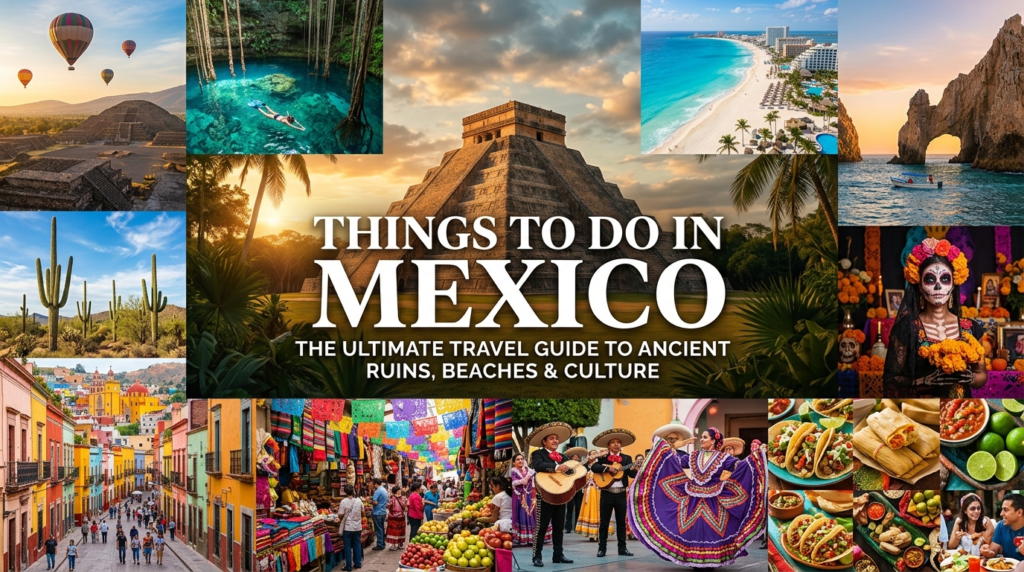
Mexico is one of the most visited countries in the world — and once you arrive, it is immediately obvious why. This is a land where ancient Mayan pyramids rise from dense jungle canopy, where Caribbean water runs so blue and clear it looks painted, where colonial cities glow with color and the smell of slow-cooked chili fills every cobblestone street. In a single trip, you can stand at the summit of one of the world’s greatest pre-Columbian ruins in the morning, swim in a sacred underground cenote at noon, eat world-class street food in the afternoon, and watch the sun melt into the Pacific Ocean in the evening.
This complete Mexico travel guide covers the best things to do in Mexico, city by city and region by region, so you can plan the perfect Mexican adventure — whether your first visit or your fifth.
Why Visit Mexico?
Why visit Mexico? Because few countries on Earth offer such an extraordinary combination of ancient history, natural beauty, culinary genius, and genuine warmth of welcome in one place. What is Mexico famous for? Ancient Mayan and Aztec civilizations whose monuments rival anything in Egypt or Greece. Caribbean beaches so perfect they have defined the global image of a tropical paradise. A food culture so rich and complex that UNESCO placed Mexican cuisine on its list of Intangible Cultural Heritage of Humanity. Vibrant, colorful cities full of colonial architecture, muralist art, and fiesta spirit. And a people whose hospitality is one of the great intangible pleasures of traveling here.
Mexico travel destinations span an extraordinary range — from the buzzing, world-class metropolis of Mexico City to the rustic fishing villages of Oaxaca’s Pacific coast, from the turquoise lagoons of the Yucatan Peninsula to the dramatic desert scenery of Baja California. The country is so large and so diverse that even experienced travelers discover something entirely new on every return visit.
Best Places to Visit in Mexico
The best places to visit in Mexico depend entirely on what kind of experience you are seeking. The Yucatan Peninsula — Cancun, Tulum, and Playa del Carmen — is Mexico’s most visited region, offering the finest Caribbean beaches alongside accessible Mayan ruins and unique cenote swimming experiences. Cultural Mexico — Mexico City, Oaxaca, Guadalajara, San Miguel de Allende, and Puebla — is where the country’s indigenous heritage, colonial history, and contemporary creativity come together most powerfully. The Pacific Coast — Puerto Vallarta and Los Cabos — offers dramatic cliffs, world-class fishing, and a more authentically Mexican resort atmosphere.
For first-time visitors, the Yucatan Peninsula is the most logical starting point — excellent infrastructure, safe and tourist-friendly, English widely spoken, and an extraordinary concentration of experiences within a small geographic area. Culture seekers will find Mexico City and Oaxaca equally compelling and more revealing of Mexico’s true depth.
Things to Do in Mexico City
City Overview
Mexico City — known locally as CDMX (Ciudad de Mexico) — is one of the great cities of the world. Home to over 22 million people in its metropolitan area, it sits on the ancient lake bed of Texcoco at 2,240 metres altitude, on the exact site where the Aztec capital of Tenochtitlan once stood. It is a city of extraordinary contradictions — ancient and ultramodern, chaotic and elegant, overwhelming and intimate — and rewards visitors who give it time with some of the finest art, food, history, and cultural experiences in the Americas.
Top Things to Do in Mexico City
Things to do in Mexico City begin at the Zocalo — the vast central plaza at the heart of the historic center and one of the largest public squares in the world. The Metropolitan Cathedral, begun in 1573 and completed over 250 years, dominates the north side of the square. Directly beneath the Zocalo lies the Templo Mayor, the great Aztec temple complex that was the religious center of Tenochtitlan, excavated only in 1978 when a construction crew accidentally broke through to it. The adjacent Templo Mayor Museum houses extraordinary Aztec artifacts.
The National Museum of Anthropology in Chapultepec Park is one of the greatest museums in the world — a vast collection of pre-Columbian art and archaeology from every major Mexican civilization. Mexico City attractions also include the Frida Kahlo Museum (Casa Azul) in Coyoacan, the Diego Rivera murals at the National Palace, the Palacio de Bellas Artes with its Art Nouveau architecture, and Xochimilco’s ancient canal system. A day trip to Teotihuacan — the ancient city of pyramids 50 kilometres northeast — is one of Mexico’s greatest historical experiences.
Best Places to Visit in Mexico City
• Zocalo and Historic Center (UNESCO World Heritage Site)
• Templo Mayor and museum
• National Museum of Anthropology
• Frida Kahlo Museum (Casa Azul)
• National Palace — Diego Rivera murals
• Palacio de Bellas Artes
• Chapultepec Park and Castle
• Xochimilco floating gardens
• Coyoacan neighborhood
• Teotihuacan pyramids (day trip)
Historical Places in Mexico City
The historic center of Mexico City is built entirely on the ruins of Tenochtitlan, the Aztec capital that was one of the largest cities in the world when Hernan Cortes arrived in 1519. The conquest of 1521 saw the city demolished and rebuilt by the Spanish, creating an urban archaeology unique in the Americas. Chapultepec Castle (1785), built on a hill sacred to the Aztecs, served as the official residence of Mexico’s heads of state and is now a magnificent history museum.
Best Time to Visit Mexico City
March through May is generally the best time — mild temperatures, dry weather, and clear skies. Day of the Dead celebrations in late October and early November transform the city into a spectacular festival of color, marigolds, and cultural expression that is one of Mexico’s most extraordinary experiences.
Is Mexico City Safe?
Mexico City is generally safe for tourists who exercise standard urban awareness. The tourist neighborhoods — the Historic Center, Roma, Condesa, Polanco, Coyoacan, and San Angel — are all well-patrolled and welcoming. Use Uber rather than street taxis. Millions of international visitors travel to CDMX safely every year.
Local Food in Mexico City
Mexico City is arguably the finest food city in Latin America. Street food alone — tacos al pastor (marinated pork on small corn tortillas with pineapple and cilantro), quesadillas, tamales, elotes (grilled corn with mayo, cheese, and chili), and churros with chocolate — is extraordinary at every price level. Mexico food and cuisine reaches one of its greatest expressions in CDMX, where regional cooking traditions from every Mexican state converge in the city’s incredible market and restaurant scene.
Mexico City Itinerary (4 Days)
• Day 1: Zocalo, Metropolitan Cathedral, Templo Mayor, National Palace Rivera murals
• Day 2: National Museum of Anthropology, Chapultepec Park and Castle
• Day 3: Frida Kahlo Museum (Coyoacan), Xochimilco canals, Roma and Condesa neighborhoods
• Day 4: Teotihuacan pyramids — Pyramid of the Sun, Pyramid of the Moon, Avenue of the Dead
Mexico City Travel Cost
Mexico City offers outstanding value for international visitors. Budget travelers who eat at street food stands and local comedores (small traditional restaurants), use the excellent metro system, and stay in guesthouses in Roma or the Centro can experience the city very affordably. Mid-range visitors enjoy excellent boutique hotels and restaurant dining at a fraction of comparable costs in North America or Europe. Your overall Mexico City budget will depend primarily on accommodation choice and whether you prefer street food or sit-down restaurants.
Things to Do in Cancun
City Overview
Cancun is Mexico’s most visited tourist destination — a purpose-built resort city on the northeastern tip of the Yucatan Peninsula where turquoise Caribbean water meets white powder sand. First developed in the early 1970s from an almost uninhabited barrier island, Cancun now receives over 15 million visitors annually. Cancun beaches Mexico are genuinely extraordinary — warm, calm, impossibly blue water, and white sand that stays cool underfoot even in direct sun. The Hotel Zone (Zona Hotelera), a 25-kilometre strip of luxury and all-inclusive resorts, is the heart of Mexico’s beach tourism industry.
Top Things to Do in Cancun
Things to do in Cancun extend well beyond the famous beaches. The Underwater Museum of Art (MUSA) features over 500 life-size sculptures installed on the seabed, creating one of the world’s most unusual snorkel destinations as coral and marine life slowly colonize the sculptures. A Chichen Itza tour is a must — just 2.5 hours away, it is one of the New Seven Wonders of the World and the finest accessible Mayan ruin in Mexico. The cenotes of the Yucatan Peninsula — underground freshwater swimming holes formed by limestone cave collapses — are among Mexico’s most unique natural attractions, accessible on day trips from Cancun. Isla Mujeres, a small island just 13 kilometres offshore, offers a quieter, more authentic Caribbean experience.
Best Places to Visit in Cancun
• Hotel Zone beaches — Playa Delfines (only public beach in the zone)
• Underwater Museum of Art (MUSA) — snorkel or dive among 500 sculptures
• Isla Mujeres — ferry trip for pristine beaches and snorkeling
• El Rey Archaeological Zone — late Mayan ruins within the Hotel Zone
• Chichen Itza — day trip to one of the New Seven Wonders of the World
• Cenote Ik-Kil — sacred natural pool near Chichen Itza
• Xcaret eco-park — underground rivers, coral reefs, and cultural shows
Historical Places in Cancun
The El Rey Archaeological Zone within the Hotel Zone itself contains the ruins of a late Mayan city inhabited from around 900 to 1500 AD — an unexpectedly atmospheric site surrounded by modern resort development. For serious Mayan history, Chichen Itza and Uxmal (two hours south) are the essential day-trip experiences. The entire Yucatan Peninsula is one of the richest concentrations of historical places in Mexico, with over 2,000 documented archaeological sites.
Best Time to Visit Cancun
December through April is the ideal time — dry, warm, and with the calmest Caribbean waters. This is peak season with the highest prices. Hurricane season runs June through November, with September and October carrying the highest risk. Travel insurance is strongly recommended if visiting during this period.
Is Cancun Safe?
Cancun’s Hotel Zone and main tourist areas are considered very safe and are heavily policed given the city’s economic dependence on tourism. Standard precautions apply — avoid isolated areas at night outside the hotel zone, use reputable transport, and be mindful of your belongings in crowded markets and public areas.
Local Food in Cancun
The Yucatan Peninsula has one of Mexico’s most distinctive regional cuisines. Try cochinita pibil — slow-roasted pork marinated in achiote paste and sour orange, traditionally cooked underground in banana leaves and the signature dish of the Yucatan. Sopa de lima (lime soup with shredded chicken), panuchos (fried tortillas stuffed with black beans topped with chicken and pickled red onion), and fresh ceviche made with local Caribbean seafood are all essential Yucatecan food experiences.
Cancun Itinerary (4 Days)
• Day 1: Hotel Zone beach, MUSA snorkeling, Playa Delfines sunset
• Day 2: Chichen Itza full day — El Castillo pyramid, Sacred Cenote, Ball Court
• Day 3: Isla Mujeres ferry — beaches, golf cart tour, snorkeling
• Day 4: Cenote swimming day trip or Playa del Carmen excursion
Cancun Travel Cost
Cancun spans the full spectrum of travel costs — from budget hostels in downtown Cancun to ultra-luxury all-inclusive resorts in the Hotel Zone. All-inclusive packages can represent excellent value for beach-focused travelers who want everything included. Budget travelers staying downtown and visiting the Hotel Zone beaches (which are all public) can experience Cancun very affordably. Your overall budget depends primarily on whether you choose all-inclusive resort accommodation or independent travel.
Things to Do in Tulum
City Overview
Tulum is one of Mexico’s most extraordinary destinations — a small town on the Caribbean coast 130 kilometres south of Cancun that has become a global destination for travelers seeking ancient Mayan history, pristine Caribbean beaches, crystal-clear cenotes, and a wellness and eco-tourism scene unique in Mexico. Tulum ruins Mexico — the only Mayan archaeological site built directly above the Caribbean Sea — are among the most dramatically situated ruins in all of Mesoamerica.
Top Things to Do in Tulum
Things to do in Tulum begin at the archaeological zone. The ruins sit on a 15-metre cliff above the turquoise Caribbean, surrounded by the original Mayan wall that once enclosed the entire city. El Castillo — the main temple at the cliff’s edge — with the Caribbean spreading endlessly behind it, creates one of the most photogenic views in Mexico. Arrive at opening time (8am) to beat the day-trip crowds from Cancun. Tulum’s beaches — particularly Playa Paraiso below the ruins and the eco-lodge beach strip — are among the finest on the Caribbean. The cenotes accessible from Tulum — Gran Cenote, Cenote Dos Ojos, and Cenote Calavera — offer extraordinary swimming in crystal-clear underground water systems within easy cycling distance.
The Sian Ka’an Biosphere Reserve — a UNESCO World Heritage Site south of Tulum — protects over 530,000 hectares of tropical forest, mangroves, coral reefs, and coastline. A boat tour through the reserve is one of the finest Riviera Maya travel experiences available anywhere on the Yucatan Peninsula.
Historical Places in Tulum
The Tulum ruins were an active Mayan trading port from approximately 1200 to 1521 AD — one of the last cities built and inhabited by the Maya before Spanish contact. The intact wall enclosing the site on three sides, and the sea cliff providing natural protection on the fourth, made it a naturally defensible trading center. The Temple of the Frescoes contains some of the finest surviving Mayan painted art in Mexico.
Best Time to Visit Tulum
November through April is optimal. Tulum can be extremely busy and expensive December through March. May and October shoulder seasons offer lower prices with generally good weather. Hurricane season carries risk from August through October.
Is Tulum Safe?
Tulum’s tourist zones — the beach strip and the archaeological zone — are generally safe. Travelers should exercise awareness in town areas and avoid the road between town and the beach late at night. Use official taxis or Uber for transport.
Local Food in Tulum
Tulum has evolved an extraordinary food scene blending Yucatecan Mexican food and cuisine with international influences. Authentic tacos, fresh ceviche with local fish and coconut, vegetable-forward dishes using local produce, and creative mezcal-based cocktails are the Tulum dining signature. The town has both budget taco stands and internationally celebrated restaurants.
Tulum Itinerary (3 Days)
• Day 1: Tulum ruins at sunrise, Playa Paraiso beach afternoon, beach club sunset
• Day 2: Gran Cenote morning swim, Dos Ojos snorkeling, town exploration and local food
• Day 3: Sian Ka’an Biosphere boat tour, Coba ruins day trip
Tulum Travel Cost
Tulum has become one of Mexico’s most expensive destinations. Budget travelers can manage with hostel accommodation in town and eating at local taco stands, while the beach zone is dominated by mid-range to luxury boutique eco-lodges. The gap between town and beachfront accommodation pricing is very significant and is the primary driver of your overall Tulum budget. Cenote entrance fees, Sian Ka’an tours, and the ruins all carry additional costs.
Things to Do in Oaxaca
City Overview
Oaxaca is Mexico’s cultural and culinary soul — a UNESCO World Heritage colonial city in the mountains of southern Mexico, home to one of the richest concentrations of indigenous culture, artisan craftsmanship, and extraordinary food anywhere in the country. It sits in the Valley of Oaxaca at 1,550 metres altitude, surrounded by mountains and pre-Columbian archaeological sites, with a warm creative character that attracts food lovers and cultural travelers from around the world.
Top Things to Do in Oaxaca
Things to do in Oaxaca begin with the food — a Mexican food experience in Oaxaca is one of the definitive culinary experiences of the Americas. The Mercado Benito Juarez and Mercado 20 de Noviembre in the city center are the best places to begin — stalls selling every variety of Oaxacan chili, cheese, chocolate, tlayudas (large crunchy tortillas with beans and toppings), and the famous seven moles. Monte Alban — a vast Zapotec ceremonial center built on a flattened mountaintop overlooking the Valley of Oaxaca — is one of Mexico’s most important archaeological sites, founded around 500 BC. Hierve el Agua — petrified mineral waterfalls cascading down a cliff edge above natural pools — is one of the most surreal natural landscapes in Mexico. Mezcal distilleries in surrounding villages offer tours explaining the artisanal production process from roasted agave to bottled spirit.
Best Places to Visit in Oaxaca
• Monte Alban — Zapotec citadel with panoramic valley views
• Santo Domingo Temple and Cultural Center — finest Mexican Baroque architecture
• Mercado Benito Juarez — the best food market in Oaxaca
• Hierve el Agua — petrified waterfalls and natural pools
• Mezcal distillery villages — San Agustin Etla, Matatlan, Santiago Matatlan
• Ethnobotanical Garden — showcase of plants used by indigenous communities
• Zocalo and walking streets of the colonial city center
Historical Places in Oaxaca
Monte Alban is one of the oldest cities in Mesoamerica and the most important Zapotec site in the world. The Santo Domingo Temple and the historic center’s colonial zocalo — built in distinctive green cantera stone — were declared a UNESCO World Heritage Site alongside Monte Alban in 1987. The Urns and Danzantes carvings at Monte Alban represent some of the earliest examples of writing in the Americas.
Best Time to Visit Oaxaca
October through December is the finest time — particularly the Day of the Dead celebrations in late October and early November, when Oaxaca’s cemeteries are decorated with marigold flowers and candlelight in one of the most beautiful cultural traditions in Mexico. Oaxaca’s highland climate is pleasant year-round with warm days and cool evenings.
Is Oaxaca Safe?
Oaxaca is considered one of Mexico’s safest destinations for tourists. The city has a relaxed, intellectual atmosphere and a very welcoming attitude toward international visitors of all backgrounds. Standard precautions apply for travel into more remote areas of the state.
Local Food in Oaxaca
Oaxacan food is one of Mexico’s great culinary traditions. The seven moles — complex sauces of chili, chocolate, and spices — are the foundation of Oaxacan cooking. Tlayudas, tasajo (air-dried beef), chapulines (toasted grasshoppers seasoned with lime and chili — a pre-Columbian protein source still beloved locally), and Oaxacan chocolate used in mole and drinking chocolate are all essential Mexican food experience highlights. Mezcal should be tried at a traditional palenque rather than a tourist bar for the authentic production context.
Oaxaca Itinerary (3 Days)
• Day 1: Mercado Juarez, Santo Domingo Temple, Zocalo, evening food tour
• Day 2: Monte Alban archaeological site, mezcal village distillery tour in the afternoon
• Day 3: Hierve el Agua day trip, artisan village visits, Tlacolula market (Sundays)
Oaxaca Travel Cost
Oaxaca is one of Mexico’s most affordable destinations for international travelers. Accommodation ranges from budget hostels to beautiful boutique hotels in colonial mansions at very reasonable prices. The food — even at excellent sit-down restaurants — is remarkably affordable. Mezcal tastings, Monte Alban entrance, and day trip transport are the main additional costs. Oaxaca offers extraordinary value for the quality and depth of cultural experience it provides.
Things to Do in Guadalajara
City Overview
Guadalajara is Mexico’s second-largest city and the capital of Jalisco state — the proud birthplace of tequila, mariachi music, and the Mexican rodeo (charreria). It is a city of enormous cultural significance, colonial architectural beauty, a thriving contemporary arts scene, and a genuine Mexican identity that feels less internationally diluted than Mexico City or the Yucatan resort towns. Taparios (Guadalajara locals) are known for their civic pride and warm hospitality.
Top Things to Do in Guadalajara
Things to do in Guadalajara center on the historic downtown, which contains one of the finest concentrations of Spanish colonial architecture in Mexico. The Guadalajara Cathedral, completed in 1618, dominates the central plaza with its distinctive yellow twin towers. The Instituto Cultural Cabanas — a UNESCO World Heritage Site — is a magnificent early 19th-century orphanage whose chapel ceiling and walls are covered in Jose Clemente Orozco’s epic murals, considered by many art historians to be the finest mural cycle in Mexico after Rivera’s National Palace works. Tlaquepaque, a suburb famous for artisan shops selling hand-blown glass, talavera pottery, and textile crafts, is one of the best places in Mexico for quality handicraft shopping. A day trip to the town of Tequila — 60 kilometres west — gives you the complete story of Mexico’s most famous spirit, from blue agave field to bottle.
Historical Places in Guadalajara
The Palacio de Gobierno contains powerful Orozco murals including a depiction of Miguel Hidalgo, the father of Mexican independence, holding a torch above a crowd representing both liberation and the dangers of revolution. The Teatro Degollado — a magnificent neoclassical opera house completed in 1866 — hosts world-class performances and is one of Mexico’s finest cultural venues.
Best Time to Visit Guadalajara
October through June is the best time. The International Mariachi Festival in October, the Guadalajara International Film Festival (FICG) in March, and the Fiestas de Octubre cultural celebrations are highlights of the city’s remarkable annual cultural calendar.
Is Guadalajara Safe?
Guadalajara is generally safe in its tourist areas — the historic center, Tlaquepaque, and the Chapultepec neighborhood are well-policed and welcoming for international visitors.
Local Food in Guadalajara
Jalisco has some of Mexico’s most beloved regional specialties. Birria — a richly spiced stew of goat or beef in a red chili broth — is Guadalajara’s most famous dish and has become an international food trend. Torta ahogada (a crusty bread roll stuffed with carnitas, drowned in fierce red chili sauce) and pozole (hominy corn soup with pork or chicken) are Jalisco staples. Tequila and locally produced craft spirits are obviously essential components of the Guadalajara food and drink experience.
Guadalajara Itinerary (2 Days)
• Day 1: Cathedral, Palacio de Gobierno Orozco murals, Instituto Cultural Cabanas, Mercado Libertad
• Day 2: Tlaquepaque artisan shopping, day trip to Tequila town and blue agave fields
Guadalajara Travel Cost
Guadalajara is an affordable Mexican city for international visitors. Accommodation, food, and local transport are all reasonably priced, and the quality-to-cost ratio for both restaurants and hotels is excellent. Museum admissions are very modest. The day trip to Tequila involves transport costs and optional distillery tour fees. Overall, Guadalajara is one of Mexico’s best-value major city destinations.
Things to Do in San Miguel de Allende
City Overview
San Miguel de Allende is one of the most beautiful colonial cities in the Americas — a small, perfectly preserved highland town in Guanajuato state that has attracted artists, writers, and creative spirits since the 1940s and was designated a UNESCO World Heritage Site in 2008. Its cobblestone streets, baroque churches, colorful facades, and extraordinary light have made it one of Mexico’s most photographed cities.
Top Things to Do in San Miguel de Allende
Things to do in San Miguel de Allende begin at the Jardin Principal — the main square where the extraordinary neo-Gothic Parroquia de San Miguel Arcangel rises in pink stone towers that glow salmon and rose in the afternoon light. It is one of the most photographed buildings in Mexico, even more beautiful at sunset and when illuminated at night. The Fabrica La Aurora — a converted textile factory now housing art galleries and design studios — is the creative heart of the city. Hot air balloon flights over the highlands at sunrise, cooking classes using traditional Bajio ingredients, and day trips to the natural thermal pools at La Gruta are all exceptional experiences.
Historical Places in San Miguel de Allende
San Miguel de Allende is the birthplace of Ignacio Allende, one of the heroes of the Mexican War of Independence (1810-1821). The Casa de Allende on the Jardin is now a regional history museum. The entire historic center — frozen in its 18th-century colonial character by strict preservation laws — is itself the most significant historical site in the city.
Best Time to Visit San Miguel de Allende
The town is pleasant year-round at its 1,870-metre altitude. Independence Day celebrations on September 15-16 are particularly intense given the city’s role in Mexico’s independence. The Festival Internacional de Jazz y Blues in August draws musicians and audiences from across the Americas.
Is San Miguel de Allende Safe?
San Miguel de Allende is consistently rated one of the safest cities in Mexico for tourists. Its large expatriate community, strong tourism economy, and well-maintained historic center make it extremely welcoming and secure for international visitors.
Local Food in San Miguel de Allende
Traditional Bajio dishes — enchiladas mineras (with guajillo chili sauce), gorditas (thick corn masa patties with various fillings), and carnitas — sit alongside internationally influenced restaurants. The bakeries producing extraordinary pan dulce (Mexican sweet breads) and pastries are not to be missed, and the Mercado Ignacio Ramirez is the best place for fresh local produce and street food.
San Miguel de Allende Itinerary (2 Days)
• Day 1: Jardin Principal, Parroquia de San Miguel Arcangel, Fabrica La Aurora, gallery hopping
• Day 2: Cooking class, El Charco del Ingenio botanical garden, hot springs at La Gruta, sunset cocktails
San Miguel de Allende Travel Cost
San Miguel has become one of Mexico’s more expensive destinations, reflecting its popularity with international travelers and expatriates. Budget travelers can find affordable guesthouses and eat well at the mercado and local fondas (small family restaurants). The city’s extraordinary charm makes it excellent value even at higher price points by international standards.
Things to Do in Puerto Vallarta
City Overview
Puerto Vallarta is Mexico’s most beloved Pacific Coast resort — a beautifully situated city at the head of Banderas Bay, where the Sierra Madre mountains descend directly to the Pacific Ocean. Unlike the purpose-built resorts of the Yucatan, Puerto Vallarta has a genuine historic town center with cobblestone streets, white-washed buildings, and a civic life that long predates its tourism development. Mexico beaches and resorts reach a distinct and genuine expression here that feels authentically Mexican.
Top Things to Do in Puerto Vallarta
Things to do in Puerto Vallarta begin on the Malecon — the 2-kilometre seaside boardwalk lined with striking sculptures by leading Mexican artists and sunset views across Banderas Bay that are simply spectacular. The Zona Romantica is Puerto Vallarta’s most charming neighborhood — cobblestone streets, art galleries, excellent restaurants, and the beautiful Playa de los Muertos (Beach of the Dead). Whale watching in Banderas Bay from December through March is one of Puerto Vallarta’s most extraordinary wildlife experiences, with humpback whales visiting to calve. The Sierra Madre mountains accessible from the city offer excellent hiking, canopy zip-line tours, and visits to indigenous Huichol communities.
Historical Places in Puerto Vallarta
The Church of Our Lady of Guadalupe with its distinctive crown-topped tower is Puerto Vallarta’s most iconic landmark. The city’s dramatic growth from small fishing village began in the 1960s when John Huston filmed The Night of the Iguana here, drawing Richard Burton and Elizabeth Taylor and setting the stage for its international resort development.
Best Time to Visit Puerto Vallarta
November through April is the prime season — warm, dry, and with the best whale watching conditions. May through October brings the rainy season with warm and lush afternoons. The bay’s geography provides natural hurricane protection, though travel insurance is advisable during late summer.
Is Puerto Vallarta Safe?
Puerto Vallarta is considered one of Mexico’s safest resort cities. The downtown, Zona Romantica, and Hotel Zone are all very safe and welcoming for tourists. The city’s strong LGBTQ+ friendly reputation reflects its broadly inclusive and tolerant community character.
Local Food in Puerto Vallarta
Pacific Coast Mexican cuisine focuses on exceptional fresh seafood. Pescado zarandeado — whole fish marinated in achiote and citrus, slow-grilled over mangrove wood — is the Pacific Coast signature dish. Fresh oysters, shrimp tacos with lime and chili, and ceviche made with Pacific fish varieties are all exceptional in Puerto Vallarta’s restaurants.
Puerto Vallarta Itinerary (3 Days)
• Day 1: Zona Romantica, Malecon walk, Church of Guadalupe, Playa de los Muertos beach
• Day 2: Whale watching (December-March) or jungle zip-line tour, water taxi to Yelapa or Los Arcos
• Day 3: Sayulita day trip (charming surf town north of Vallarta), local artisan markets
Puerto Vallarta Travel Cost
Puerto Vallarta offers a full range of accommodation from budget guesthouses in the Zona Romantica to luxury all-inclusive resorts north of the city. Dining is excellent value for the quality — fresh Pacific seafood at affordable local prices. Tours, whale watching, and jungle excursions add additional costs but represent outstanding value for the experiences they deliver.
Things to Do in Chichen Itza and the Yucatan
Region Overview
Chichen Itza is one of the most important archaeological sites in the Americas — a vast Mayan city that flourished between 600 and 1200 AD and is now a UNESCO World Heritage Site and one of the New Seven Wonders of the World. Located in the heart of the Yucatan Peninsula, it is accessible on day trips from Cancun, Tulum, and Playa del Carmen and represents the central attraction of any Riviera Maya travel itinerary.
Top Things to Do in Chichen Itza
A Chichen Itza tour must center on El Castillo — the 24-metre pyramid of Kukulcan that is the symbol of the entire Mayan world. Built with extraordinary astronomical precision, on the spring and autumn equinoxes a shadow falls on the staircase creating the appearance of a serpent descending — solar engineering planned into the building over a thousand years ago. The Great Ball Court (the largest in Mesoamerica), the Sacred Cenote (used for ritual offerings), the Temple of the Warriors, and El Caracol observatory are all within the site. Arrive early to experience the ruins before the day-trip buses from Cancun arrive. Merida — the capital of Yucatan state — is one of Mexico’s most elegant colonial cities, and the Puuc route of Mayan sites south of Merida — Uxmal, Kabah, and Labna — contains some of the finest Mayan architectural detail in Mexico.
Historical Places in Chichen Itza
The Yucatan Peninsula is the most historically dense region in Mexico outside Mexico City. Chichen Itza was a major political and economic capital for several centuries. The town of Valladolid between Chichen Itza and the Caribbean coast preserves beautiful 16th-century Spanish colonial architecture and is an excellent base for exploring the surrounding region.
Best Time to Visit
November through May is most comfortable. The spring equinox (around March 21) draws large crowds for the famous serpent shadow effect — arrive extremely early or book an overnight stay nearby to experience it before the main crowds arrive.
Is Chichen Itza Safe?
The archaeological zone is very safe and well-managed. The drive from Cancun or Tulum on the main Yucatan highways is straightforward and safe.
Local Food near Chichen Itza
Valladolid has excellent cochinita pibil, longaniza (Yucatecan sausage), and papadzules (egg-filled tortillas in a pumpkin seed sauce) at very local, affordable prices. The town’s central market is an excellent place for an authentic Yucatecan lunch before or after visiting the ruins.
Chichen Itza & Yucatan Itinerary (3 Days)
• Day 1: Chichen Itza from opening time, cenote swim at Ik-Kil, Valladolid overnight
• Day 2: Ek Balam ruins (climb to summit of partially excavated pyramid), Cenote Zaci
• Day 3: Merida — central plaza, Paseo de Montejo, regional museum, Yucatecan dinner
Travel Cost
Chichen Itza entrance fees are the primary cost — a combination of federal and state fees apply. The surrounding region of Valladolid and Merida is very affordable for accommodation and dining. Renting a car gives maximum flexibility at the best overall cost, while organized tours from Cancun or Playa del Carmen are convenient but carry operator premiums.
Things to Do in Los Cabos
City Overview
Los Cabos — The Capes — refers to the municipalities of Cabo San Lucas and San Jose del Cabo at the southern tip of the Baja California Peninsula, where the Pacific Ocean meets the Sea of Cortez in spectacular fashion. Jacques Cousteau called the Sea of Cortez the world’s aquarium — and the marine biodiversity surrounding Los Cabos fully justifies that description. It is Mexico’s most luxurious Mexico beaches and resorts destination.
Top Things to Do in Los Cabos
Things to do in Los Cabos begin at El Arco — the iconic natural rock arch at Land’s End where the Pacific and Sea of Cortez visibly meet, accessible by water taxi from Cabo San Lucas marina. It is one of the most photographed natural landmarks in Mexico. Sport fishing in the waters off Los Cabos is world-famous — marlin, yellowfin tuna, and dorado are the primary targets. San Jose del Cabo has a beautifully preserved historic center with a colonial church, art galleries, and a popular Thursday evening art walk. Whale shark tours in the Sea of Cortez offer extraordinary encounters with the world’s largest fish.
Best Time to Visit Los Cabos
October through June is the prime season. Whale watching for gray and humpback whales peaks December through April. Summer brings humidity and hurricane risk but also the lowest hotel rates of the year.
Is Los Cabos Safe?
Los Cabos is considered very safe for tourists within the resort and town areas. The tourism corridor between San Jose del Cabo and Cabo San Lucas is heavily patrolled and internationally oriented.
Local Food in Los Cabos
Baja California has its own distinct culinary identity — Baja Med cuisine blending Mexican ingredients with Mediterranean cooking techniques and extraordinary fresh Pacific and Sea of Cortez seafood. Fish tacos — crispy fried or grilled fresh fish in corn tortillas with shredded cabbage, crema, and lime — originated in Baja California and are simply exceptional here. Wines from the Valle de Guadalupe, Mexico’s finest wine region, are also a highlight.
Los Cabos Itinerary (3 Days)
• Day 1: El Arco water taxi, Cabo San Lucas marina, Playa Medano beach
• Day 2: San Jose del Cabo Art District, Estero de San Jose nature reserve, evening art walk
• Day 3: Whale shark snorkeling tour or deep-sea fishing excursion
Los Cabos Travel Cost
Los Cabos is the most expensive beach destination in Mexico, with luxury resort pricing dominating the Corridor. Budget travelers will find limited options in the resort zone itself, but more affordable stays are available in the historic centers of Cabo San Lucas and San Jose del Cabo. Fishing charters, whale shark tours, and water taxis are the primary significant activity costs to budget for.
Things to Do in Playa del Carmen
City Overview
Playa del Carmen — Playa to locals — is a sophisticated beach town on the Riviera Maya, 68 kilometres south of Cancun, that has grown from a small fishing village into one of Mexico’s most popular coastal destinations. It occupies a sweet spot between the full-scale resort experience of Cancun and the eco-boutique scene of Tulum — with excellent beaches, a vibrant pedestrian boulevard (Quinta Avenida), and easy access to cenotes and ruins.
Top Things to Do in Playa del Carmen
Things to do in Playa del Carmen center on La Quinta Avenida — a 20-block pedestrian boulevard of restaurants, boutiques, bars, and cafes running parallel to the beach and the social center of the town. Beach clubs along the Caribbean shore, Xcaret eco-park (a spectacular natural park built around underground rivers, coral reefs, and Mayan archaeological sites), and the ferry to Cozumel Island — one of the world’s finest dive destinations, 30 minutes offshore — are the main activities. The cenotes accessible from Playa — particularly Cenote Azul and the Hidden Worlds cenote park — offer excellent snorkeling and diving in the crystal-clear underground water system of the Yucatan.
Historical Places in Playa del Carmen
The Riviera Maya travel corridor between Playa del Carmen and Tulum is extraordinarily rich in historical sites — the Xaman-Ha Mayan ruins within Playa del Carmen itself are modest, but Tulum, Coba, Muyil, and the full Chichen Itza circuit are all accessible on day trips. The Maya Train now connects Playa del Carmen to these destinations efficiently.
Best Time to Visit Playa del Carmen
December through April is peak season — dry, warm, and with the clearest Caribbean water. May through November is less crowded with lower prices, though the September through October hurricane season requires travel insurance.
Is Playa del Carmen Safe?
Playa del Carmen’s tourist areas — La Quinta Avenida and the beach clubs — are generally safe and well-patrolled. Standard precautions apply after midnight and outside the main tourist zones.
Local Food in Playa del Carmen
La Quinta Avenida has dozens of excellent restaurants. For authentic Mexican food, local taqueria stands away from the main tourist drag serve outstanding Yucatecan tacos al pastor, cochinita pibil, and fresh ceviche at local prices. The street food quality is genuinely excellent throughout the town.
Playa del Carmen Itinerary (3 Days)
• Day 1: Quinta Avenida, Caribbean beach clubs, beachfront sunset
• Day 2: Xcaret eco-park full day — underground rivers, coral reef snorkeling, evening cultural show
• Day 3: Cozumel diving/snorkeling day trip or cenote tour
Playa del Carmen Travel Cost
Playa del Carmen is moderately priced compared to Tulum and Los Cabos. A wide range of accommodation from budget hostels to boutique hotels and all-inclusive resorts gives travelers flexibility. Xcaret and Cozumel day trips are the main significant additional costs. Overall, Playa del Carmen provides excellent value for the quality and diversity of its Caribbean experience.
Things to Do in Puebla
City Overview
Puebla is Mexico’s fourth-largest city and one of its most historically and gastronomically significant — a beautifully preserved colonial city 130 kilometres southeast of Mexico City, with over 5,000 historic buildings in its UNESCO World Heritage historic center, and a claim to being the birthplace of mole poblano and chile en nogada — two of Mexico’s most celebrated culinary inventions.
Top Things to Do in Puebla
Things to do in Puebla begin at the Cathedral of Puebla — one of the tallest and most richly decorated cathedrals in the Americas. The Barrio del Artista (Artists’ Quarter) and the Callejon de los Sapos (Alley of the Frogs) are colorful neighborhoods full of studios, antique dealers, and cafes with a genuinely local character. The Cholula pyramid complex, just 10 kilometres from Puebla’s center, contains the Great Pyramid of Cholula — the largest pyramid by volume in the world, so completely covered in vegetation by the time the Spanish arrived that they built a colonial church on top, mistaking it for a natural hill. Excavated tunnels run through the pyramid and you can climb to the church above for extraordinary views toward Popocatepetl volcano.
Historical Places in Puebla
The Capilla del Rosario in the Santo Domingo Church is considered the finest example of Mexican Baroque architecture in the country — an explosion of gilded plasterwork, tiles, and paintings that earned it the nickname the eighth wonder of the world from colonial chroniclers. The Museo Amparo houses one of the finest collections of pre-Columbian art in Mexico, spanning 3,000 years of Mesoamerican civilization.
Best Time to Visit Puebla
Puebla is pleasant year-round. Cinco de Mayo (May 5) is celebrated here with particular intensity as the site of the 1862 Battle of Puebla. The chile en nogada season (July through September) is the best time to eat one of Mexico’s most spectacular seasonal dishes.
Is Puebla Safe?
Puebla’s historic center and main tourist areas are safe and welcoming. Standard urban awareness applies in areas outside the main tourist corridors, as with any large Mexican city.
Local Food in Puebla
Mole poblano — the complex dark sauce of chili, chocolate, and over 30 ingredients — was created here and is considered the national dish of Mexico. The best versions are in Poblano restaurants and family kitchens throughout the city. Chile en nogada (a roasted poblano chili stuffed with minced meat, fruit, and spices, topped with walnut cream sauce and pomegranate seeds in Mexico’s flag colors) is available seasonally. Cemitas — Puebla’s distinctive large sesame bread sandwich — are the city’s great street food signature.
Puebla Itinerary (2 Days)
• Day 1: Cathedral, Capilla del Rosario, Barrio del Artista, mole poblano lunch at a local restaurant
• Day 2: Cholula pyramid complex and church, Talavera pottery workshop, Popocatepetl views
Puebla Travel Cost
Puebla is one of Mexico’s most affordable major cities for tourists. Accommodation, food, and transport are all very reasonably priced. Close enough to Mexico City to visit as a day trip (2 hours by bus), which further reduces costs for those who choose not to overnight. Puebla offers genuinely outstanding cultural and culinary value at minimal expense.
Recommended First-Timer Mexico Itinerary
Mexico Itinerary 7 Days — Yucatan Peninsula
• Day 1: Arrive Cancun — Hotel Zone beach, acclimatize
• Day 2: Chichen Itza full day — cenote swim at Ik-Kil afterward
• Day 3: Drive/bus to Tulum — ruins, Gran Cenote
• Day 4: Sian Ka’an biosphere, Coba ruins day trip
• Day 5: Playa del Carmen — Quinta Avenida, Xcaret
• Day 6: Cozumel day trip or Bacalar lagoon
• Day 7: Return to Cancun for departure
Mexico Itinerary 7 Days — Cultural Mexico
• Day 1-2: Mexico City — Historic Center, National Museum of Anthropology
• Day 3: Coyoacan, Frida Kahlo Museum, Teotihuacan day trip
• Day 4: Bus or flight to Oaxaca
• Day 5: Oaxaca — Monte Alban, food tour
• Day 6: Hierve el Agua, mezcal village distillery tour
• Day 7: Puebla — Cathedral, Cholula pyramid, return to Mexico City
First-Timer Tips: Affordable travel in Mexico is very achievable. The ADO bus network connects all major Yucatan Peninsula destinations in air-conditioned comfort at very low cost. Uber is available in all major cities. Always carry small denomination Mexican pesos for street food and local markets. Learn a few Spanish phrases — even simple greetings are deeply appreciated by locals.
Mexico Travel Tips and Practical Information
Visa Requirements
Most international visitors do not need a visa to enter Mexico. Citizens of the USA, Canada, EU, UK, and most other nations can visit for up to 180 days without a visa, receiving a tourist card (Forma Migratoria Multiple) on arrival. Do I need a visa for Mexico? For the majority of international travelers, the answer is no — but always verify based on your specific nationality before traveling.
Best Time to Visit Mexico
December through April is the best overall period for the Yucatan Peninsula and Caribbean coast. For Mexico City, Oaxaca, and the highlands, the dry season (November through May) is most comfortable. Pacific Coast destinations are best November through May. The rainy season (June through October) brings lower prices and lush landscapes but also hurricane risk on coastal areas.
Currency and Payments
Mexico uses the Mexican Peso (MXN). Cash is essential for street food, markets, and smaller businesses. ATMs are widely available in cities and tourist areas. Always pay in pesos rather than US dollars for the best exchange rates. Carry small denomination bills for street food vendors.
Getting Around Mexico
Mexico’s ADO bus network covers all major destinations on the Yucatan Peninsula and south Mexico in air-conditioned comfort at very affordable prices. The Tren Maya (Maya Train) now connects Cancun, Playa del Carmen, Tulum, and the Yucatan Peninsula via a new rail network. Uber is available in Mexico City, Guadalajara, Cancun, and most major cities. Domestic flights connect Mexico City to all major destinations efficiently.
Is Mexico Safe for Tourists?
The main tourist destinations — Yucatan Peninsula, Mexico City’s tourist neighborhoods, Oaxaca, Guadalajara, San Miguel de Allende, Puerto Vallarta, and Los Cabos — are all considered safe for international travelers. Mexico is a large country and safety varies significantly by state. Always check your government’s current travel advisory and follow local advice once there.
How to Plan a Trip to Mexico
This Mexico travel planning guide recommends deciding early whether your trip is primarily beach-focused (Yucatan Peninsula, Riviera Maya, or Pacific Coast) or culture-focused (Mexico City, Oaxaca, Guadalajara, Puebla) — or a combination of both. How many days in Mexico is enough? Seven days covers either the Yucatan Peninsula highlights or the Mexico City and Oaxaca cultural circuit well. Ten to fourteen days allows you to combine beach and culture destinations for a complete experience.
Mexico trip ideas for different traveler types:
• History lovers: Mexico City → Teotihuacan → Oaxaca → Chichen Itza → Merida
• Beach lovers: Cancun → Playa del Carmen → Tulum → Bacalar lagoon
• Food lovers: Mexico City → Oaxaca → Puebla — the holy trinity of Mexican cuisine
• Budget travelers: Oaxaca, Merida, Puebla, and Mexico City offer world-class experiences at minimal cost
• Luxury travelers: Los Cabos, Riviera Maya boutique resorts, and Mexico City’s Polanco neighborhood
Mexican Culture and Traditions
Mexican culture and traditions are among the most vibrant and deeply rooted in the Americas. Day of the Dead (Dia de los Muertos), celebrated November 1-2, is Mexico’s most internationally recognized cultural tradition — a genuinely joyful celebration in which families gather at cemeteries to honor deceased relatives with offerings, marigold flowers, food, and music. Experiencing it in Oaxaca, Patzcuaro, or Mexico City is one of the most moving cultural experiences available to travelers in the Americas.
Mariachi music — born in Jalisco — is a living cultural tradition of love songs, laments, and celebrations performed by elaborately uniformed musicians. Traditional Mexican crafts — Talavera pottery from Puebla, hand-woven textiles from Oaxaca, huichol beadwork from Jalisco — represent artistic traditions of great beauty and cultural significance that make meaningful souvenirs. The variety of Mexico travel experiences available through cultural immersion — attending a village fiesta, learning to make mole from a Oaxacan family, watching a live lucha libre wrestling event in Mexico City — are the memories that last longest after you return home.
Conclusion
Mexico is one of those rare countries that genuinely exceeds every expectation travelers bring to it. Whatever version of Mexico you come looking for — the ancient world of the Maya, the colonial grandeur of Oaxaca, the electric energy of Mexico City, the turquoise perfection of Caribbean beaches, the smoky depths of a mezcal tasting in a mountain distillery, the joyful chaos of a local market — Mexico delivers it all in abundance, and always with a warmth of welcome that makes every visit feel personal.
This complete guide to things to do in Mexico has covered the country’s greatest destinations, most important historical sites, finest food traditions, and practical information for planning a journey that suits every travel style and budget. Affordable travel in Mexico is not a compromise — it is one of the world’s great travel values. And at whatever level you choose to experience it, Mexico will give you memories that outlast everything else.
Come hungry, come curious, and come ready to fall in love. Mexico is waiting.
FAQs — Things to Do in Mexico
1. Is Mexico good for first-time travelers?
Absolutely. The Yucatan Peninsula offers excellent infrastructure, widely spoken English, and an extraordinary concentration of experiences — all at very affordable prices.
2. How much does it cost to travel to Mexico?
Mexico is very affordable overall. Street food, local transport, and budget accommodation are inexpensive. The main exceptions are Tulum and Los Cabos, which lean toward luxury pricing.
3. Is Mexico safe for tourists?
Yes, in the main tourist areas. The Yucatan Peninsula, Mexico City’s tourist neighborhoods, Oaxaca, Guadalajara, Puerto Vallarta, and Los Cabos are all generally safe. Always check your government’s travel advisory before departure.
4. What is the best time to visit Mexico?
December through April is ideal — dry season with the finest Caribbean and Pacific weather. October and November bring spectacular Day of the Dead celebrations. The rainy season (June–October) offers lower prices but carries hurricane risk on the coasts.
5. Do I need a visa for Mexico?
Most travelers from the USA, Canada, EU, UK, and Australia do not need a visa — you receive a tourist card on arrival valid for up to 180 days. Always verify for your specific nationality.
6. What are the best historical places in Mexico?
Teotihuacan, Chichen Itza, Tulum ruins, Monte Alban, Palenque, Uxmal, and the historic centers of Mexico City, Oaxaca, Puebla, and San Miguel de Allende are the standouts.
7. How many days in Mexico is enough?
Seven days covers either the Yucatan Peninsula or the Mexico City and Oaxaca circuit well. Ten to fourteen days lets you combine beach and culture for a complete experience.
8. What is Mexican food culture like?
One of the world’s great culinary traditions — UNESCO recognized. Oaxacan moles, Yucatecan cochinita pibil, Jalisco birria, Pueblan mole poblano, Mexico City tacos al pastor, and Baja fish tacos are all distinct regional classics.
9. What are the best beaches in Mexico?
The Riviera Maya — Tulum, Playa del Carmen, and Cancun — offers world-class Caribbean beaches. Bacalar’s seven-color lagoon is stunning. Los Cabos has dramatic Pacific and Sea of Cortez coastline. Puerto Vallarta’s beaches are beautifully situated.
10. What should I pack for Mexico?
Light clothing for the coast, a layer for highland cities like Oaxaca and Mexico City, strong sunscreen, insect repellent for jungle areas, comfortable shoes for cobblestone streets, and small denomination pesos for street food.