
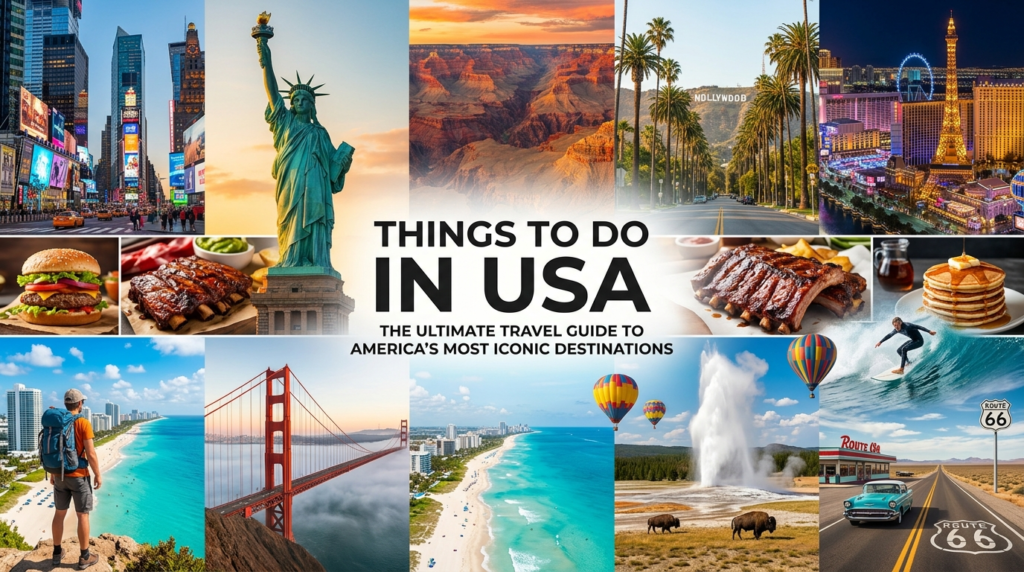
The United States of America is one of the most extraordinary countries on Earth — a vast, endlessly diverse nation of 50 states, six time zones, and an almost incomprehensible range of landscapes, cities, cultures, and experiences. From the granite towers of Manhattan rising above Central Park to the silent red canyon walls of the Grand Canyon, from the jazz-filled streets of New Orleans to the volcanic beaches of Hawaii, the USA offers something genuinely remarkable for every type of traveler who visits.
This USA travel guide covers the country’s most iconic cities, must-see natural wonders, essential planning information, and the cultural experiences that make America one of the world’s great travel destinations. Whether you are visiting for the first time or planning your return to discover new corners of this remarkable country, this guide gives you everything you need to plan the perfect American adventure.
Why Visit the USA?
What makes the USA so compelling as a travel destination is its sheer scale and variety. In a single trip, you can experience the cultural energy of New York City, the desert wonder of the Grand Canyon, the music traditions of Nashville, the tropical paradise of Hawaii, and the high-tech glamour of Los Angeles — all within a single country. American culture and lifestyle are equally diverse, shaped by wave after wave of immigration from every continent, producing cities where dozens of languages are spoken and cuisines from around the world are represented on every block.
The USA is also home to 63 national parks — some of the most spectacular protected landscapes on Earth. These parks protect everything from the geysers of Yellowstone to the redwood forests of California, from the glaciers of Alaska to the coral reefs of the Florida Keys. A road trip across USA through these landscapes is one of the world’s truly great travel experiences.
Famous landmarks in USA draw millions of visitors annually — the Statue of Liberty, the Golden Gate Bridge, the White House, Times Square, and the Hollywood Sign are globally recognized symbols that carry the weight of American history, culture, and mythology. Experiencing them in person carries a different charge than any photograph can convey.
Things to Do in New York City
City Overview
New York City is quite simply one of the greatest cities on Earth — a metropolis of eight million people spread across five boroughs, where the ambition, creativity, and diversity of the entire world seem to concentrate into a single relentlessly energetic place. It is the most visited city in the USA and rightfully sits at the top of virtually every list of global must-visit destinations. New York City attractions set the standard for world-class urban experiences.
Top Things to Do in New York
The Empire State Building, rising 1,454 feet from street to antenna, is the most iconic skyscraper in the world and a non-negotiable New York experience. The observation decks on the 86th and 102nd floors offer views across all five boroughs — on a clear day, you can see six states. Central Park is Manhattan’s 843-acre green heart — walk the Mall, rent a rowboat on the Lake, visit Strawberry Fields, or simply sit on the Great Lawn watching the city’s skyline as a backdrop. The High Line — an elevated park built on a former freight railway above the streets of the Meatpacking District and Chelsea — is one of New York’s most innovative and beautiful public spaces, lined with art installations, gardens, and sweeping Hudson River views.
Broadway theatre is a uniquely New York experience — there is nothing quite like watching a world-class musical or play in one of Midtown’s historic theatres. Times Square, the intersection of Broadway and Seventh Avenue, pulses with neon light and energy at all hours of the day and night — genuinely overwhelming at first, and genuinely thrilling once you surrender to it. The Statue of Liberty, reached by ferry from Battery Park, is one of America’s most powerful and moving monuments — a gift from France in 1886 that continues to symbolize freedom and welcome.
Best Places to Visit in New York City
- Empire State Building and Top of the Rock observation deck
- Central Park and the Metropolitan Museum of Art (The Met)
- Statue of Liberty and Ellis Island
- Times Square and Broadway
- The High Line and Chelsea Market
- Brooklyn Bridge and DUMBO
- 9/11 Memorial and Museum
- Museum of Modern Art (MoMA)
- Coney Island beach and boardwalk
Historical Places in New York City
The 9/11 Memorial and Museum, built on the footprints of the Twin Towers, is one of America’s most solemn and important historical sites — a profound tribute to the nearly 3,000 people who died in the September 11, 2001 attacks. Ellis Island, through which over 12 million immigrants passed between 1892 and 1954, is the symbolic gateway through which America was built. The Tenement Museum on the Lower East Side preserves the actual apartments where immigrant families lived in the 19th and early 20th centuries, bringing the city’s extraordinary immigration history to life with extraordinary intimacy.
Best Time to Visit New York City
Spring (April and May) and fall (September and October) offer the most pleasant weather for exploring New York on foot — mild temperatures, manageable crowds, and the city looking its most photogenic. Summer is hot, humid, and very busy but full of free outdoor concerts, films in the park, and beach days. Winter brings cold temperatures and the extraordinary magic of Christmas in New York — the Rockefeller Center tree, department store windows, and ice skating in Bryant Park.
Is New York City Safe?
New York City is safe for tourists. Crime rates have fallen dramatically since the 1990s and the city is now one of America’s most welcoming and well-policed major urban centers. Standard urban precautions apply — be aware of your surroundings, keep valuables secure in crowded areas, and use the subway confidently (it is safe and very efficient). Specific neighborhoods in all five boroughs are lively and welcoming at all hours.
Local Food in New York City
USA food and cuisine is nowhere more diverse or exciting than New York. A genuine New York pizza slice — thin crust, folded in half, eaten walking down the sidewalk — is a cultural institution. The city’s bagels, made with New York water that many claim gives them their distinctive chew, are genuinely different from bagels anywhere else. The food scene spans every cuisine imaginable — from Michelin-starred tasting menus in Midtown to $1 oysters at happy hour, from soup dumplings in Flushing Chinatown to the legendary pastrami sandwich at Katz’s Delicatessen on the Lower East Side (open since 1888).
New York City Itinerary (3 Days)
- Day 1: Empire State Building, Times Square, High Line, Chelsea Market, Hudson River sunset
- Day 2: Central Park, The Met, Upper West Side, Broadway evening show
- Day 3: Statue of Liberty, Ellis Island, Brooklyn Bridge walk, DUMBO, Brooklyn pizza
New York City Travel Cost
New York is one of the most expensive cities in the world, but it is also genuinely manageable on a range of budgets. The city’s subway system is affordable and connects virtually everywhere. Many of its greatest experiences — Central Park, the High Line, the Brooklyn Bridge, the Brooklyn Museum (suggested donation), the Staten Island Ferry (free) — cost nothing. Museum admission, Broadway tickets, and dining at top restaurants are significant costs. Your overall New York budget will depend primarily on your accommodation choice (the city’s biggest single expense) and how many ticketed attractions and experiences you include.
Things to Do in Washington DC
City Overview
Washington DC is America’s capital and its most historically and politically significant city — a planned federal city laid out in a perfect grid, filled with monuments, memorials, government buildings, and some of the world’s finest museums. What makes Washington DC genuinely extraordinary is that virtually all of its greatest attractions are completely free to enter. The Smithsonian Institution, the world’s largest museum and research complex, operates 17 museums and galleries in the city, all at no charge. This alone makes DC one of the world’s great museum cities.
Top Things to Do in Washington DC
Things to do in Washington DC begin on the National Mall — the grand two-mile-long open parkway connecting the Lincoln Memorial at one end to the Capitol Building at the other, lined with monuments, memorials, and museum buildings. Standing before the Lincoln Memorial and reading the text of the Gettysburg Address inscribed on its walls is an experience of genuine emotional power. The Washington Monument, the Vietnam Veterans Memorial, the Korean War Veterans Memorial, and the World War II Memorial each carry their own profound significance.
The Smithsonian’s National Museum of Natural History houses the Hope Diamond and one of the world’s finest natural history collections. The National Air and Space Museum contains the Wright Brothers’ original Flyer, the Apollo 11 command module, and artifacts from the Space Race that document some of humanity’s greatest achievements. The National Museum of American History tells the full story of America — including its darkest chapters — with exceptional depth and honesty. Georgetown, the city’s oldest neighborhood, offers beautiful Federal-style architecture, independent boutiques, and waterfront dining along the C&O Canal.
Historical Places in Washington DC
Ford’s Theatre, where President Abraham Lincoln was assassinated on April 14, 1865, is a working theatre that also preserves the exact box where Lincoln sat and operates an adjacent museum with the pistol, key artifacts, and a deeply moving account of that night. The Library of Congress, the world’s largest library, is also one of Washington’s most beautiful buildings — its Great Hall of richly decorated marble columns, mosaics, and painted ceilings is breathtaking. The Capitol Building’s stunning Rotunda, decorated with Constantino Brumidi’s fresco depicting George Washington, is one of America’s greatest architectural achievements.
Best Time to Visit Washington DC
Spring is the perfect time to visit — particularly late March and early April when the famous Japanese cherry blossoms bloom around the Tidal Basin, transforming the city into a spectacular pink canopy. Fall (September to November) offers comfortable temperatures and fewer crowds. Summer is hot and crowded. Winter is cold but offers the extraordinary sight of a snow-covered National Mall.
Is Washington DC Safe?
Washington DC is generally safe in the areas most relevant to tourists — the National Mall, Georgetown, Capitol Hill, and the major museum neighborhoods. Like all cities, DC has areas that require more awareness. The highly visible security presence around government buildings and monuments makes the central tourist zone particularly well-monitored.
Local Food in Washington DC
DC’s food scene has transformed dramatically in recent years into one of America’s most sophisticated. The city’s diversity drives a restaurant culture that spans West African, Ethiopian, Vietnamese, Latin American, and Chesapeake Bay seafood traditions. Maryland blue crab — steamed with Old Bay seasoning and eaten at a paper-covered communal table with a mallet — is one of the region’s definitive culinary experiences. Ben’s Chili Bowl on U Street, a Washington institution since 1958, serves the famous DC half-smoke (a pork and beef sausage) that Barack Obama publicly declared his favorite.
Washington DC Itinerary (2 Days)
- Day 1: National Mall — Lincoln Memorial, Vietnam Veterans Memorial, Washington Monument, National Museum of Natural History, Air and Space Museum
- Day 2: Capitol Building tour, Library of Congress, Ford’s Theatre, Georgetown waterfront
Washington DC Travel Cost
Washington DC is one of the best-value major city destinations in the USA. The Smithsonian museums, all National Mall memorials, and most of the city’s greatest outdoor spaces are completely free. Accommodation in the city itself can be expensive, but neighboring areas in Virginia and Maryland offer significantly more affordable options with excellent Metro connections. Food ranges from very affordable street food and food halls to upscale dining along 14th Street and Penn Quarter.
Things to Do in Miami
City Overview
Miami is America’s most glamorous and sun-drenched city — a subtropical metropolis on the southern tip of Florida where Art Deco architecture, Latin American culture, world-class beaches, and a vibrant nightlife scene combine into an experience unlike any other American city. Known as the Magic City, Miami is the gateway to both the Caribbean and Latin America, and its culture, music, food, and language reflect this extraordinary convergence.
Top Things to Do in Miami
Things to do in Miami begin at South Beach — the famous strip of white sand and turquoise Atlantic water backed by the pastel Art Deco buildings of Ocean Drive and Collins Avenue that defines Miami’s visual identity worldwide. The Art Deco Historic District, a National Historic Landmark, preserves over 800 buildings constructed between 1923 and 1943 in the distinctive Streamline and Tropical Deco styles — a walking tour through these streets is one of America’s great architectural experiences.
Wynwood Walls is Miami’s celebrated outdoor street art museum — a neighborhood of former warehouses transformed into one of the world’s most remarkable collections of large-scale murals by internationally acclaimed artists. Little Havana, the heart of Miami’s Cuban-American community, offers Calle Ocho (Eighth Street) with its domino players, cigar rollers, Cuban cafés, and the unique cultural energy of the Cuban diaspora. Everglades National Park, just an hour’s drive from Miami, is the third-largest national park in the continental USA — an utterly unique subtropical wilderness of sawgrass, mangrove, and cypress swamp, home to American alligators, manatees, and over 360 species of bird.
Historical Places in Miami
The Freedom Tower in downtown Miami — an ornate 1925 Spanish Renaissance Revival skyscraper — served as the processing center for Cuban refugees fleeing Castro’s revolution from 1962 to 1974 and is now a powerful museum of Cuban-American history. Coral Gables, the planned Mediterranean Revival suburb built in the 1920s, contains the spectacular Venetian Pool — a public swimming hole built in 1923 inside a former coral rock quarry, fed by natural springs.
Best Time to Visit Miami
November through April is Miami’s best season — dry, warm (but not oppressive), and with lower humidity than the summer months. December through March is peak season with the highest prices and busiest beaches. May through October is the wet season — afternoon thunderstorms are common and hurricane season runs June through November. Summer prices drop significantly and crowds thin, making it an interesting budget option despite the heat.
Is Miami Safe?
Miami is safe in its major tourist areas — South Beach, Wynwood, Brickell, Coconut Grove, and the Venetian Islands are all well-policed and comfortable for visitors. Standard urban precautions apply in all areas. The beach areas are particularly welcoming and well-patrolled.
Local Food in Miami
Miami’s food scene is one of America’s most exciting and diverse. Cuban food dominates — try a classic Cuban sandwich (ham, roasted pork, Swiss cheese, pickles, and mustard pressed in Cuban bread) from any local bakery. Ceviche from Miami’s Peruvian restaurants, arepas from Venezuelan spots in Doral, and Haitian griot (fried seasoned pork) from the Little Haiti neighborhood all reflect the city’s extraordinary Latin and Caribbean culinary heritage. Joe’s Stone Crab on South Beach, open since 1913, is an American institution — stone crab claws dipped in mustard sauce are a Miami delicacy.
Miami Itinerary (3 Days)
- Day 1: South Beach, Art Deco walking tour, Ocean Drive
- Day 2: Wynwood Walls, Little Havana, Calle Ocho, Coconut Grove
- Day 3: Everglades National Park airboat tour, sunset cruise on Biscayne Bay
Miami Travel Cost
Miami’s travel costs vary enormously depending on where you stay and what you do. South Beach hotel rooms command premium prices, while accommodation in Wynwood, Brickell, or Coral Gables offers better value with easy access to everything. Street food and local Cuban restaurants are extremely affordable. The beach itself is free, and Wynwood Walls entry is free. The Everglades airboat tour and nightlife activities are the main additional costs to factor into your Miami budget.
Things to Do in New Orleans
City Overview
New Orleans is America’s most unique and irreplaceable city — a place where French, Spanish, West African, Caribbean, and American cultures have blended over three centuries into something entirely its own. The food is incomparable, the music plays everywhere from morning to 3am, the architecture of the French Quarter is unlike anything else in North America, and the city’s approach to celebration, community, and life is deeply and genuinely infectious. New Orleans is the birthplace of jazz and one of America’s great culinary capitals.
Top Things to Do in New Orleans
Things to do in New Orleans begin in the French Quarter — the oldest neighborhood in the city, founded by the French in 1718 and rebuilt under Spanish rule in the late 18th century after devastating fires. Jackson Square, the heart of the French Quarter, is surrounded by artists, street musicians, tarot readers, and the stunning St. Louis Cathedral — the oldest continuously active cathedral in the USA. Bourbon Street — infamous for its 24-hour bars, live music, and relentless energy — runs through the heart of the Quarter. But the real soul of New Orleans lives in the quieter streets just off Bourbon — in the Frenchmen Street jazz clubs of the Marigny neighborhood, where local musicians play genuine New Orleans jazz without a cover charge.
The city’s above-ground cemeteries, known as the Cities of the Dead, are extraordinary architectural and cultural sites — New Orleans buries its dead above ground because the city sits below sea level, and the ornate marble tombs, family vaults, and mausoleums of St. Louis Cemetery No. 1 and Lafayette Cemetery No. 1 are among the most photogenic and atmospheric sites in America. The National WWII Museum, located in New Orleans and ranked among the world’s finest war museums, tells the full story of the Second World War with extraordinary multimedia exhibits that cover every major theater of the conflict.
Historical Places in New Orleans
The Cabildo, the building where the Louisiana Purchase was signed in 1803 (transferring a vast swath of North America from France to the USA), now houses the Louisiana State Museum’s most important collection. The Beauregard-Keyes House on Chartres Street is one of the finest surviving Greek Revival raised cottages in the French Quarter. The antebellum plantations along the River Road outside New Orleans — Oak Alley, Laura, and Whitney — are powerful historical sites that address the full history of the plantation system, including the lives of the enslaved people who built and maintained them.
Best Time to Visit New Orleans
February through April is the golden season — Mardi Gras (Fat Tuesday, the day before Ash Wednesday) is the city’s most spectacular festival, bringing hundreds of thousands of visitors for weeks of parades, music, and celebration. Spring Jazz Fest in late April and early May is another world-class event. October and November offer excellent weather and the city’s Halloween celebration is one of the most creative in America. Avoid midsummer — the heat and humidity are intense, and hurricane season peaks in August and September.
Is New Orleans Safe?
New Orleans requires more awareness than most American tourist cities. The French Quarter and the Garden District are generally safe for tourists during the day and evening. As in any city, avoid isolated streets late at night and be aware of your surroundings. The city’s vibrant street life and the presence of many visitors in the French Quarter makes it feel lively and relatively safe during normal tourist hours.
Local Food in New Orleans
New Orleans has one of the most distinctive and celebrated food cultures in America. Gumbo — a richly spiced stew thickened with okra or filé powder, containing seafood, sausage, or chicken — is the city’s signature dish. Jambalaya (a rice dish with meat and vegetables, Cajun-spiced) and étouffée (shellfish smothered in a buttery Cajun sauce) are equally essential. Beignets — square pillows of fried dough covered in powdered sugar — from Café Du Monde, open 24 hours on Jackson Square since 1862, are a New Orleans ritual. Po’boys (overstuffed French bread sandwiches with fried shrimp, oysters, or roast beef) and chargrilled oysters from the raw bar at Drago’s are other unmissable experiences.
New Orleans Itinerary (3 Days)
- Day 1: French Quarter walking tour, Jackson Square, St. Louis Cathedral, Café Du Monde beignets, Bourbon Street evening
- Day 2: Frenchmen Street jazz clubs, Lafayette Cemetery, Garden District mansions, po’boy lunch
- Day 3: National WWII Museum, Riverfront streetcar ride, River Road plantation day trip
New Orleans Travel Cost
New Orleans is one of America’s most affordable major tourist cities. Accommodation in the French Quarter ranges from budget guesthouses to luxury boutique hotels — but even mid-range options are reasonably priced by major city standards. Food is exceptional value — the city’s greatest culinary experiences are found in unpretentious neighborhood restaurants rather than expensive fine dining. The National WWII Museum has an admission fee but is worth every cent. During Mardi Gras, prices for accommodation spike dramatically — book months in advance for this period.
Things to Do in Chicago
City Overview
Chicago is America’s third-largest city and one of its most architecturally extraordinary — the birthplace of the modern skyscraper, a city of world-class museums and restaurants, a lakefront of breathtaking beauty, and a musical heritage that spans blues, jazz, soul, and house music. The Windy City sits on the southwestern shore of Lake Michigan and its waterfront, parks, and architectural grandeur make it one of America’s most genuinely beautiful urban environments.
Top Things to Do in Chicago
Things to do in Chicago begin at Millennium Park — the city’s magnificent 24.5-acre public park in the heart of the Loop, home to Cloud Gate (the beloved “Bean” — Anish Kapoor’s massive reflective steel sculpture), the Jay Pritzker Pavilion outdoor concert venue, and the Crown Fountain. The Chicago Riverwalk, along the south bank of the Chicago River through the downtown canyons of skyscrapers, is one of the world’s great urban promenades and the starting point for the city’s legendary architectural boat tours.
The Art Institute of Chicago — one of the oldest and largest art museums in the USA — holds a collection of exceptional quality, including Georges Seurat’s “A Sunday on La Grande Jatte” and Grant Wood’s “American Gothic.” The Willis Tower (formerly the Sears Tower) Skydeck on the 103rd floor has glass-floored ledges that jut out over the city 1,353 feet above the street — exhilarating for anyone willing to step out. Chicago’s blues and jazz heritage is celebrated in the many clubs of the South Side and the annual Chicago Blues Festival, one of the world’s largest free outdoor music festivals.
Historical Places in Chicago
The Chicago Water Tower, built in 1869, is one of the few structures that survived the Great Chicago Fire of 1871 and stands today as a landmark of the city’s remarkable resilience and rapid reconstruction. The Chicago Cultural Center, built in 1897, is one of the most beautiful public buildings in the USA — its Tiffany glass domes are the largest Tiffany stained glass domes in the world. The Hull House, founded by Jane Addams in 1889 as a settlement house for immigrants and the poor, is now a museum honoring one of America’s greatest social reformers.
Best Time to Visit Chicago
June through August is Chicago’s vibrant summer season — long, warm days, outdoor concerts, the lakefront beaches, and festivals including Lollapalooza make this the city’s most energetic season. Spring and fall are excellent for sightseeing with pleasant temperatures. Winter in Chicago is genuinely brutal — temperatures regularly drop below -10°C and the famous lake wind makes it feel even colder — but the city’s winter festivals and the charm of snow-covered Michigan Avenue have their own appeal.
Is Chicago Safe?
Chicago’s central tourist areas — the Magnificent Mile, Millennium Park, the Museum Campus, the Riverwalk, and Lincoln Park — are safe and welcoming for visitors. The city has higher crime rates in certain peripheral neighborhoods that tourists typically do not visit. Standard urban precautions apply throughout. Chicago’s architecture, culture, food, and lakefront make it a genuinely rewarding and very manageable destination.
Local Food in Chicago
Chicago has one of America’s most distinctive and fiercely debated food traditions. Chicago-style deep-dish pizza — a thick-crusted, sauce-on-top pie loaded with cheese and toppings and baked in a cast-iron pan — is one of America’s great regional specialties. Try it at Giordano’s or Lou Malnati’s. The Chicago-style hot dog — a steamed all-beef frankfurter on a poppy seed bun with yellow mustard, relish, chopped onion, tomato slices, sport peppers, and celery salt (absolutely no ketchup) — is another local institution. The city’s food scene beyond these classics is equally extraordinary, with exceptional steakhouses, James Beard Award-winning restaurants, and a world-class Chicago-style Italian beef sandwich scene.
Chicago Itinerary (3 Days)
- Day 1: Millennium Park (the Bean), Chicago Riverwalk, architectural boat tour, Willis Tower Skydeck
- Day 2: Art Institute of Chicago, Museum of Science and Industry, Lincoln Park Zoo
- Day 3: Blues club night, Chicago Cultural Center, day trip to Navy Pier or Wrigley Field
Chicago Travel Cost
Chicago is moderately priced by major US city standards — more affordable than New York or San Francisco but more expensive than New Orleans or Nashville. Millennium Park and the lakefront are free. Museum admission fees are reasonable. A deep-dish pizza for two is very affordable. Accommodation ranges from budget hostels to luxury hotels along the Magnificent Mile. Internal transportation via the ‘L’ train is efficient and affordable.
Things to Do in Las Vegas
City Overview
Las Vegas is one of the most extraordinary cities on Earth — a neon-lit entertainment capital rising from the Nevada desert where the rules of normal city life seem to be temporarily suspended. The Las Vegas Strip, a 4.2-mile stretch of Las Vegas Boulevard South lined with some of the world’s most extravagant hotels, casinos, and entertainment venues, is one of America’s most visited and photographed urban landscapes. Las Vegas things to do extend well beyond gambling into world-class dining, spectacular shows, and increasingly, access to some of the Southwest’s greatest natural wonders.
Top Things to Do in Las Vegas
Things to do in Las Vegas begin on the Strip — walk its length from the Luxor’s pyramid and sphinx to the Venetian’s replica Grand Canal and Bellagio’s choreographed fountain show (free to watch, running every 30 minutes). Fremont Street in old Downtown Las Vegas features the LED Fremont Street Experience — a 1,500-foot-long canopy of 16.4 million LEDs displaying massive light shows above the pedestrian street every night, and the world’s largest zipline. The Grand Canyon is 4 hours from Las Vegas by car — a day trip to the South Rim is one of the most dramatic excursions available from any American city.
Red Rock Canyon National Conservation Area, just 17 miles west of the Strip, offers a dramatically different perspective on Nevada’s landscape — a stunning geological red rock formation with excellent hiking, rock climbing, and scenic drives that feels completely removed from the neon world just behind you. Zion National Park, just 2.5 hours from Las Vegas in Utah, is one of America’s most spectacular national parks — its narrow slot canyons, towering sandstone cliffs, and the famous Angels Landing hike attract visitors from around the world.
Historical Places in Las Vegas
The Mob Museum (National Museum of Organized Crime and Law Enforcement) in downtown Las Vegas is one of America’s most compelling historical museums — housed in the former federal courthouse where hearings on organized crime were held in 1950, it tells the full story of the American Mafia with exceptional artifacts, interactive exhibits, and personal testimony. The Neon Museum on North Las Vegas Boulevard is a “boneyard” of retired neon signs from decades of Las Vegas history, preserving the visual heritage of the Strip’s golden era.
Best Time to Visit Las Vegas
Spring (March to May) and fall (September to November) are the most pleasant times to visit — temperatures are warm but not brutal, and the desert sun is manageable. Summer in Las Vegas is genuinely extreme — temperatures regularly exceed 110°F (43°C), making outdoor activities difficult though pool season in the desert is its own experience. Winter nights are surprisingly cold in the desert despite the warm days.
Is Las Vegas Safe?
Las Vegas is generally safe in the major tourist areas of the Strip and downtown. The casinos and hotels are heavily secured private environments. As in any city with a significant entertainment economy, petty theft and scams targeting tourists occur — keep valuables secure and be aware of unsolicited offers. The area immediately surrounding the Strip has higher crime rates in certain blocks — exercise standard awareness.
Local Food in Las Vegas
Las Vegas has evolved into one of America’s premier fine dining destinations, with virtually every major American celebrity chef operating a flagship restaurant on or near the Strip. Gordon Ramsay, Wolfgang Puck, José Andrés, and countless others have Las Vegas outposts. Beyond fine dining, Las Vegas buffets — though fewer in number than in previous decades — remain a cultural institution. For authentic local flavor, head to the Spring Mountains Road restaurant corridor, where extraordinary Vietnamese pho, Chinese dim sum, and Korean barbecue serve the city’s large Asian-American population at a fraction of Strip prices.
Las Vegas Itinerary (3 Days)
- Day 1: Strip walk, Bellagio Fountains, Venetian Grand Canal, Fremont Street Experience at night
- Day 2: Red Rock Canyon morning hike, day at a pool, celebrity chef dinner on the Strip
- Day 3: Day trip to Grand Canyon South Rim or Zion National Park
Las Vegas Travel Cost
Las Vegas operates on a uniquely variable pricing model. Mid-week hotel rooms on the Strip can be surprisingly affordable (casinos subsidize accommodation to get guests through the door), while weekend and event nights see prices multiply dramatically. Food costs range from very affordable buffets and food court options to extremely expensive tasting menus at celebrity restaurants. The biggest variable is, of course, gambling — which can represent no cost at all or any amount imaginable depending on your choices. Overall, a Las Vegas visit is very manageable on a wide range of budgets.
Things to Do in Los Angeles
City Overview
Los Angeles is the entertainment capital of the world — a sprawling, sun-drenched metropolis of four million people spread across a 503-square-mile basin between the Pacific Ocean and the San Gabriel Mountains. LA is where movies are made, trends are born, and the American dream takes its most visible and flamboyant form. The Los Angeles travel guide cannot be reduced to Hollywood alone — this is also a city of extraordinary museums, world-class beaches, exceptional food diversity, and access to some of California’s finest natural landscapes.
Top Things to Do in Los Angeles
Things to do in Los Angeles begin at the places that define its mythology. The Hollywood Walk of Fame runs along 1.3 miles of Hollywood Boulevard and Vine Street, embedding over 2,700 five-pointed stars honoring entertainment industry figures into the pavement. Griffith Observatory on the southern slope of Mount Hollywood offers the most spectacular views of the Los Angeles Basin, the Hollywood Sign, and the Pacific Ocean — and is one of the most iconic viewpoints in California. The Getty Center, a hilltop campus of extraordinary Richard Meier architecture, houses one of the world’s finest collections of European paintings, sculpture, and decorative arts, with panoramic views of the city and the Malibu coastline.
Santa Monica Pier and Venice Beach Boardwalk represent the quintessential Southern California beach experience — street performers, bodybuilders, skaters, and sunbathers all share the famous boardwalk in a spectacle that captures LA’s unique outdoor social culture. The Getty Villa in Malibu, modeled on a Roman country house and set above the Pacific, houses the Getty’s collection of ancient Greek, Roman, and Etruscan art. Joshua Tree National Park, three hours east of LA, is one of California’s most otherworldly desert landscapes — ancient Joshua tree forests among massive granite boulders, spectacular for hiking and stargazing.
Historical Places in Los Angeles
Olvera Street in downtown LA marks the original pueblo where the city was founded in 1781 — the oldest street in Los Angeles, lined with Mexican market stalls and restaurants, it preserves the city’s pre-American colonial heritage. The Bradbury Building (1893) in downtown is one of America’s most celebrated works of Victorian commercial architecture — its ornate iron railings, glazed roof, and open cage elevators have appeared in dozens of films. The La Brea Tar Pits in the Miracle Mile district is one of the world’s most remarkable paleontological sites — active tar pits in the middle of the city that have yielded over one million fossils of Ice Age megafauna.
Best Time to Visit Los Angeles
Los Angeles enjoys mild, Mediterranean weather virtually year-round, making it genuinely one of the most weather-reliable cities in the USA. June through August brings warm beach weather though a marine layer (known as June Gloom) can keep the coast overcast in the mornings. September through November is often considered the best month — warmer inland temperatures, less marine layer, and the fall light that makes the city particularly photogenic. December through February brings occasional rain but also the lowest hotel prices.
Is Los Angeles Safe?
Los Angeles requires contextual awareness. The primary tourist areas — Santa Monica, West Hollywood, Beverly Hills, Koreatown, Los Feliz, Silver Lake, and Downtown — are all generally safe and welcoming. LA’s famous unhoused population concentration in certain downtown areas (particularly Skid Row) requires awareness. Use rideshare apps rather than street taxis. The beach communities and museum districts are comfortable for all visitors.
Local Food in Los Angeles
Los Angeles has one of the world’s most exciting and diverse food cultures. The city’s enormous Mexican-American population means LA has the finest Mexican food outside of Mexico — tacos al pastor from Guisados in Boyle Heights, birria tacos from many East LA spots, and the vegetarian innovation happening across the city all push Mexican cuisine to extraordinary heights. Korean barbecue in Koreatown, Vietnamese pho in San Gabriel Valley, Japanese ramen in Little Tokyo, Ethiopian injera in Fairfax, and the farm-to-table Californian cuisine that originated here and spread worldwide — LA is one of the world’s essential food cities.
Los Angeles Itinerary (3 Days)
- Day 1: Griffith Observatory, Hollywood Walk of Fame, The Getty Center
- Day 2: Santa Monica Pier, Venice Beach Boardwalk, Abbot Kinney boutiques, sunset on the beach
- Day 3: Getty Villa Malibu, Beverly Hills and Rodeo Drive, Koreatown dinner
Los Angeles Travel Cost
Los Angeles is an expensive city primarily because of accommodation and transportation — the city is very spread out and a rental car or frequent rideshare use is essentially necessary. Budget travelers who use the Metro, eat at taco trucks and local markets, and visit free attractions (Griffith Observatory, the beach, the Getty Center) can manage reasonably. Mid-range and luxury travelers find LA caters well to all preferences. The biggest cost variable is the car — factor in either a rental or significant rideshare spending.
Things to Do in San Francisco
City Overview
San Francisco is one of America’s most beautiful, creative, and culturally distinctive cities — a compact seven-by-seven-mile peninsula packed with Victorian painted houses, steep hills, iconic bridges, extraordinary food, and the innovative spirit that has continuously reshaped the world from Silicon Valley to the west. The Golden Gate Bridge, Alcatraz, Fisherman’s Wharf, and the city’s famous cable cars are among America’s most recognized landmarks.
Top Things to Do in San Francisco
Things to do in San Francisco begin with the Golden Gate Bridge — the internationally recognized Art Deco suspension bridge completed in 1937 that spans the entrance to San Francisco Bay. Walking or cycling across the bridge (1.7 miles each way) in the morning, before the afternoon fog rolls in, offers spectacular views of the bay, the city skyline, and the Marin Headlands. Alcatraz Island — the former maximum-security federal penitentiary that housed Al Capone, Robert Stroud (the Birdman), and Machine Gun Kelly — is a fascinating and atmospheric historical site reached by a 15-minute ferry from Fisherman’s Wharf. The audio tour, narrated by former prisoners and guards, is one of the finest audio tours of any American attraction.
The Ferry Building Marketplace on the Embarcadero is a beautifully renovated 1898 ferry terminal that houses over 40 local food artisans — consider it the finest expression of San Francisco’s farm-to-table food culture in one building. Golden Gate Park, larger than Central Park, contains the de Young Museum of art, the California Academy of Sciences (housing a planetarium, aquarium, and natural history museum under one living roof), the Japanese Tea Garden, and miles of hiking and cycling trails. Chinatown — the oldest in North America, established in 1848 — remains one of the most vibrant and authentic Chinese neighborhoods outside Asia, with excellent restaurants, herbal medicine shops, and temples.
Historical Places in San Francisco
The Painted Ladies — the row of Victorian Stick-Eastlake houses on Steiner Street overlooking Alamo Square Park — are among the most photographed houses in America and represent the city’s extraordinary Victorian residential architectural heritage. Haight-Ashbury, the neighborhood that became the epicenter of the 1960s counterculture movement and the Summer of Love (1967), retains its bohemian character with vintage clothing stores, record shops, and murals celebrating the era. Mission Dolores (founded 1776) is the oldest intact building in San Francisco, built by the Spanish Franciscan missionaries who established the city.
Best Time to Visit San Francisco
September through November is the best time to visit — warm, clear, and with the least fog. The city’s famous fog (nicknamed Karl by locals) rolls in from the Pacific most reliably in June and July — a phenomenon called June Gloom that can keep the city gray and cool even in what should be summer. December through February is the rainy season, but the city remains functional and beautiful. Spring brings wildflowers to the surrounding hills.
Is San Francisco Safe?
San Francisco’s well-documented issues with property crime and its large unhoused population require honest acknowledgment. Tourist areas including Fisherman’s Wharf, Chinatown, Union Square, the Ferry Building, and the Marina are generally comfortable. The Tenderloin and certain SoMa streets require more awareness. Never leave valuables in a parked car — car break-ins are extremely common throughout the city. Rideshare apps are more reliable and safer than street taxis.
Local Food in San Francisco
San Francisco’s food culture is as distinctive as any in the USA. The Mission District’s burritos — massive, foil-wrapped cylinders of rice, beans, meat, and salsa from taquerias like La Taqueria and El Farolito — are a local institution that spawned a worldwide phenomenon. Dungeness crab, in season from November through June, is San Francisco’s definitive seafood experience — eaten cracked and cold at a Fisherman’s Wharf stall or prepared in cioppino (the local seafood stew) at a North Beach Italian restaurant. Sourdough bread from Boudin Bakery (baking since 1849, using the original starter culture) is another San Francisco institution that reflects the city’s Gold Rush heritage.
San Francisco Itinerary (3 Days)
- Day 1: Golden Gate Bridge walk, Sausalito ferry return, Fisherman’s Wharf, Alcatraz evening tour
- Day 2: Ferry Building, Mission District murals and burritos, Dolores Park, Castro neighborhood
- Day 3: Chinatown, Haight-Ashbury, Golden Gate Park, de Young Museum
San Francisco Travel Cost
San Francisco is one of America’s most expensive cities for accommodation — hotel prices are consistently high across most neighborhoods. Food ranges from very affordable (taqueria burritos, dim sum in the Richmond District) to extremely expensive (tasting menus at Michelin-starred restaurants). Public transport via BART and Muni is efficient and affordable. The Golden Gate Bridge, Golden Gate Park, and Coit Tower viewpoint are free. Alcatraz requires advance booking and a modest ferry/admission fee.
Things to Do in Nashville
City Overview
Nashville, Tennessee is America’s music capital — a city where live music plays virtually every hour of the day and night on Lower Broadway, where the world’s greatest country music artists got their start, and where a rapidly growing population has made it one of America’s most dynamic and exciting urban destinations. Known as Music City, Nashville combines its legendary country and Americana musical heritage with a world-class restaurant scene, thriving arts culture, and access to some of the South’s finest natural landscapes.
Top Things to Do in Nashville
Things to do in Nashville are anchored by Lower Broadway — the legendary honky-tonk district where neon signs, live music, and the smell of hot chicken create an irresistible atmosphere that has made Nashville one of America’s most visited cities. Every bar on the street has live music running from early afternoon until 3am, and most charge no cover — simply walk in, find a cold beer, and enjoy some of the finest country, rockabilly, and bluegrass music you will hear anywhere.
The Grand Ole Opry, the world’s longest-running live radio broadcast (since 1925), is Nashville’s most sacred musical institution — attending a show at the Grand Ole Opry House is a genuinely moving experience of American musical heritage. The Country Music Hall of Fame and Museum is one of America’s finest music museums, housing the world’s largest archive of country music artifacts — Elvis Presley’s “Solid Gold” Cadillac, Johnny Cash’s handwritten lyrics, and Taylor Swift’s stage costumes among them. The Johnny Cash Museum on Third Avenue is a beautifully curated tribute to the Man in Black.
Historical Places in Nashville
The Parthenon in Centennial Park — a full-scale replica of the Athenian Parthenon, built in 1897 and the only full-size replica in the world — houses a museum and the spectacular 42-foot replica of Athena Parthenos inside. Belle Meade Historic Site is an antebellum plantation estate that addresses the full history of slavery alongside the story of the thoroughbred horse breeding that made Nashville wealthy in the 19th century. The Fisk Jubilee Singers at Fisk University (founded 1866) have been performing since 1871 and their African American spiritual music tradition is one of Nashville’s most important cultural legacies.
Best Time to Visit Nashville
Spring (March to May) and fall (September to October) are Nashville’s best seasons — comfortable temperatures, outdoor festival season, and the city’s natural surroundings of rolling Tennessee hills looking their most beautiful. Summer is hot and humid but the music scene and outdoor activities remain vibrant. CMA Fest in June draws enormous crowds and requires accommodation booked months in advance.
Is Nashville Safe?
Nashville is generally safe in its major tourist areas — Lower Broadway, the Gulch, 12 South, East Nashville, and Germantown are all welcoming neighborhoods with active street life and strong community presence. Standard awareness applies throughout. The city’s rapid growth has brought increased activity to all areas.
Local Food in Nashville
Nashville is the birthplace of hot chicken — a fiercely seasoned fried chicken coated in a paste of cayenne and other spices that ranges from mild to genuinely incapacitating. Prince’s Hot Chicken Shack (where the dish was invented in the 1940s) and Hattie B’s are the essential addresses. Beyond hot chicken, Nashville’s food scene includes excellent meat-and-three diners (where you choose one meat and three side dishes from the steam table — collard greens, cornbread, mac and cheese, fried okra), exceptional BBQ at Martin’s Bar-B-Que Joint, and a sophisticated farm-to-table restaurant scene that has made the city a major dining destination.
Nashville Itinerary (2 Days)
- Day 1: Lower Broadway honky-tonks, Grand Ole Opry show (evening), Country Music Hall of Fame
- Day 2: Johnny Cash Museum, Belle Meade plantation, Centennial Park Parthenon, hot chicken dinner
Nashville Travel Cost
Nashville is one of America’s best-value major tourist cities. Accommodation is reasonably priced by big city standards. The music on Lower Broadway is mostly free (tip the performers generously). The Grand Ole Opry ticket is the main ticketed entertainment expense. Hot chicken and meat-and-three meals are very affordable. The city’s rapid growth has increased prices somewhat but it remains significantly more affordable than coastal metros.
Things to Do in Hawaii
Island Overview
Hawaii is America’s most extraordinary state — an archipelago of volcanic islands rising from the Pacific Ocean 2,400 miles southwest of California, where Polynesian culture, tropical rainforest, active volcanoes, and some of the world’s most beautiful beaches create an experience utterly unlike anywhere else in the USA or on Earth. Each of Hawaii’s main islands has its own distinct character: Oahu is the most visited and home to Honolulu; Maui offers the most diverse landscapes; the Big Island contains active lava flows; Kauai is the most lush and dramatic; and Molokai preserves the most authentic Hawaiian culture.
Top Things to Do in Hawaii
Things to do in Hawaii begin with the islands themselves — each offers a completely different experience. On Oahu, the USS Arizona Memorial at Pearl Harbor National Memorial is one of America’s most moving historical sites — the white marble structure floats above the sunken battleship where 1,177 American sailors remain entombed, killed in the December 7, 1941 Japanese attack that brought the USA into World War II. Diamond Head State Monument, the dramatic volcanic crater rising above Waikiki Beach, offers a rewarding 1.8-mile hike to 360-degree views of Honolulu and the Pacific.
On Maui, the Road to Hana — a 64-mile winding road through 59 bridges and over 600 curves along the jungle-covered northeastern coastline — is one of the world’s great drives. Haleakala National Park on Maui allows you to watch the sunrise from above the clouds at 10,023 feet — one of the most profound natural experiences available anywhere in the Pacific. On the Big Island, Hawaii Volcanoes National Park offers the extraordinary opportunity to watch active lava flows and walk through hardened lava fields around Kilauea, one of the world’s most continuously active volcanoes.
Historical Places in Hawaii
The Iolani Palace in Honolulu, built in 1882, was the official residence of the Hawaiian Kingdom’s last monarchs — Queen Liliuokalani was imprisoned here after the US-backed overthrow of the Hawaiian government in 1893, making it a site of profound historical and cultural significance for Native Hawaiian people. The Bishop Museum, established in 1889, is the largest museum in Hawaii and holds the world’s most extensive collection of Polynesian cultural artifacts, royal Hawaiian heirlooms, and natural history collections.
Best Time to Visit Hawaii
Hawaii is genuinely a year-round destination with warm tropical weather throughout the year. December through April is peak tourist season — whale watching season (humpback whales are in Hawaiian waters from December through May), lower humidity, and slightly drier weather. May through September is summer — slightly warmer and more humid, with excellent beach weather. Shoulder months of May, June, and September offer the best combination of good weather and lower prices.
Is Hawaii Safe?
Hawaii is one of the safest destinations in the USA. The main safety considerations are natural — ocean currents and wave conditions can be extremely dangerous on some beaches, and the volcanic landscapes of the Big Island require awareness of hazards. Always swim at beaches with lifeguard stations and respect ocean warning flags. Do not approach lava flows without a ranger.
Local Food in Hawaii
Hawaiian food culture is one of America’s most distinctive regional cuisines, blending Native Hawaiian, Japanese, Chinese, Korean, Filipino, and Portuguese influences. Poke — cubed raw fish (most commonly ahi tuna) marinated in soy sauce, sesame oil, and green onions — originated in Hawaii long before it became a worldwide phenomenon, and eating it from a local poke shop is a completely different experience from mainland versions. Plate lunch — a generous serving of protein, two scoops of white rice, and macaroni salad — reflects the Japanese bento box influence on Hawaiian working culture. The malasada (a Portuguese-influenced deep-fried doughnut rolled in sugar) from Leonard’s Bakery in Honolulu is a Hawaiian institution.
Hawaii Itinerary (7 Days)
- Day 1–3: Oahu — Pearl Harbor Memorial, Diamond Head hike, Waikiki Beach, North Shore surf watching
- Day 4–5: Maui — Road to Hana, Haleakala sunrise, Kaanapali Beach
- Day 6–7: Big Island — Hawaii Volcanoes National Park, black sand beaches, snorkeling with manta rays
Hawaii Travel Cost
Hawaii is the most expensive of America’s 50 states to visit, partly because everything must be shipped to the islands and partly because of the high demand from both domestic and international tourists. Accommodation ranges from budget hostels on Oahu to extraordinary luxury resort properties on Maui and the Big Island. The islands themselves — beaches, volcanic landscapes, hiking trails, and snorkeling spots — are free. The main costs are flights (booking well in advance helps significantly), accommodation, and inter-island flights if visiting multiple islands. Local plate lunch restaurants are genuinely affordable and serve excellent food.
USA National Parks — Must-Visit Natural Wonders
The national parks in USA are among the country’s greatest treasures — 63 protected areas encompassing some of the most spectacular landscapes on Earth.
Grand Canyon National Park (Arizona): One mile deep, 18 miles wide, and 277 miles long — the Grand Canyon is genuinely one of the most overwhelming natural sights on Earth. The South Rim is the most accessible, with paved viewpoints, guided ranger walks, and the famous Bright Angel Trail descending into the canyon’s layers of geology. Sunrise and sunset paint the canyon walls in colors that shift from pale gold to deep crimson with extraordinary drama.
Yellowstone National Park (Wyoming/Montana/Idaho): America’s first national park (established 1872) sits atop a supervolcanic hotspot and contains more geothermal features than anywhere else on Earth — including Old Faithful, the most famous geyser in the world (erupting approximately every 90 minutes). Yellowstone is also home to the largest bison herd in the USA, wolves reintroduced in 1995, and free-ranging grizzly bears.
Yosemite National Park (California): Yosemite Valley, carved by glaciers and framed by El Capitan (the world’s largest granite monolith) and Half Dome, is one of America’s most iconic landscapes. Yosemite Falls, the tallest waterfall in North America, and the Tunnel View (the panoramic view at the entrance to the valley) are among the most photographed scenes in the USA.
Zion National Park (Utah): Zion’s narrow slot canyons, towering red sandstone cliffs, and the Virgin River corridor make it one of the Southwest’s most dramatic landscapes. The Angels Landing trail — ending with a chain-assisted climb up a narrow spine of rock — is one of America’s most exhilarating hikes, while the Narrows (wading through the Virgin River between canyon walls) is uniquely immersive.
Great Smoky Mountains National Park (Tennessee/North Carolina): The most visited national park in the USA, the Smokies offer misty mountain ridges covered in ancient Appalachian forest, extraordinary wildlife including black bears, and the best remaining examples of traditional Appalachian culture and heritage.
Grand Canyon visit tips: Arrive at sunrise for the best light and fewest crowds. Carry more water than you think you need — the canyon is significantly hotter at lower elevations. The America the Beautiful annual pass ($80) provides access to all national parks and is essential value for any serious park visitor.
Recommended First-Timer USA Itinerary
For first-time visitors asking where to go in USA, these routes cover the essential experiences.
USA Itinerary 7 Days — East Coast Focus
- Day 1–3: New York City — Empire State Building, Central Park, Statue of Liberty, Brooklyn, Broadway
- Day 4: Washington DC — National Mall, Smithsonian museums, Lincoln Memorial
- Day 5: Flight or drive to New Orleans — French Quarter, evening jazz
- Day 6–7: New Orleans — WWII Museum, Garden District, Cajun food, return flight from New Orleans or onward
USA Itinerary 7 Days — West Coast Focus
- Day 1–2: Los Angeles — Hollywood, Getty Center, Santa Monica Beach
- Day 3: Drive to Las Vegas — Strip walk, Fremont Street
- Day 4: Grand Canyon day trip from Las Vegas
- Day 5: Drive to San Francisco via Death Valley or fly
- Day 6–7: San Francisco — Golden Gate Bridge, Alcatraz, Ferry Building, Chinatown
USA Itinerary 10 Days — Combined Best of
- Day 1–3: New York City
- Day 4: Washington DC
- Day 5: Flight to New Orleans
- Day 6: New Orleans
- Day 7: Flight to Las Vegas
- Day 8: Grand Canyon or Zion National Park day trip
- Day 9: Drive to Los Angeles
- Day 10: Los Angeles — return flight
USA Travel Tips and Practical Information
Visa and ESTA Requirements: Citizens of 42 countries (including UK, EU nations, Australia, Japan, South Korea, and others) can visit the USA visa-free for up to 90 days under the Visa Waiver Program using ESTA (Electronic System for Travel Authorization) — apply online at least 72 hours before departure. Citizens of most other countries require a B-2 tourist visa from a US Embassy or Consulate. Always check current requirements for your specific nationality.
Best Time to Visit USA Overall: The USA’s vast size means there is no single “best time” — it depends entirely on your destinations. Spring (April to June) and fall (September to October) offer pleasant conditions across most of the country. Summer is peak season for national parks and East Coast cities. Winter is ideal for Florida, Hawaii, and Southwest desert destinations.
Currency and Tipping Culture: The US Dollar is the currency. Tipping is a fundamental part of American culture and service economy — not an optional gesture. In restaurants, 18–20% of the pre-tax bill is standard. For bartenders, $1–2 per drink. For hotel housekeeping, $3–5 per night. For taxi and rideshare drivers, 15–20%. Not tipping in restaurants is considered deeply disrespectful as servers often earn most of their income from tips.
Getting Around: The USA is best explored by a combination of domestic flights (affordable when booked in advance), rental cars (essential for national parks, road trips, and many suburban areas), and rideshare apps (Uber and Lyft function well in all major cities). Amtrak trains connect many East Coast cities efficiently. The US interstate highway system makes a road trip across USA genuinely achievable and deeply rewarding.
Safety Tips: The USA is generally safe for international tourists. The main safety considerations are: petty theft in crowded tourist areas, car break-ins (never leave valuables visible), and area-specific awareness in certain urban neighborhoods. The USA also has a higher rate of gun ownership than any other wealthy nation — this is relevant context though it rarely affects tourist experiences.
Health Insurance: This is critically important for visitors to the USA. American healthcare costs are the highest in the world — a brief emergency room visit can cost thousands of dollars without insurance. Purchase comprehensive travel insurance with medical coverage before arriving. This is non-negotiable advice for any international visitor.
How to Plan a Trip to the USA
This USA travel planning guide recommends starting with your primary interest — cities, national parks, beaches, music, food, or history — and building your itinerary around a geographic region rather than trying to cover the entire country in one trip.
East Coast vs West Coast: East Coast cities (New York, Washington DC, Boston, Philadelphia, New Orleans) are dense, walkable, and connected by train. West Coast cities (Los Angeles, San Francisco, Seattle) require more driving and are separated by longer distances. The Southwest (Las Vegas, Grand Canyon, Zion, Arches) is a natural geography ideal for a dedicated road trip.
USA trip ideas for different travelers:
- History and culture: New York → Washington DC → Philadelphia → Boston (Amtrak Northeast Corridor)
- Music and food: Nashville → Memphis → New Orleans → Austin
- National parks: Las Vegas → Grand Canyon → Zion → Bryce Canyon → Arches → Mesa Verde
- Beaches and sun: Miami → Florida Keys → Hawaii (requires additional flight)
- City highlights: New York → Chicago → Los Angeles → San Francisco
American Culture and Lifestyle
American culture and lifestyle are shaped by the country’s founding principles — individualism, optimism, and the belief in reinvention — alongside the extraordinary diversity of its immigrant populations. The USA is a nation of regional identities as much as a unified national identity. The culture of New England (measured, historically minded, seafood-loving) is genuinely different from the culture of the Deep South (warm, religiously observant, BBQ-obsessed), which is different again from California (health-conscious, innovative, outdoor-oriented) or the Midwest (generous, community-focused, deeply proud).
Sport is central to American social life in ways that are genuinely different from most of the world — the NFL, NBA, MLB, and NHL command tribal loyalties and enormous public investment. Attending a live game is one of the most authentically American experiences available to any visitor.
The great American road trip — driving the Pacific Coast Highway, Route 66, the Blue Ridge Parkway, or the Alaska Highway — is an act of cultural as much as physical exploration, connecting you to the landscapes and communities that define this enormous and fascinating country.
Conclusion
The USA is the most visited country in the world for a simple reason: it delivers extraordinary experiences with remarkable consistency, across an almost incomprehensible range of landscapes, cities, and cultural environments. From the vertical drama of New York’s skyline to the geological poetry of the Grand Canyon, from the musical heritage of New Orleans and Nashville to the natural wonder of Hawaii’s volcanic islands, America continues to astonish visitors who arrive with open eyes and genuine curiosity.
This guide to things to do in USA has covered the country’s essential cities, most important natural wonders, practical planning information, and the cultural depth that makes any American journey more than just a series of sightseeing stops. The USA rewards travelers who go beyond the famous landmarks to engage with the country’s neighborhoods, food traditions, music scenes, and national parks — the places where America’s real character reveals itself most honestly and most beautifully.
Wherever your American journey takes you, one thing is certain: you will come home with stories worth telling for years.
FAQs — Things to Do in USA
1. What are the best cities to visit in the USA for first-time visitors?
New York City is essential. Washington DC (free museums), San Francisco, New Orleans, and Las Vegas with a Grand Canyon day trip round out the perfect first-timer circuit.
2. How much does it cost to travel to the USA?
Costs vary widely. New York, San Francisco, and Hawaii are expensive. New Orleans, Nashville, and national park areas offer much better value. The biggest cost for international visitors is often the flight rather than in-country spending.
3. Is the USA safe for tourists?
Yes, the USA is generally safe. Standard urban precautions apply. The most important advice is to purchase comprehensive travel insurance — American healthcare without coverage is extremely expensive.
4. What is the best time to visit the USA?
Spring (April–June) and fall (September–November) suit most regions. Summer is peak season for national parks. Winter brings lower prices and warm weather in Hawaii and Florida.
5. Do I need a visa to visit the USA?
Citizens of 42 countries can visit visa-free for 90 days using the ESTA system — apply online before departure. Other nationalities need a B-2 tourist visa. Check the official US government website for current requirements.
6. What are the best national parks in the USA?
Grand Canyon, Yellowstone, Yosemite, Zion, Great Smoky Mountains, Glacier, Arches, and Acadia top the list. The America the Beautiful annual pass covers all national parks and is excellent value.
7. What is a USA road trip like?
One of the world’s great travel experiences. The Pacific Coast Highway, Route 66, and the Blue Ridge Parkway are among the most scenic drives on Earth. Rental cars are affordable and the road system is very visitor-friendly.
8. What are the most famous landmarks in USA?
Statue of Liberty, Golden Gate Bridge, Grand Canyon, the White House, Mount Rushmore, Niagara Falls, the Hollywood Sign, Times Square, and the Gateway Arch in St. Louis.
9. What is USA food culture like?
A regional patchwork — New Orleans gumbo, Chicago deep-dish pizza, Nashville hot chicken, Texas BBQ, New England lobster rolls, and California farm-to-table cuisine. Every American city has its own distinct food identity.
10. How many days do I need to travel the USA?
10 to 14 days suits one region well — either an East or West Coast circuit. Three weeks lets you combine both coasts or add the national parks. The country genuinely rewards multiple visits.