
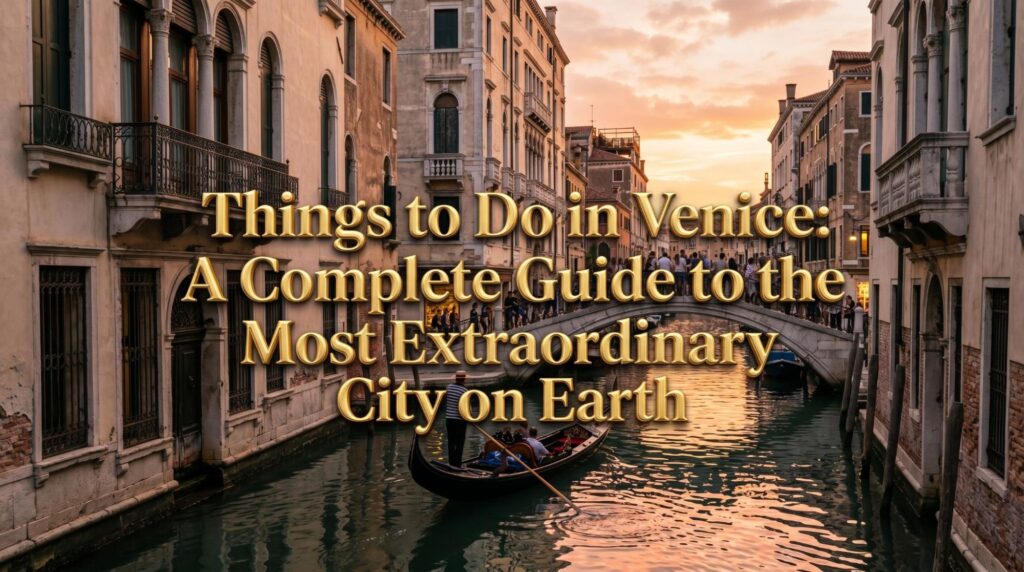
Venice: A City That Should Not Exist But Does So Magnificently
There is an argument to be made that Venice is the single most improbable, most audacious and most beautiful city ever built by human hands. Constructed across 118 small islands in a shallow lagoon in the northern Adriatic Sea, connected by 400 bridges spanning 150 canals and home to some of the most extraordinary Gothic, Byzantine and Renaissance architecture in the entire world, Venice defies every rational expectation of what a city can and should be. There are no roads for cars. There are no bicycles. There is no noise except the sound of water lapping against ancient stone foundations, the distant cry of gondoliers and the bells of churches that have been marking the hours for a thousand years. The things to do in Venice are as extraordinary, as layered and as unlike anything else in the world as the city itself.
This Venice travel guide is designed to help every type of traveler experience Venice with the depth, patience and genuine appreciation that this incomparable city deserves. Venice is not a city to rush through. It is a city to get lost in, to sit with, to eat in, to watch the light change over and to allow it to work its extraordinary magic on you at whatever pace it chooses. The travelers who complain that Venice is overrated are almost always the ones who spent a single crowded afternoon there without ever venturing beyond the Piazza San Marco into the quieter and more genuinely magical neighborhoods that make this city truly unforgettable.
Finding the Best of Venice
The best places to visit in Venice are distributed across an island city of remarkable density and variety where every neighborhood, every island and every canal has its own distinct character, history and atmosphere. Unlike Rome or Florence where the major attractions are clearly defined and geographically concentrated, Venice rewards wandering and discovery as much as it rewards arriving at a specific destination with a specific purpose.
The sestieri or six historic neighborhoods of Venice including San Marco, Cannaregio, Castello, Dorsoduro, San Polo and Santa Croce each offer a completely different experience of the city. San Marco contains the most famous landmarks and the most tourists. Cannaregio in the north is the most authentically residential and local. Castello in the east is the largest and least visited sestiere with a wonderful everyday Venetian character. Dorsoduro on the south bank is home to the finest museums and the most vibrant student and artistic community. San Polo and Santa Croce together form the commercial and market heart of the city around the Rialto.
The Greatest Attractions and Things to Do in Venice
Things to do in Venice begin with the architectural and artistic wonders that have made this city one of the most visited and most studied in the entire world and extend outward into the islands, food markets, quiet canals and neighborhood bacari wine bars that reveal the living and authentic character of Venetian life.
St. Mark’s Basilica
St. Mark’s Basilica is one of the most extraordinary and visually overwhelming buildings in the entire world. Built to house the relics of St. Mark the Evangelist which were brought to Venice from Alexandria in 828 AD, the current basilica dates primarily from the 11th century and represents one of the finest examples of Byzantine architecture in the Western world. Its five great domed roofs, its extraordinary mosaics covering over 8,000 square meters of interior surface and its facade encrusted with marble columns, sculptures and golden mosaics plundered from Constantinople and other conquered cities create an effect of such accumulated splendor that no visitor can fail to be overwhelmed. Book skip the line tickets in advance as queues for standard entry can be very long. The Pala d’Oro altarpiece and the Treasury contain some of the most extraordinary examples of Byzantine goldsmithing in existence and are well worth the additional entry fee.
Doges Palace Venice
The Doges Palace Venice is one of the most magnificent examples of Gothic architecture in the entire world and for centuries was the seat of political power, judicial authority and governmental administration of the Most Serene Republic of Venice, one of the most powerful and long lasting states in all of European history. The palace’s extraordinary facade of interlaced Gothic arches in pink Verona marble and white Istrian stone is an architectural achievement of remarkable sophistication and beauty. Inside the palace the state rooms are decorated with extraordinary paintings by Tintoretto, Veronese and other great Venetian masters including what is claimed to be the largest oil painting in the entire world, Tintoretto’s Paradise in the Great Council Chamber. The Bridge of Sighs connecting the palace to the adjacent prison is one of the most famous and most photographed landmarks in Venice. Book tickets well in advance.
Rialto Bridge Venice
The Rialto Bridge Venice is the oldest and most famous of the four bridges spanning the Grand Canal and one of the most instantly recognizable landmarks in all of Venice. Built in its current stone form between 1588 and 1591 to designs by Antonio da Ponte, the Rialto Bridge is a single span arch of extraordinary elegance lined with shops and offering outstanding views up and down the Grand Canal in both directions. The Rialto Market immediately north of the bridge on the San Polo bank of the Grand Canal is one of the finest and most atmospheric food markets in all of Italy with outstanding fresh fish, seafood, vegetables and fruit displayed in colorful abundance every morning from Tuesday to Saturday.
The Grand Canal
The Grand Canal is the main artery of Venice, a reverse S shaped waterway approximately 3.8 kilometers long that winds through the heart of the city flanked on both sides by some of the most magnificent palaces and buildings in the entire history of European architecture. Taking Vaporetto water bus line 1 which travels the full length of the Grand Canal from the railway station to St. Marks Square is one of the finest and most affordable ways to experience Venice from the water and should be among the very first things any visitor does upon arriving in the city.
Venice Carnival Guide
The Venice Carnival guide introduces one of the most spectacular, most atmospheric and most celebrated festivals in the entire world. The Venice Carnival which takes place in the weeks leading up to Lent every February is a tradition with roots stretching back to the 11th century and at its height in the 18th century was one of the most famous and most attended events in all of Europe. Today the carnival fills the streets, squares and canals of Venice with extraordinary masked and costumed figures, magnificent balls in historic palaces, outdoor performances and a collective atmosphere of mystery, beauty and theatrical excess that transforms the city into something even more extraordinary than it already is. Book accommodation many months in advance if you plan to visit during carnival as the city fills up very quickly.
Best Neighborhoods in Venice
Understanding the best neighborhoods in Venice is the key to experiencing the city beyond its most famous and most crowded landmarks and discovering the genuine and everyday character of Venetian life.
Dorsoduro
Dorsoduro is widely considered the most rewarding and most varied neighborhood in all of Venice for visitors who want to experience both outstanding cultural institutions and genuine local life in equal measure. It is home to the Gallerie dell’Accademia which is the greatest collection of Venetian painting in the world and the Peggy Guggenheim Collection which is the finest modern art museum in Italy. The waterfront Zattere promenade is the most beautiful and most peaceful waterfront walk in Venice with extraordinary views across the Giudecca Canal. The Campo Santa Margherita is the most authentically lively and local square in Venice, a large irregular campo where university students, local residents and visitors mix in the most natural and unpretentious way in the city.
Cannaregio
Cannaregio is the most densely populated and most authentically residential neighborhood in Venice and offers the finest opportunity to experience the city as its actual inhabitants rather than its visitors experience it. The neighborhood is home to the Venetian Ghetto which was the first ghetto in the entire world, established in 1516 and home to an extraordinary concentration of synagogues and a deeply moving museum dedicated to Jewish Venetian history. The Fondamenta della Misericordia and Fondamenta degli Ormesini are the finest bacari streets in Venice, lined with small wine bars where locals drink ombra glasses of local white wine and eat cicheti small snacks standing at the bar in one of the most authentically Venetian social rituals imaginable.
San Polo
San Polo is the smallest sestiere in Venice but one of the most rewarding containing the extraordinary Frari Church which houses Titian’s magnificent Assumption of the Virgin above the high altar, the Scuola Grande di San Rocco with its extraordinary ceiling paintings by Tintoretto and the magnificent Rialto Market. It is also one of the most pleasant and least tourist heavy neighborhoods for evening dining and drinking.
Best Museums in Venice
The best museums in Venice reveal the extraordinary artistic heritage of a city that for centuries was one of the wealthiest, most powerful and most culturally productive states in the entire world.
The Gallerie dell’Accademia in Dorsoduro is the greatest single collection of Venetian painting in existence covering the full sweep of the Venetian school from the 14th century to the 18th century including masterpieces by Bellini, Carpaccio, Giorgione, Titian, Tintoretto and Veronese. The Peggy Guggenheim Collection occupies the unfinished Palazzo Venier dei Leoni directly on the Grand Canal and houses one of the finest collections of modern and contemporary art in Europe including outstanding works by Picasso, Kandinsky, Mondrian, Pollock, Dali and many others. The Ca d’Oro on the Grand Canal houses the Galleria Franchetti with a beautiful collection of paintings and sculptures in one of the finest Gothic palaces in Venice. The Museo Correr in St. Marks Square provides the most comprehensive and intelligently presented overview of Venetian history and culture of any museum in the city.
Venice Food Guide
The Venice food guide reveals a culinary tradition that is deeply rooted in the lagoon environment, the Adriatic Sea and the centuries of international trade that made Venice one of the great crossroads of flavors and ingredients in the entire world.
Essential Venetian Dishes and Foods
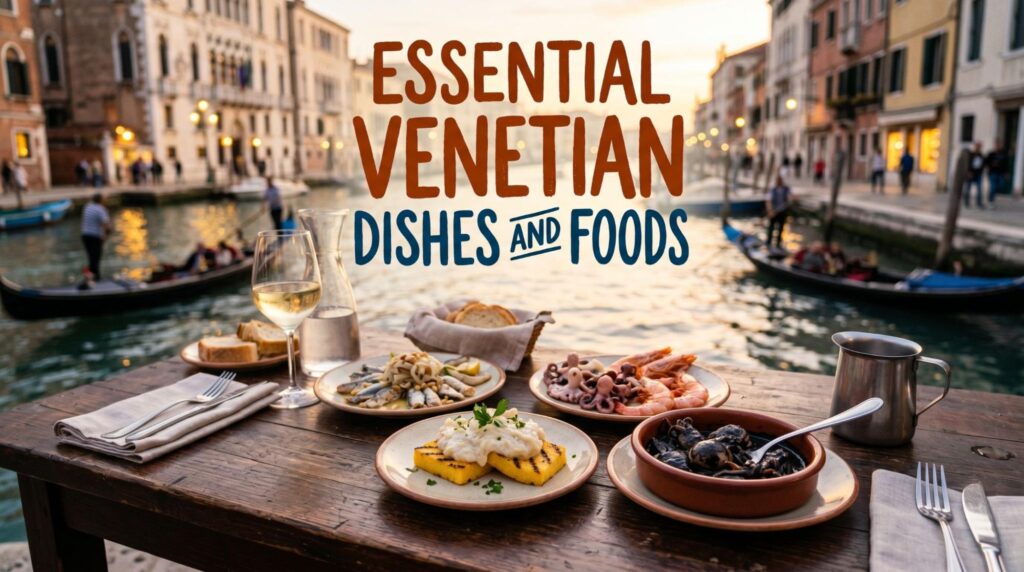
Cicheti are the most fundamentally and authentically Venetian food experience available, small bite sized snacks ranging from simple bread with salt cod cream to elaborate compositions of marinated vegetables, grilled polenta and fresh seafood that are served in bacari wine bars throughout the city and eaten standing at the bar with a small glass of local wine in a social ritual that is completely unique to Venice. Sarde in Saor is the most ancient and most distinctly Venetian dish in existence, sweet and sour marinated sardines with onions, pine nuts, raisins and vinegar in a recipe that has been unchanged since medieval times when it served as a method of preserving fish during long sea voyages. Risi e Bisi is a classic Venetian dish of rice and fresh peas that sits somewhere between a risotto and a soup and was traditionally served to the Doge on the feast day of St. Mark. Bigoli in Salsa is thick whole wheat spaghetti served with a deeply savory sauce of slow cooked onions and anchovy paste that is one of the most honest and satisfying pasta dishes in the Venetian repertoire. Fritto Misto di Mare is a magnificent mixed fry of fresh seafood including squid, shrimp, soft shell crab and small fish that showcases the extraordinary quality of fresh Adriatic seafood available in Venice.
Where to Eat and Drink in Venice
The most important piece of advice for eating well in Venice is to avoid any restaurant that displays photographs of its food on an outdoor menu board or that employs someone to stand outside and invite passing tourists to come in. These establishments are universally tourist traps offering mediocre food at inflated prices. Instead seek out the bacari wine bars of Cannaregio and San Polo for cicheti and ombra wine, the trattorias of Castello and Dorsoduro for genuine home style Venetian cooking and the Rialto Market area for the most vibrant and atmospheric food shopping experience in the city.
Day Trips From Venice
The day trips from Venice available to visitors allow for an excellent and varied exploration of the broader Veneto region and the extraordinary landscapes and cities that surround the lagoon.
Verona is the most rewarding and most frequently visited day trip from Venice, a magnificent city of Roman ruins, medieval architecture and Renaissance art that is most famous internationally as the setting of Shakespeare’s Romeo and Juliet. The journey from Venice takes approximately 70 minutes by train. Padua is a beautiful and deeply historic university city just 30 minutes from Venice by train home to one of the most extraordinary and moving rooms in all of Italian art history, the Scrovegni Chapel where Giotto’s extraordinary fresco cycle painted between 1303 and 1305 covers every surface of the interior with a completeness and emotional power that has rarely been equaled in Western art. The Brenta Riviera is a beautiful stretch of the Brenta River lined with magnificent Palladian villas that were the summer residences of wealthy Venetian noble families and can be explored by boat, bicycle or car. Treviso is a charming and largely overlooked medieval city just 30 minutes from Venice with beautiful frescoed walls, excellent food and virtually no tourists.
Getting Around Venice
Getting around Venice is one of the most immediately unusual and enjoyable aspects of visiting this extraordinary city. There are no cars, no buses, no bicycles and no motorcycles anywhere in Venice. Movement through the city is entirely on foot or by water.
On foot is by far the finest and most rewarding way to explore Venice. The city is compact enough that virtually all destinations in the historic center are reachable on foot though the route between any two points is rarely straightforward and getting pleasantly lost is an inevitable and enjoyable part of the Venetian experience. The Vaporetto water bus network operated by ACTV serves the Grand Canal and all the outer islands with a comprehensive timetable. The most useful routes for visitors are line 1 which travels the full length of the Grand Canal very slowly stopping at every landing and line 2 which covers the same route more quickly. A 24 hour, 48 hour or 72 hour Vaporetto travel pass offers excellent value for visitors planning to use the water buses frequently. Water taxis are available throughout the city but are expensive. Gondola rides are primarily a tourist experience rather than a practical means of transport but taking a traghetto gondola ferry which crosses the Grand Canal at several points for a very small fee is an authentic and affordable way to experience a gondola briefly as actual Venetians use them.
Venice Itinerary
Venice Itinerary 3 Days
A Venice itinerary of 3 days gives you enough time to experience the essential highlights of this extraordinary city while also allowing time to get genuinely lost in its quieter and more authentic corners.
Day 1 begins with St. Marks Basilica and the Doges Palace in the morning followed by a Vaporetto ride the full length of the Grand Canal in the afternoon and an evening spent exploring the bacari and cicheti bars of the Cannaregio neighborhood.
Day 2 is devoted to Dorsoduro beginning with the Gallerie dell’Accademia in the morning followed by the Peggy Guggenheim Collection in the early afternoon, a walk along the Zattere waterfront and an evening in the Campo Santa Margherita.
Day 3 begins with an early morning visit to the Rialto Market followed by the Frari Church and the Scuola Grande di San Rocco in the San Polo neighborhood and an afternoon boat trip to the islands of Murano and Burano.
Extended Venice Itinerary
A Venice itinerary of five or more days allows for a much more complete and deeply rewarding exploration of the city including all six sestieri, the outer islands of Murano, Burano and Torcello, day trips to Verona and Padua and extended time in the food markets, bacari and quieter neighborhoods that reveal the genuine living character of this extraordinary city.
Best Time to Visit Venice
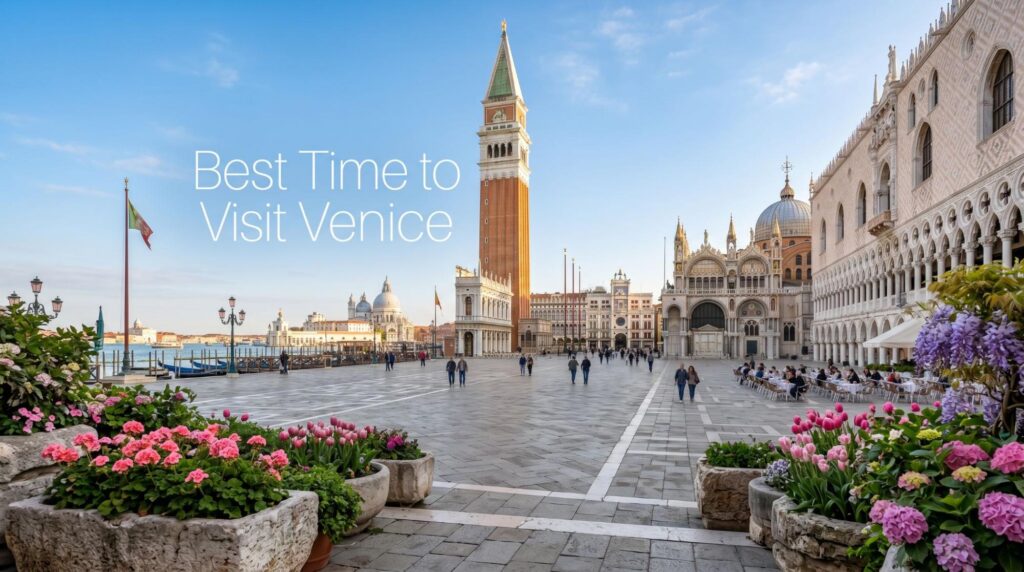
The best time to visit Venice is from April to June and September to October when the weather is warm and pleasant, the light on the water and the buildings is extraordinary and the summer crowds have not yet reached their overwhelming peak or have begun to thin.
July and August are the hottest and most crowded months in Venice with temperatures regularly exceeding 33 degrees Celsius and the city becoming extremely and sometimes uncomfortably busy especially around St. Marks Square and the Rialto. The Acqua Alta flooding season runs from October through to January and while it does not prevent visiting the city it does require the use of raised walkways in the lowest lying areas and waterproof footwear.
November to March outside of the Carnival period offers the quietest and most atmospheric experience of Venice with dramatically reduced crowds, very affordable accommodation prices and a misty and melancholic beauty that many visitors find the most genuinely Venetian and the most moving of all the seasonal moods of this extraordinary city.
Is Venice Safe for Tourists
Is Venice safe for tourists is a question that most first time visitors ask before planning their trip. Venice is an extremely safe city with virtually no violent crime and a tourism infrastructure of great experience and professionalism. The most common concern for visitors is the risk of becoming lost in the labyrinthine streets which is more of an enjoyable inevitability than a genuine safety concern. Pickpocketing can occasionally occur in the most crowded areas around St. Marks Square and on busy Vaporetto routes. Keep your belongings secure and be aware of your surroundings in very crowded spaces. Venice is one of the safest cities in all of Italy for tourists.
Venice Travel Budget
Understanding your Venice travel budget before you arrive will help you plan a genuinely enjoyable experience of this extraordinary city without unwanted financial surprises.
Venice is significantly more expensive than most Italian cities due to the logistical complexity of supplying an island city with all the goods and services its residents and visitors require. Budget travelers staying in hostels and eating cicheti at bacari can manage on approximately 80 to 110 dollars per day. Mid-range travelers staying in comfortable hotels and dining at good restaurants should budget between 150 and 250 dollars per day. Luxury travel in Venice including the extraordinary historic palace hotels along the Grand Canal, private gondola experiences and fine dining starts from 400 dollars per day and can go considerably higher.
Budget travel in Venice requires smart choices and an understanding of where the value lies. Eating standing up at bacari wine bars is dramatically more affordable than sitting down at a restaurant and produces a far more authentic and enjoyable Venetian food experience. The Vaporetto travel pass represents excellent value. The best views in Venice including the Piazzale San Marco waterfront, the view from the Rialto Bridge and the view from the Campanile bell tower are either free or very affordable.
Closing Thoughts
Venice is a city that operates on its own completely separate logic from the rest of the world and rewards those who are willing to surrender to that logic entirely. Whether you are watching the dawn light spread across the Grand Canal from the Rialto Bridge before the city wakes, eating your first plate of sarde in saor in a tiny bacaro in Cannaregio while locals discuss the day around you, standing before Tintoretto’s Paradise in the vast and gilded Great Council Chamber of the Doges Palace or simply sitting on a fondamenta canal bank dangling your feet above the water as a gondola drifts silently past, the things to do in Venice create a quality of experience and memory that is genuinely and completely unlike anything else that travel can offer.
This Venice travel guide has covered the essential landmarks, neighborhoods, museums, food culture, islands, day trips and practical information you need to plan an extraordinary visit to one of the greatest and most extraordinary cities in the entire history of human civilization.
Frequently Asked Questions
What are the best things to do in Venice?
The best things to do in Venice include visiting St. Marks Basilica and the Doges Palace, riding the Vaporetto along the Grand Canal, exploring the Gallerie dell’Accademia, eating cicheti at bacari wine bars in Cannaregio, visiting the islands of Murano and Burano and getting wonderfully lost in the quieter neighborhoods away from the main tourist crowds.
How many days do I need in Venice?
A Venice itinerary of 3 days covers the essential highlights comfortably. A Venice itinerary of five or more days allows for a much more complete exploration including the outer islands, day trips to Verona and Padua and deeper immersion in the quieter neighborhoods.
What is the best time to visit Venice?
The best time to visit Venice is from April to June and September to October for the finest combination of pleasant weather, manageable crowds and the most beautiful light on the water and the buildings.
Is Venice safe for tourists?
Yes. Is Venice safe for tourists is a common concern but Venice is one of the safest cities in Italy with virtually no violent crime. The main advice is to keep belongings secure in crowded areas around St. Marks Square.
What is the Doges Palace like?
The Doges Palace Venice is one of the most magnificent Gothic buildings in the world and the former seat of political power of the Venetian Republic housing extraordinary paintings by Tintoretto and Veronese and the famous Bridge of Sighs connecting the palace to the adjacent prison.
What is the Rialto Bridge like?
The Rialto Bridge Venice is the oldest bridge spanning the Grand Canal, built between 1588 and 1591 and lined with shops offering outstanding views up and down the Grand Canal. The adjacent Rialto Market is one of the finest food markets in all of Italy.
What are the best day trips from Venice?
The best day trips from Venice include Verona for its Roman ruins and medieval architecture, Padua for Giotto’s extraordinary Scrovegni Chapel frescoes, the Brenta Riviera for magnificent Palladian villas and Treviso for an authentic and largely tourist-free medieval city experience.
What is the Venice Carnival like?
The Venice Carnival guide describes one of the most spectacular festivals in the entire world, a tradition with roots stretching back to the 11th century that fills Venice every February with extraordinary masked and costumed figures, magnificent balls in historic palaces and a collective atmosphere of mystery and theatrical beauty that is completely unique.