
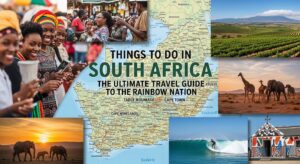
There are very few countries on Earth that can match the sheer scale of experiences packed into a single destination. South Africa is one of them. In a single trip, you can watch lions stalk across golden savannah at sunrise, stand at the tip of a continent where two oceans collide, sip world-class wine in valleys of breathtaking beauty, explore townships full of art and resilience, surf world-class waves, and hike trails through mountain wilderness that has existed for billions of years. South Africa is not simply a travel destination. It is a world within a world.
So why visit South Africa? Because nowhere else offers this extraordinary combination of wildlife, history, natural beauty, cultural depth, and warmth of welcome in one place. The country carries the weight of a complicated past — the apartheid era that shaped its politics, its landscape, and its people — alongside the extraordinary spirit of reconciliation and hope that followed. Understanding South Africa means engaging with all of it, and for travelers who do, the experience is genuinely life-changing.
This complete guide covers the best things to do in South Africa, region by region and city by city, so you can plan the adventure of a lifetime.
Why Visit South Africa?
What is South Africa famous for? The Big Five — lion, leopard, elephant, rhino, and buffalo — draw safari lovers from across the globe to its legendary national parks, above all the iconic Kruger National Park. Cape Town Table Mountain, one of the New Seven Wonders of Nature, is one of the most recognizable and photographed landmarks in the world. The Garden Route South Africa offers one of the most beautiful coastal drives on any continent. South Africa’s wines rival the best in France and Italy. And the history of Nelson Mandela, the anti-apartheid struggle, and the birth of democracy in 1994 gives the country a political and moral story that continues to resonate worldwide.
South Africa is a country of eleven official languages, dozens of distinct cultural identities, and an extraordinary range of landscapes — from the Kalahari Desert to the Drakensberg Mountains, from Mediterranean coastal cliffs to subtropical Indian Ocean beaches. It is, as its own people call it, the Rainbow Nation — and that rainbow is visible in every city, every neighborhood, and every plate of food you encounter here.
Things to Do in Cape Town
City Overview
Cape Town is regularly voted one of the most beautiful cities in the world, and standing at its waterfront — with the flat-topped silhouette of Table Mountain rising behind you and the Atlantic Ocean spread before you — it is easy to understand why. Known affectionately as the Mother City, Cape Town was founded in 1652 by the Dutch East India Company and has grown into a vibrant, cosmopolitan metropolis that blends extraordinary natural scenery with rich cultural heritage, world-class food, and a genuinely warm, creative spirit. It is South Africa’s most visited city and the starting point for most international travelers.
Top Things to Do in Cape Town
Things to do in Cape Town begin with Table Mountain — always. Rising 1,085 meters above the city, this ancient flat-topped sandstone massif is a UNESCO World Heritage Site and the anchor of the entire Cape Peninsula landscape. Take the revolving cable car to the summit for panoramic views stretching from the Atlantic Ocean to the Cape Peninsula, or hike one of several trails to the top — the Platteklip Gorge route is the most popular. Go early in the morning to avoid both queues and the afternoon clouds that frequently drape themselves across the summit like a tablecloth.
A Robben Island tour is one of South Africa’s most powerful and important experiences. The island, just off the V&A Waterfront, served as a maximum-security prison during the apartheid era and is where Nelson Mandela was imprisoned for 18 of his 27 years behind bars. Today it is a UNESCO World Heritage Site, and guided tours are led by former political prisoners who bring the history to life with a personal authority no book or film can replicate. Mandela’s tiny cell, the limestone quarry where prisoners broke rocks in the blazing sun, the isolation ward — all of it is deeply moving and utterly essential for understanding modern South Africa.
The V&A Waterfront is Cape Town’s heart — a beautifully redeveloped historic harbour complex with excellent restaurants, craft markets, the Two Oceans Aquarium, art galleries, and the ferry terminal for Robben Island. Cape Town Table Mountain, Boulders Beach (home to a colony of African penguins), the Cape of Good Hope, Chapman’s Peak Drive, and the Bo-Kaap neighborhood with its rainbow-painted houses and Cape Malay heritage all deserve full-day explorations of their own.
Best Places to Visit in Cape Town
- Table Mountain and Cape Point Nature Reserve
- Robben Island
- V&A Waterfront
- Bo-Kaap neighborhood
- Boulders Beach (African penguins)
- Camps Bay and Clifton beaches
- Chapman’s Peak Drive
- Kirstenbosch National Botanical Garden
- District Six Museum
- Constantia Wine Valley
Historical Places in Cape Town
The Castle of Good Hope, completed in 1679, is the oldest surviving colonial building in South Africa. The District Six Museum tells the devastating story of how 60,000 non-white residents were forcibly removed from their homes by the apartheid government in 1966. The Slave Lodge, one of Cape Town’s oldest buildings, now serves as a museum exploring the long history of slavery at the Cape. Bo-Kaap, with its mosques and brightly painted terraced houses, is the living cultural heart of Cape Malay heritage — descendants of enslaved people and political exiles brought from Dutch colonies in Southeast Asia centuries ago.
Best Time to Visit Cape Town
November through March is Cape Town’s summer — warm, sunny, and dry, perfect for beaches and outdoor activities. This is peak tourist season, so accommodation should be booked well in advance. April to June brings mild autumn weather that is excellent for sightseeing. July and August are winter months with cool temperatures and some rain, but also fewer crowds and lower prices. Spring (September to October) brings wildflowers and whale sightings along the coast.
Is Cape Town Safe?
Cape Town is generally safe in tourist areas, but like all large South African cities, requires common-sense precautions. Stick to well-populated tourist zones, particularly after dark. Avoid isolated hiking trails alone. Keep valuables out of sight in vehicles. Cape Town’s tourist areas — the V&A Waterfront, the Winelands, the Cape Peninsula — are well-patrolled and safe for international visitors who stay aware of their surroundings.
Local Food in Cape Town
Cape Town’s food scene is one of the most exciting in Africa. South African culture and traditions have produced a uniquely layered cuisine in the Cape, where Cape Malay spicing, indigenous African ingredients, and European colonial traditions all blend together. Try bobotie — a Cape Malay classic of curried minced meat baked with a savoury egg custard topping, served with yellow rice and chutneys. Gatsby sandwiches — massive, overfilled rolls with hot chips and various fillings — are a Cape Town institution. Fresh West Coast seafood, particularly crayfish, snoek (a local fish), and grilled linefish, is exceptional. Pair everything with a glass from one of the Constantia Valley estates and you have one of the finest meals available anywhere on the continent.
Cape Town Itinerary (4 Days)
- Day 1: Table Mountain cable car, V&A Waterfront, Bo-Kaap walking tour
- Day 2: Robben Island ferry, District Six Museum, Bree Street evening dining
- Day 3: Cape Peninsula — Boulders Beach penguins, Cape of Good Hope, Chapman’s Peak Drive
- Day 4: Kirstenbosch Gardens, Constantia wine tasting, Camps Bay sunset
Cape Town Travel Cost
Travel costs in Cape Town span a remarkably wide range. Budget travelers can find excellent hostel accommodation, use shared transport, and eat at local market stalls very affordably. Mid-range visitors enjoy charming guesthouses and a wonderful array of neighbourhood restaurants at moderate prices. The Robben Island ferry, cable car to Table Mountain, and wine estate visits all carry entrance fees that should be factored into your daily budget. Overall, your Cape Town spending will reflect the experiences you choose — the city genuinely caters to every budget level without compromising on quality.
Things to Do in Johannesburg
City Overview
Johannesburg — Jo’burg or Joburg to locals — is South Africa’s largest city and its economic powerhouse. Built on gold, literally (the city sits on the world’s largest gold reef, discovered in 1886), it grew explosively from a mining camp into a sprawling metropolis of over 6 million people. It is not a conventionally beautiful city, but it is endlessly fascinating — a place of stark contrasts, remarkable resilience, and a cultural energy that nowhere else in Africa quite matches. Soweto, the historic township where both Nelson Mandela and Archbishop Desmond Tutu once lived, is one of the most important places in all of South African history.
Top Things to Do in Johannesburg
Things to do in Johannesburg begin at the Apartheid Museum — one of the finest and most powerful museums in the world. Through photographs, film, artifacts, and deeply personal testimonies, it tells the full story of South Africa’s apartheid era from its racist foundations to its eventual dismantling. The museum’s design itself — with separate entrances for “whites” and “non-whites” — is a deliberate, confronting act that sets the emotional tone immediately. Allow at least three hours.
A Soweto township tour is another essential experience. This vast urban township was the birthplace of the anti-apartheid struggle and is today a vibrant, complex community of over a million people. Visit the Hector Pieterson Memorial, commemorating the 1976 student uprising. Walk along Vilakazi Street, the only street in the world to have housed two Nobel Peace Prize winners (Nelson Mandela and Desmond Tutu). Visit the Mandela House museum, a modest home that speaks volumes about a man of extraordinary humility. Soweto today is also home to excellent restaurants, craft markets, and a thriving creative scene.
The Maboneng Precinct is Johannesburg’s creative neighbourhood reborn — a formerly industrial area now full of galleries, design studios, restaurants, and street art. Constitution Hill, the site of the Constitutional Court (where South Africa’s post-apartheid constitution was drafted), incorporates the old Fort prison where both Mahatma Gandhi and Nelson Mandela were once held.
Historical Places in Johannesburg
The Gold Reef City complex, built around the Crown Mines goldfield, offers underground tours of a historic gold mine — a visceral reminder of the labour and exploitation upon which the city was built. Constitution Hill’s Old Fort and Women’s Jail, now part of the Constitutional Court complex, represents both the darkest chapters of South African history and the triumph of democracy that followed.
Best Time to Visit Johannesburg
May through September is the best time — dry season brings clear skies and comfortable temperatures. Summers (October to March) bring afternoon thunderstorms and humidity but lush green landscapes. Winter nights can be surprisingly cold at Johannesburg’s altitude of 1,753 meters.
Is Johannesburg Safe?
Johannesburg has a reputation for crime that requires honest acknowledgement. While millions of tourists visit safely every year, it is the city in South Africa that requires the most caution. Stick to established tourist areas — Sandton, Maboneng, the Waterfront at Newtown — particularly after dark. Use Uber rather than street taxis. Keep valuables secure and be aware of your surroundings at traffic lights. With appropriate caution, Johannesburg is very much a worthwhile and rewarding visit.
Local Food in Johannesburg
South Africa food and cuisine in Johannesburg reflects the city’s extraordinary diversity. Try braai (the South African barbecue tradition — slow-cooked meat over wood or charcoal, a social ritual as much as a meal), pap and wors (maize porridge with boerewors sausage), and biltong (air-dried, spiced cured meat that you will find in every supermarket and is genuinely addictive). Soweto’s Orlando Towers area has excellent local restaurants serving authentic township food and craft beer.
Johannesburg Itinerary (2 Days)
- Day 1: Apartheid Museum, Constitution Hill, Maboneng Precinct
- Day 2: Soweto tour — Hector Pieterson Memorial, Vilakazi Street, Mandela House, Gold Reef City
Johannesburg Travel Cost
Johannesburg offers a wide range of accommodation from budget backpackers in Maboneng to luxury hotels in Sandton. The Apartheid Museum entrance fee is very reasonable for what it delivers. Soweto township tours with a reputable local guide are excellent value. Overall, Johannesburg is more affordable than Cape Town for accommodation and daily expenses.
Things to Do in Kruger National Park
Park Overview
Kruger National Park is one of the greatest wildlife sanctuaries on Earth and the crown jewel of South Africa’s remarkable network of South Africa national parks. Stretching across 19,485 square kilometres of northeastern South Africa — roughly the size of Wales — it is home to an extraordinary concentration of African wildlife including all of the Big Five (lion, leopard, elephant, rhino, and buffalo), as well as cheetah, wild dog, hippopotamus, giraffe, zebra, and over 500 species of bird. A Kruger National Park safari is for many travelers the defining experience of their entire South Africa trip.
Top Things to Do in Kruger National Park
A South Africa wildlife safari in Kruger begins before dawn. Early morning game drives — leaving camp as the sun barely rises above the bush — offer the best chances of seeing predators active and drinking at waterholes. Driving yourself through the park in a rented vehicle is a genuinely thrilling experience. The major game-viewing roads between rest camps like Skukuza, Lower Sabie, and Satara take you through different ecological zones — dense riverine forest, open savannah, rocky kopjes — each supporting different wildlife communities.
The H4-1 road along the Sabie River near Lower Sabie is widely considered the best road in all of Kruger for wildlife sightings. Night drives from camps, guided by rangers with spotlights, reveal nocturnal creatures — civets, genets, owls, and sometimes predators on the move. Bushwalks with an armed Field Guide take you into the bush on foot — an utterly different, deeply intimate encounter with Africa’s wilderness that no vehicle safari can replicate.
Historical Places in Kruger
Kruger contains over 255 archaeological and historical sites within its boundaries, including Iron Age settlements, San rock art sites, and the Thulamela archaeological site — the remains of a sophisticated Iron Age city occupied between 1250 and 1700 AD, where a queen and king were buried with gold and ivory treasures.
Best Time to Visit Kruger
May to September (dry season) is the optimal time for game viewing. Vegetation thins out, animals concentrate around permanent water sources, and the absence of rain means less malaria risk. October and November bring the first rains and newborn animal season — herds of impala fawns and zebra foals bring their own magic. December through March is the wet season — bush is lush and green, migratory birds arrive, but game can be harder to spot through dense vegetation.
Is Kruger National Park Safe?
Kruger National Park is very safe to visit and is one of South Africa’s most well-managed tourism environments. Follow park rules strictly — never leave your vehicle outside designated areas, maintain safe distances from animals, and always return to camp before gate closing time. The wildlife itself, rather than crime, is the only safety consideration in the park.
Local Food in Kruger
Kruger’s rest camps have restaurants serving solid South African meals — venison stew, boerewors rolls, pap, and braai. The experience of cooking your own braai at a campsite while watching vervet monkeys attempt to steal your sausages is, for many visitors, one of the most authentically South African moments of their entire trip.
Kruger Itinerary (3 Days)
- Day 1: Arrive via Hazyview gate, afternoon game drive along H4-1 Sabie River road
- Day 2: Full-day self-drive — early morning to Lower Sabie, midday rest, late afternoon to Skukuza waterhole
- Day 3: Dawn guided bush walk, morning drive, depart via Panorama Route (Blyde River Canyon)
Kruger Travel Cost
Kruger National Park has accommodation options ranging from basic camping sites to fully equipped guest cottages within the park itself, all managed by SANParks. Private lodges on the park boundary offer luxury safari experiences at a significantly higher price point. Conservation entrance fees apply per person per day. Self-drive safaris in your own or rented vehicle are considerably more affordable than guided lodge safaris. The experience and quality of wildlife viewing does not necessarily reflect the price of accommodation — some of the most extraordinary sightings happen to self-drive visitors on public roads.
Things to Do in Durban
City Overview
Durban is South Africa’s third-largest city and its busiest port — a subtropical Indian Ocean city with the warmest climate in the country, golden sandy beaches, and a cultural identity shaped profoundly by its large Indian population, the descendants of workers brought to colonial Natal in the 19th century to work the sugar cane fields. Durban is unlike any other South African city — louder, hotter, more fragrant with spices, and with a street-food culture that is uniquely its own.
Top Things to Do in Durban South Africa
Things to do in Durban South Africa start with the beaches. The Golden Mile — a beachfront promenade stretching along the city’s Indian Ocean coast — is one of South Africa’s most famous stretches of coastline. The water here is warm year-round, sheltered by shark nets, and the beach culture is genuinely vibrant and welcoming. North Beach and South Beach are the most popular, while Umhlanga Rocks, a short drive north, is one of the most beautiful beaches in the country.
UShaka Marine World is one of the largest marine theme parks in the world and a spectacular attraction — its underwater tunnels lead through shark tanks, while the outdoor water park makes it perfect for families. The Victoria Street Market, built on the site of the original Indian market established in the 1800s, is an extraordinary sensory experience — stalls overflowing with spices, fabrics, traditional medicines, and handcrafts. The Durban Botanic Gardens, established in 1849, are the oldest surviving botanic gardens in Africa and a beautiful place to spend a morning.
Historical Places in Durban
The Natal Museum and the Local History Museums tell the story of KwaZulu-Natal from prehistoric times through the Anglo-Zulu War, the colonial period, and into democracy. The Warrior’s Gate, dedicated to those who fell in the Anglo-Zulu War of 1879, stands as a significant historical marker. Day trips to the KwaZulu-Natal Battlefields — Isandlwana, Rorke’s Drift — where one of the most dramatic and consequential military confrontations of the 19th century took place, are profoundly interesting historically.
Best Time to Visit Durban
Durban enjoys warm, subtropical weather year-round. Summer (November to March) is hot and humid with afternoon showers. Winter (May to August) is pleasantly warm and dry — arguably the ideal time to visit for beach activities without oppressive heat. The annual sardine run (June–July) draws massive marine wildlife to KZN’s coast in one of nature’s most spectacular events.
Is Durban Safe?
Durban requires sensible urban precautions similar to Johannesburg. The beachfront Golden Mile is generally safe during daylight hours, and tourist areas like Umhlanga are well-patrolled. Avoid the CBD and isolated areas after dark. Use Uber for transport within the city.
Local Food in Durban
Durban’s food culture is unlike anywhere else in South Africa. Bunny chow — a hollowed-out half loaf of bread filled with fragrant curry (lamb, chicken, or bean) — is Durban’s iconic street food and was born in the city’s Indian community. It is one of the most genuinely delicious and satisfying dishes you will eat anywhere in Africa. Roti and curry, fresh samosas, and Indian sweets are everywhere. Try the beachfront food stalls for fresh coconut water and local grilled corn. The Durban food experience is one of the country’s great culinary treasures.
Durban Itinerary (2 Days)
- Day 1: Golden Mile beach, UShaka Marine World, Victoria Street Market, bunny chow lunch
- Day 2: Durban Botanic Gardens, Umhlanga Rocks beach, sunset at the harbour
Durban Travel Cost
Durban is generally more affordable than Cape Town and Johannesburg. Accommodation ranges from budget beach guesthouses to beachfront hotels. Street food and local Indian restaurants offer extraordinary value. The city’s major attractions are modestly priced and the beach itself is free.
Things to Do in Pretoria
City Overview
Pretoria is South Africa’s administrative capital — the seat of government, home to foreign embassies, and a city of wide, tree-lined avenues and grand colonial architecture. Known as the Jacaranda City for the 70,000 jacaranda trees that transform its streets into a breathtaking purple canopy every October and November, Pretoria has a more measured, dignified character than Johannesburg just 50 kilometres to the south. It is an important historical and political city that rewards visitors who take the time to explore beyond the obvious.
Top Things to Do in Pretoria
Things to do in Pretoria centre on the Union Buildings — the magnificent sandstone complex designed by Sir Herbert Baker and completed in 1913, which serves as the official seat of the South African government. The terraced gardens below the building feature a statue of Nelson Mandela with arms raised in triumph — one of the most photographically powerful images of post-apartheid South Africa. The Voortrekker Monument, a massive granite structure built to honour the Afrikaner settlers who trekked into the South African interior in the 1830s, is a controversial but historically significant landmark offering panoramic views over the city.
The Freedom Park museum and memorial on Salvokop Hill is one of Pretoria’s most moving attractions — a beautifully designed space commemorating the millions of South Africans who died during the country’s many conflicts, from the pre-colonial era through the liberation struggle. The National Zoological Gardens of South Africa is one of the largest zoos in the world, while the Pretoria Art Museum holds an excellent collection of South African art from the 20th century.
Historical Places in Pretoria
Church Square, at the heart of old Pretoria, is surrounded by significant historical buildings and features a statue of Paul Kruger (Transvaal Republic president) at its centre. Melrose House, where the Peace of Vereeniging ending the Anglo-Boer War was signed in 1902, is now a well-preserved museum. The historic suburb of Arcadia contains many of South Africa’s foreign embassies in elegant early 20th-century mansions.
Best Time to Visit Pretoria
Spring (September to November) is spectacular when the jacaranda trees are in bloom — the entire city turns purple and the visual effect is genuinely magical. October and November offer the most reliable bloom. Summer brings afternoon thunderstorms; winter is dry, cool, and very clear.
Is Pretoria Safe?
Pretoria is generally considered slightly safer than Johannesburg, with a strong government and diplomatic security presence. Exercise standard urban precautions — avoid isolated areas at night and keep valuables secure. The main tourist and government areas are well-patrolled.
Local Food in Pretoria
Pretoria’s food scene blends traditional South African dishes with international cuisine. Boerewors (farmer’s sausage) at a local braai, traditional Afrikaner potjiekos (slow-cooked stew in a cast-iron pot), and fresh biltong from any supermarket or deli are authentic local experiences. The city’s Hatfield and Brooklyn neighbourhoods have vibrant restaurant and café scenes.
Pretoria Itinerary (1–2 Days)
- Day 1: Union Buildings, Freedom Park, Church Square
- Day 2: Voortrekker Monument, Melrose House, National Zoological Gardens
Pretoria Travel Cost
Pretoria is one of South Africa’s more affordable major cities. Accommodation is generally less expensive than Cape Town, and the city’s government character means it has a good range of practical hotels and guesthouses at moderate prices. Most historical attractions have modest entrance fees.
Things to Do in the Garden Route
Region Overview
The Garden Route is one of South Africa’s most celebrated travel experiences — a 300-kilometre stretch of coastline between Mossel Bay and Storms River in the Western and Eastern Cape provinces, combining dramatic sea cliffs, pristine lagoons, ancient indigenous forests, mountain passes, and a series of charming coastal towns. South Africa beaches and coastline reach some of their most spectacular expressions along the Garden Route, where the Indian Ocean meets a landscape of extraordinary biodiversity. It was recognised as a UNESCO Biosphere Reserve and is best explored at a leisurely pace by self-drive.
Top Things to Do on the Garden Route
Knysna is the Garden Route’s jewel — a lagoon town famous for its Heads (dramatic twin cliffs guarding the lagoon entrance to the sea), its resident population of Knysna seahorses (one of the world’s rarest), excellent oysters, and the beautiful Featherbed Nature Reserve accessible by ferry across the lagoon. The surrounding Knysna Forests contain some of the last old-growth indigenous forest in South Africa, home to the legendary Knysna elephants (one of the southernmost elephant populations in Africa).
Tsitsikamma National Park is a coastal wilderness gem — its famous suspension bridge over the Storms River mouth is one of South Africa’s most photographed natural landscapes. The Otter Trail, South Africa’s most iconic and sought-after hiking trail, runs 42 kilometres through the park and must be booked months in advance. The Bloukrans Bridge, the world’s highest commercial bungee jump at 216 metres, attracts adrenaline seekers from across the globe.
Plettenberg Bay (Plett) is a beautiful resort town with magnificent beaches, a thriving whale and dolphin population, and the remarkable Birds of Eden free-flight aviary — the world’s largest. Mossel Bay, at the Garden Route’s western end, is where explorer Bartolomeu Dias landed in 1488, making it one of the first points of contact between European explorers and the African interior.
Historical Places on the Garden Route
The Bartolomeu Dias Museum Complex in Mossel Bay commemorates the 1488 Portuguese landing with a full-size replica caravel, a post office tree (used by early sailors to leave and collect letters), and extensive exhibits on early exploration. George, the largest city on the Garden Route, has a beautiful Victorian-era town centre and the George Museum exploring the region’s indigenous timber industry and railway history.
Best Time to Visit the Garden Route
The Garden Route is a year-round destination with a mild Mediterranean-influenced climate. December through February offers the warmest beach weather. July through October brings whale watching season when Southern Right Whales come to the coast to calve — particularly spectacular from the cliffs above the sea. The famous Outeniqua Pass can be misty in winter but is never impassable.
Is the Garden Route Safe?
The Garden Route is one of South Africa’s safest tourist regions. The towns are small, the communities are welcoming, and the outdoor focus of most activities makes it a particularly relaxed and pleasant area for travelers. Standard road safety precautions apply for self-drive visitors.
Local Food on the Garden Route
Seafood dominates the Garden Route food scene. Knysna oysters — briny, fresh, and eaten with a squeeze of lemon at waterfront restaurants — are a genuine delicacy. Grilled linefish (kabeljou, yellowtail, or snoek), fresh crayfish in season, and smoked fish from local smokehouses are exceptional. The towns also have excellent artisan bakeries, farm stalls selling local honey and preserves, and restaurants serving contemporary South African cuisine using locally sourced ingredients.
Garden Route Itinerary (4–5 Days)
- Day 1: Mossel Bay — Dias Museum, St Blaize Lighthouse hike, oysters at the harbour
- Day 2: George — Outeniqua Pass, Wilderness beach
- Day 3: Knysna — the Heads, Featherbed Reserve, lagoon oysters, Knysna Forests
- Day 4: Plettenberg Bay — Robberg Nature Reserve, Bae Boardwalk, Birds of Eden
- Day 5: Tsitsikamma — Storms River Mouth suspension bridge, Nature’s Valley
Garden Route Travel Cost
The Garden Route offers accommodation options from backpacker hostels to luxury boutique hotels and self-catering holiday homes. Self-drive is the most flexible and economical way to explore. Accommodation in high season (December–January) commands premium prices — book well in advance. Overall, the Garden Route is accessible at multiple budget levels, with the main costs being accommodation, petrol, and entrance fees to national parks.
Things to Do in Stellenbosch (Cape Winelands)
City Overview
Stellenbosch is South Africa’s wine capital and one of its most historically charming towns — a university city of gabled Cape Dutch architecture, oak-lined streets, excellent restaurants, and over 200 wine estates set against dramatic mountain landscapes. Founded in 1679 and making it the second-oldest European settlement in South Africa after Cape Town, Stellenbosch sits at the heart of the Cape Winelands, a region that produces some of the finest wines in the Southern Hemisphere.
Top Things to Do in Stellenbosch
Things to do in Stellenbosch are anchored by wine. The estates of the Stellenbosch Wine Route — many centuries old, with gracious tasting rooms, restaurants, and gardens — produce extraordinary Cabernet Sauvignon, Chenin Blanc, Pinotage (South Africa’s own grape variety), and blends that rival the world’s best. Spier, Rust en Vrede, Waterford, and Jordan are among the most acclaimed estates. The nearby Franschhoek valley, founded by French Huguenot refugees in 1688, is equally beautiful and famous for its cuisine as much as its wine.
The Stellenbosch Village Museum is a beautifully preserved complex of four historic houses dating from 1709 to 1850, offering an intimate window into Cape Dutch domestic life across the centuries. Walking the town’s historic centre — past the Braak (village green), the historic churches, and the thatched Cape Dutch homesteads — is one of South Africa’s most pleasurable urban experiences. The Dylan Lewis Sculpture Garden on the Stellenbosch Mountain offers a unique combination of contemporary bronze sculpture and fynbos wilderness.
Historical Places in Stellenbosch
The Stellenbosch Dorp Street is lined with some of the finest examples of Cape Dutch, Georgian, and Victorian architecture in the country. The VOC Kruithuis (powder house), built in 1777, is one of the oldest structures in the town. The Rhenish Complex, a group of historic buildings including South Africa’s oldest surviving teacher-training facility (1840), reflects the town’s deep educational heritage.
Best Time to Visit Stellenbosch
February through April is the harvest season — vineyards are heavy with grapes, estates are most active, and the landscape is at its most beautiful with golden leaves turning in the Boland autumn. October and November bring spectacular spring blossoms. Summer (December to January) is hot and busy. Winter is quiet and cool with some rain, but wine tastings continue year-round.
Is Stellenbosch Safe?
Stellenbosch is one of South Africa’s safest towns for tourists. The wine estate areas, the historic town centre, and the university precinct are all relaxed and welcoming. Standard precautions apply in any public space.
Local Food in Stellenbosch
Stellenbosch has one of the finest restaurant scenes in Africa. Cape Dutch farmhouse cooking — slow-roasted lamb, bredie (slow-cooked meat and vegetable stew), koeksisters (sweet twisted doughnuts soaked in syrup), and malva pudding (a warm, sticky South African dessert) — is served alongside contemporary Cape cuisine that draws on the full breadth of the country’s culinary heritage. Pairing food with estate wine while seated on a terrace overlooking vines and mountains is one of South Africa’s greatest simple pleasures.
Stellenbosch Itinerary (2 Days)
- Day 1: Wine route estates (Spier, Waterford, Jordan), Stellenbosch Village Museum, historic town walk
- Day 2: Franschhoek — Huguenot Memorial Museum, wine tram, gourmet lunch at a Franschhoek estate
Stellenbosch Travel Cost
Stellenbosch wine experiences range from affordable estate tastings (often charged per person per flight of wines) to extravagant gourmet lunches at world-renowned restaurant estates. Accommodation in Stellenbosch town is more affordable than Cape Town, while vineyard guest lodges and boutique hotels on estates carry premium pricing. The Franschhoek Wine Tram hop-on hop-off experience is an excellent value way to visit multiple estates.
Things to Do in Port Elizabeth (Gqeberha)
City Overview
Port Elizabeth — officially renamed Gqeberha in 2021 — is the Eastern Cape’s largest city and the eastern gateway to both the Garden Route and some of South Africa’s finest private wildlife reserves. Known historically as the Friendly City for its welcoming character, it combines beautiful Indian Ocean beaches with a rich colonial history and convenient access to malaria-free Big Five game reserves like Addo Elephant National Park and Shamwari.
Top Things to Do in Port Elizabeth
Things to do in Port Elizabeth begin at Addo Elephant National Park — one of South Africa’s most accessible and remarkable national parks, located just 72 kilometres from the city. Addo is home to over 600 elephants, the densest elephant population in the world, alongside black rhino, lion, buffalo, spotted hyena, and the unique flightless dung beetle (protected here because it is integral to the park’s ecological cycle). The park’s malaria-free status makes it particularly family-friendly.
The Boardwalk entertainment complex along the Summerstrand beachfront is Gqeberha’s social hub. The Blue Flag beaches of Hobie Beach and Summerstrand offer safe, clean swimming in the warm Indian Ocean surf. The Nelson Mandela Bay Stadium, built for the 2010 FIFA World Cup, dominates the harbour skyline and offers tours.
Historical Places in Port Elizabeth
The Donkin Reserve, a public green space at the heart of the city, features a pyramid erected in 1820 by Acting Governor Sir Rufane Donkin as a memorial to his late wife Elizabeth — after whom the city was originally named. The Campanile Tower, built in 1923 to commemorate the arrival of the 1820 British Settlers, offers panoramic views over the harbour. The Red Location Museum, in a former township residential area, is an internationally acclaimed architectural landmark dedicated to the history of apartheid resistance in the Eastern Cape.
Best Time to Visit Port Elizabeth
The Eastern Cape enjoys mild, relatively stable weather year-round, making Gqeberha a genuinely all-season destination. Summer (November to March) is warm for beaches; winter (May to August) is ideal for game viewing in Addo. The city’s position between two major climate zones gives it consistently pleasant conditions.
Is Port Elizabeth Safe?
Gqeberha requires sensible precautions in the city centre, but the beachfront areas, the suburban neighbourhoods, and Addo National Park are all relaxed and welcoming for tourists. As with all South African cities, avoid isolated areas after dark.
Local Food in Port Elizabeth
The Eastern Cape has its own distinct food traditions drawing on Xhosa cultural heritage. Umngqusho (samp and beans, a traditional staple), umBhako (baked maize bread), and fresh Indian Ocean seafood are the local highlights. The city’s restaurant scene is improving steadily, with several excellent spots along the Summerstrand beachfront.
Port Elizabeth Itinerary (2 Days)
- Day 1: Addo Elephant National Park — full-day game drive
- Day 2: Hobie Beach, Red Location Museum, Donkin Reserve, harbour area
Port Elizabeth Travel Cost
Gqeberha is generally more affordable than Cape Town or Johannesburg. Accommodation, food, and local activities are reasonably priced. The main cost consideration is Addo Elephant National Park conservation fees and any accommodation within or adjacent to the park.
Things to Do in the Drakensberg Mountains
Region Overview
The Drakensberg — meaning “Dragon’s Mountains” in Afrikaans — is one of Africa’s most dramatic and beautiful mountain ranges, a towering escarpment that forms the border between South Africa and the highland kingdom of Lesotho. Stretching across KwaZulu-Natal and the Eastern Cape, it reaches its highest point at Thabana Ntlenyana (3,482 metres). The Drakensberg is a UNESCO World Heritage Site, recognised for both its extraordinary natural beauty and its extraordinary San rock art — the most extensive collection in sub-Saharan Africa.
Top Things to Do in the Drakensberg
Hiking is the primary draw — the Drakensberg offers trails from easy valley walks to serious multi-day ridge traverses. The Cathedral Peak area offers spectacular views and accessible hiking for all fitness levels. The Amphitheatre in the Royal Natal National Park is one of the world’s great mountain panoramas — a 5-kilometre curved cliff face rising 1,200 metres with the Tugela Falls (the world’s second-highest waterfall) cascading from its summit plateau.
San rock art sites, some painted over 3,000 years ago by the indigenous San people, are found throughout the Drakensberg in caves and overhangs. The Didima Rock Art Centre provides excellent context and guided tours to the most significant sites. Bird watching in the Drakensberg is world-class — lammergeiers (bearded vultures), bald ibises, and summit specials like drakensberg siskin and Gurney’s sugarbird are among the prized sightings.
Best Time to Visit the Drakensberg
April through September (dry season) is ideal — clear visibility, green valleys, and snow on the highest peaks in winter. Summer (November to March) brings afternoon thunderstorms and occasional mist that can obscure summit views but makes the valley vegetation lush and rich.
Is the Drakensberg Safe?
The Drakensberg is safe for hikers and visitors. Solo hikers on longer trails should register at park offices and ideally hike with a partner or group. Weather can change rapidly at altitude — always carry extra layers and waterproofs regardless of the morning forecast.
Local Food in the Drakensberg
Drakensberg accommodation — mostly mountain lodges and resorts — provides hearty South African meals suited to post-hiking appetites. Traditional potjiekos (cast-iron pot stew) cooked over outdoor fires, fresh trout from mountain streams, and warming soups are the regional highlights. Farm stalls along the approach roads sell excellent local cheese, honey, and preserves.
Drakensberg Itinerary (2–3 Days)
- Day 1: Royal Natal National Park — Amphitheatre viewpoint, Tugela Falls hike
- Day 2: San rock art cave tour, Cathedral Peak area hiking
- Day 3: Giant’s Castle Reserve — eland and bearded vulture, Lammergeier hide
Drakensberg Travel Cost
The Drakensberg’s mountain lodges and resorts range from mid-range family-friendly resorts to intimate boutique lodges, with SANParks camps offering more budget-friendly options within the national park areas. Park entrance fees apply. The region is excellent value compared to private safari lodges and delivers landscape and wildlife experiences of comparable emotional impact.
Things to Do in Hermanus
City Overview
Hermanus is a beautiful coastal town on Walker Bay, about 90 minutes east of Cape Town along the Whale Coast. It is internationally renowned as the best land-based whale watching destination in the world. From June through November, Southern Right Whales arrive in Walker Bay to calve and nurse their young, and the sight of these enormous creatures breaching, playing, and nursing calves just metres from the shore is one of the most extraordinary wildlife experiences available anywhere on the planet.
Top Things to Do in Hermanus
Whale watching is the signature experience — walk the 12-kilometre cliff path that traces the full length of the town’s dramatic coastline for breathtaking views of whales in the bay below. The Old Harbour and its museum, the Marine Dynamics shark cage diving operation at Gansbaai (nearby), and the excellent Hermanus Brewery are all popular visitor experiences. The surrounding Hemel-en-Aarde wine valley — “Heaven and Earth” — is one of South Africa’s most exciting emerging wine regions, known particularly for its cool-climate Pinot Noir, Chardonnay, and Sauvignon Blanc.
The annual Hermanus Whale Festival in late September celebrates the whale season with live music, food markets, and art exhibitions — one of the Western Cape’s most popular annual events.
Historical Places in Hermanus
The Old Harbour Museum, housed in the former fishermen’s harbour dating to the 1850s, tells the story of the town’s fishing community. The cliff path above the harbour contains a plaque honouring the contributions of the town’s early fishing families, many of whom were Malay and Xhosa.
Best Time to Visit Hermanus
June through November is whale season — the absolute best time for whale watching. September is peak whale activity. The summer months (December through February) are warm and pleasant for beaches, with the town generally less crowded than during peak whale season.
Is Hermanus Safe?
Hermanus is one of the Western Cape’s safest and most pleasant tourist towns. Its small size, clean streets, and predominantly tourism-oriented economy make it very welcoming for visitors of all backgrounds. The cliff path is well-maintained and safe during daylight hours.
Local Food in Hermanus
Fresh seafood and Hemel-en-Aarde valley wines are the culinary highlights. Try fresh crayfish and abalone (seasonal, strictly regulated), West Coast mussels, and grilled snoek at the Old Harbour. The Hemel-en-Aarde wine estates — Hamilton Russell, Bouchard Finlayson, and Creation — have excellent restaurants that pair outstanding wines with locally sourced menus.
Hermanus Itinerary (1–2 Days)
- Day 1: Cliff path whale watching, Old Harbour Museum, Hermanus town exploration
- Day 2: Hemel-en-Aarde wine valley, Gansbaai shark cage diving (optional), return to Cape Town
Hermanus Travel Cost
Hermanus accommodation ranges from budget B&Bs to upscale boutique hotels with sea views. During peak whale season and the Whale Festival, prices rise and availability is limited — book well ahead. The cliff path whale watching is completely free. Wine tasting at Hemel-en-Aarde estates involves a per-tasting fee. Shark cage diving at Gansbaai is a significant additional cost but for many visitors is the most exhilarating experience of their trip.
Recommended First-Timer South Africa Itinerary
For first-time visitors asking where to go in South Africa, this route balances the country’s essential highlights.
South Africa Itinerary 7 Days
- Day 1–2: Cape Town — Table Mountain, V&A Waterfront, Robben Island, Bo-Kaap
- Day 3: Cape Peninsula — Cape of Good Hope, Boulders Beach penguins
- Day 4: Stellenbosch and Franschhoek wine estates
- Day 5: Drive the Garden Route — Hermanus (whale watching in season), Mossel Bay
- Day 6: Knysna — the Heads, oysters, Featherbed Reserve
- Day 7: Fly from George to Johannesburg — Soweto and Apartheid Museum
South Africa Itinerary 10 Days (Extended)
Add to the 7-day route:
- Day 8: Fly Johannesburg to Hoedspruit — Kruger National Park afternoon game drive
- Day 9: Full-day Kruger safari — Big Five game drives
- Day 10: Morning Kruger game drive, Blyde River Canyon viewpoints, return to Johannesburg
Tips for First-Timers: South Africa is much larger than most visitors expect — flying between regions saves enormous amounts of time. Domestic airlines FlySafair, Airlink, and Lift connect Cape Town, Johannesburg, George, and Hoedspruit (Kruger gateway) efficiently. A rental car is essential for the Garden Route and Western Cape but less necessary in cities where Uber is excellent. Always drive on the left. Malaria prophylaxis is recommended if visiting Kruger.
South Africa Travel Tips and Practical Information
Visa Requirements: Citizens of the USA, UK, EU, Canada, Australia, and many other nations do not require a visa for South Africa and may enter for up to 90 days visa-free. So — do I need a visa for South Africa? Most Western passport holders do not, but always verify current requirements for your specific nationality before travel.
Best Time to Visit South Africa Overall: South Africa is a year-round destination with different seasons suiting different activities. May to September (dry season) is best for wildlife safaris. November to March is best for Cape Town beaches and the Garden Route. June to November brings whale watching to the Western Cape coast. No single month is universally “best” — it depends entirely on which activities you prioritise.
Currency: South Africa uses the South African Rand (ZAR). The Rand’s relatively favourable exchange rate against major Western currencies makes South Africa genuinely affordable. ATMs are widely available in cities and towns. Card payments are accepted almost everywhere in tourist areas.
Getting Around: South Africa is a large country and self-driving or flying between major regions is often necessary. Rental cars are excellent value and give maximum flexibility for the Garden Route, Winelands, and rural areas. Uber is safe, reliable, and affordable in Cape Town, Johannesburg, Durban, and Pretoria. The Gautrain train connects Johannesburg OR Tambo airport with Sandton and Pretoria.
Health: Malaria prophylaxis is recommended for visitors to Kruger National Park and northern South Africa. The Western Cape, Cape Town, the Garden Route, and the Eastern Cape are malaria-free. Yellow fever vaccination may be required if arriving from certain countries — check requirements. The sun is extremely intense in South Africa — sunscreen, a hat, and hydration are essential.
Safety Tips: South Africa requires more active safety awareness than most developed-world destinations. Drive with doors locked and windows up in cities. Use Uber rather than street taxis in Johannesburg and Durban. Never leave valuables visible in a parked vehicle. Avoid walking alone in unfamiliar urban areas after dark. The tourist-focused areas — Cape Town’s waterfront, Stellenbosch, Kruger — are all safe and welcoming for international visitors who follow basic precautions.
How to Plan a Trip to South Africa
How many days in South Africa is enough? Ten to fourteen days is the recommended minimum for a first visit — enough to explore Cape Town and the Winelands, drive part of the Garden Route, and add either a Kruger safari or a stay in the Drakensberg. Seven days is workable but requires tight focus on one region.
This South Africa travel planning guide recommends building your trip around two or three geographic anchors. The classic first-timer combination is Cape Town + Garden Route + Kruger safari — connecting the country’s top cultural city, most beautiful coastal drive, and premier wildlife experience into a single unforgettable journey.
South Africa trip ideas for different traveler types:
- History and culture lovers: Cape Town → Johannesburg (Apartheid Museum, Soweto) → Pretoria
- Wildlife enthusiasts: Kruger → Addo → Hluhluwe-iMfolozi → Greater Kruger private reserves
- Beach and outdoor lovers: Cape Town → Garden Route → Durban golden beaches
- Wine lovers: Cape Town → Stellenbosch → Franschhoek → Hemel-en-Aarde
- Budget travelers: South Africa’s excellent hostel network, self-drive rental cars, and SANParks rest camps make affordable travel in South Africa entirely achievable across all major regions
South African Culture and Traditions
South African culture and traditions are as diverse as the country’s eleven official languages and multiple ethnic groups. The most visible cultural thread running through every South African experience is the tradition of the braai — a social gathering built around fire and grilled meat that transcends racial and cultural boundaries and is practiced with equal enthusiasm in Soweto backyards, Stellenbosch wine estates, and Kruger camp sites.
Ubuntu — the Nguni philosophy meaning “I am because we are” — is the spiritual heart of South African culture, expressing the deep interconnectedness of community life and the responsibility individuals have to one another. It was this philosophy, embodied most powerfully by Nelson Mandela, that made South Africa’s peaceful transition to democracy possible.
Township culture is a vibrant and creative force — from Soweto’s jazz tradition to the Cape Flats’ ghoema drumming and the extraordinary visual artists working in studios across the country. Traditional Zulu, Xhosa, Ndebele, and Sotho cultural practices — beadwork, ceremonial dress, storytelling, and music — continue to be practiced and celebrated alongside modern South African life.
Conclusion
South Africa is a country that asks something of its visitors beyond simply sightseeing — it asks you to engage with its history, its people, its contradictions, and its extraordinary hope. The country that produced Nelson Mandela, that dismantled apartheid through negotiation and forgiveness rather than revolution, and that built the most progressive constitution in the world on the ashes of one of history’s most brutal racial regimes is a country whose story matters to all of humanity.
And beyond all of that, it is one of the most spectacularly beautiful, biologically diverse, and endlessly rewarding places to travel on the face of the Earth. From the moment the silhouette of Table Mountain appears through your plane window, to the last morning in Kruger when a lion crosses the road three metres in front of your vehicle, to the final glass of Stellenbosch Cabernet as the Boland Mountains turn gold in the late afternoon sun, South Africa travel experiences stay with you for the rest of your life.
Pack your bags. Get your visa sorted if you need one. Book those flights. South Africa is waiting — and it is more than worth every moment of the journey.
FAQs — Things to Do in South Africa
1. Is South Africa good for first-time travelers?
South Africa is an excellent first-time African destination. English is widely spoken, infrastructure is well-developed compared to most of Africa, and the range of experiences is extraordinary. Start in Cape Town, which is one of the world’s most beautiful and manageable cities for first-time visitors to the continent.
2. How much does it cost to travel to South Africa?
South Africa offers genuine value across all budget levels. The favourable exchange rate means international visitors often find it significantly more affordable than they expected. Affordable travel in South Africa is very achievable — SANParks rest camps, hostel networks, and local restaurants all offer budget options. Safari lodges, boutique wine estate hotels, and gourmet restaurants offer luxury at prices well below comparable European or North American equivalents.
3. Is South Africa safe for tourists?
South Africa is safe for tourists who take informed, sensible precautions. Millions of international visitors travel throughout the country safely every year. The key is staying aware of your environment, using reputable transport in cities, and not placing yourself in unnecessary risk situations — particularly after dark in urban areas.
4. What is the best time to visit South Africa?
It genuinely depends on what you want to do. For Kruger safaris, May to September is best. For Cape Town beaches, November to March. For whale watching, June to November. For the Garden Route, virtually year-round. South Africa rewards visits in any season.
5. Do I need a visa for South Africa?
Most Western passport holders (USA, UK, EU, Canada, Australia) can enter South Africa visa-free for up to 90 days. Always verify current requirements for your specific nationality and ensure your passport has sufficient validity and blank pages — South Africa requires at least one full blank page for entry stamps.
6. What are the best places to visit in South Africa?
The essential experiences include Cape Town (Table Mountain, Robben Island, V&A Waterfront), Kruger National Park (Big Five safari), the Garden Route (Knysna, Tsitsikamma, Plettenberg Bay), Stellenbosch and the Cape Winelands, Johannesburg (Apartheid Museum, Soweto), the Drakensberg Mountains, Hermanus (whale watching), Durban (Golden Mile beaches, bunny chow), and Pretoria (Union Buildings, Voortrekker Monument).
7. How many days in South Africa is enough?
Ten to fourteen days is the recommended minimum for a well-rounded first visit. Seven days is enough for either Cape Town and the Winelands, or a Johannesburg and Kruger combination, but not both. Three weeks allows you to combine all major regions without rushing.
8. What is South Africa famous for?
South Africa is famous for the Big Five wildlife safari experience, Nelson Mandela and the anti-apartheid struggle, Cape Town’s extraordinary setting between mountains and sea, world-class wines from the Winelands, the Kruger National Park, bungee jumping at Bloukrans Bridge, the Garden Route, shark cage diving, and the unique Cape Floral Kingdom biodiversity.
9. What should I pack for South Africa?
Light, breathable clothing is essential for coastal and summer visits. Warm layers are needed for Kruger game drives (mornings can be cold even in summer) and Drakensberg hiking. Neutral, earthy tones are recommended for game drives to avoid startling wildlife. Comfortable walking shoes are crucial. Bring quality sunscreen, a wide-brimmed hat, and insect repellent for Kruger. Binoculars are invaluable for wildlife viewing.
10. What are the South Africa national parks worth visiting?
South Africa’s SANParks network manages 21 national parks of extraordinary quality. Beyond Kruger, Addo Elephant National Park (Eastern Cape, malaria-free, incredible elephant density), the Garden Route National Park (Tsitsikamma section), Table Mountain National Park (encompassing Cape Point), the Agulhas National Park (southernmost tip of Africa), and the Karoo National Park all deserve strong consideration. Each offers a completely different landscape and wildlife experience.